- Represents one of the few modern studies exploring developments in scholastic and Renaissance notions of conscience
- Synthesizes literary, theological and historical approaches
- Presents case studies from England and the Hispanic World that reveal shared traditions, strategies, and conclusions regarding moral uncertainty
- Sheds new light on the crises of conscience of ordinary people, as well as prominent individuals such as Thomas More
- Offers new research on the ways practical theologians in England, Spain, and France participated in political debate and interacted with secular counsellors and princes
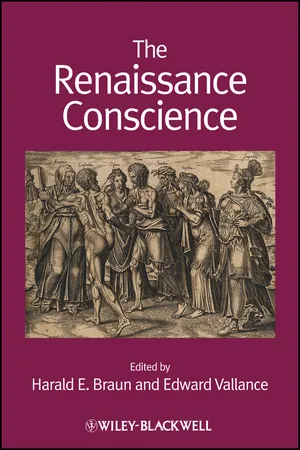
eBook - ePub
The Renaissance Conscience
- English
- ePUB (mobile friendly)
- Available on iOS & Android
eBook - ePub
The Renaissance Conscience
About this book
This book presents one of the first studies of the Renaissance notion of conscience, through examining theological manuals, legal treatises, letters and other sources of the period.
Information
1
Jean Gerson, moral certainty and the Renaissance of ancient Scepticism
In the last decades a veritable academic industry has emerged, busily investigating Renaissance and post-Renaissance scepticism. Its production is focused on the revival of the Pyrrhonian and Academic branches of ancient Scepticism in humanist and enlightenment thought. In comparison, connections between early modern sceptical and scholastic ideas have hardly been investigated. Yet parallels between the renaissance of ancient Scepticism and the vast expansion of early modern Catholic casuistry exist. Catholic moral theology supplied casuistry with (scholastic) Probabilism (doctrina probabilitatis), a novel doctrine for dealing with moral uncertainty. Both early modern Neo-Pyrrhonism and Probabilism undermined in different ways older practices of weighing reasons. Neo-Pyrrhonism attacked the idea of a reliable weighing of reasons head on, while Probabilism legitimized acting on the basis of inferior reasons as long as a certain standard of justification was preserved. In both cases the old requirement to follow the best reasons was abandoned. It is also remarkable that Neo-Pyrrhonism and Probabilism flourished roughly for the same time and had similar practical functions. Probabilists were even attacked for propagating a peculiar brand of Scepticism, and their defences reveal that they were aware of the affinities between Probabilism and sceptical thought. This suggests that the often-quoted Pyrrhonian crisis in early modern philosophy may well have been a much broader crisis of uncertainty that befell early modern humanism and Scholasticism alike – a topic that I have more fully discussed elsewhere.1
The present chapter will follow the idea of a conjoined development of sceptical and scholastic approaches to uncertainty back to the late Middle Ages. It is well known that new directions of governing consciences, and hence of casuistry, became fashionable in the first half of the fifteenth century. In this period, theologians like Jean Gerson, Johannes Nider, and Antonino of Florence prepared the ground for later developments that, step by step, led to Probabilism (which was conceived in 1577 in Salamanca by Bartolomé de Medina). Did these developments in moral theology have any influence on the rediscovery of ancient Scepticism? Did they nourish an interest in Scepticism that may have contributed to its renaissance in the sixteenth century? These are the questions which the present inquiry will broach and, hopefully, answer at least partially for Jean Gerson, the eminent theologian and chancellor of the University of Paris at the beginning of the fifteenth century.
In the first section, I will briefly address medieval Scepticism before (in the second section) introducing Jean Gerson (1363–1429), the person and the scholar, and presenting him as innovative director of consciences who coined the term ‘moral certainty’ (certitudo moralis) and launched a tradition of benevolent casuistry. Gerson was aware of a ‘criterion problem’ which, according to Richard Popkin, was resurrected for the first time since antiquity during the Reformation and became a driving force of humanist interest in ancient Scepticism. For Popkin, the Reformation was the primary stimulus for the insight that no clear criterion for discerning true from false theological claims exists.2 But a similar criterion problem had already afflicted Christianity during the Great Western Schism (1378–1417), as the writings of Gerson document. Moreover, this problem was tied to long-known difficulties of distinguishing divine from demonic inspirations. Last but not least, Gerson made interesting remarks about Academic Scepticism. These remarks are explicitly linked to the scholastic concept of moral certainty and show that a limited defence of Academic Scepticism and scholastic methods of dealing with uncertainty went hand in hand for Gerson.
SCEPTICISM IN THE MIDDLE AGES
Before we come to the guiding questions of this inquiry, their medieval background deserves some comment. There are two main approaches towards the study of Scepticism in the Middle Ages.3 The first is concerned with sceptical tendencies in Scholasticism. In the nineteenth century, students of medieval philosophy and theology became aware that sceptical arguments were prominent in the work of late thirteenth and fourteenth century theologians. Henry of Ghent, Peter Olivi, Nicolas of Autrecourt, Jean Buridan and above all William of Ockham rightly or wrongly became famous – or notorious – for holding sceptical views. This assessment, combined with the assumption that the spread of Scepticism was a sign of disease, contributed significantly to the picture of a demise of high Scholasticism in the fourteenth century. Recent studies of sceptical ideas in medieval Scholasticism come to a less pessimistic result. A detailed study by Dominik Perler, for example, breaks with the view that Scepticism is an indicator of decay. Instead, the emergence of sceptical arguments in the late Middle Ages is regarded as a sign of an innovative capacity of Scholasticism that was not only preserved throughout the fourteenth century, but did survive deep into the early modern era. Perler identifies four groups of sceptical issues in scholastic debates between 1267 and 1377:4 doubts about the possibility of absolutely certain natural cognition; general doubts about absolute certainty; doubts concerning knowledge by intuition; doubts concerning demonstrative knowledge. For our present purposes it is not necessary to pursue the details of these debates and to discuss the complex epistemological models at the heart of the issues. In any case, close inspection shows that the conceptual stock of Scholasticism allowed for a mitigation of sceptical arguments, in a manner often resembling modern rejections of radical Scepticism.
The second major approach to Scepticism in the Middle Ages focuses on the fate of ancient sceptical texts, positions and terms. Research on these issues often takes the form of a hunt for unknown occurrences of the word ‘sceptic’ or for missing links in chains of textual and doctrinal transmission. By now a fairly stable picture has emerged, showing that Pyrrhonism was scarcely mentioned and never discussed throughout the Middle Ages. Academic Scepticism was known because it was discussed by Cicero and Augustine, but no extensive discussions of Academic Scepticism (for example, like Pedro de Valencia’s in the sixteenth century) can be found.5 New studies indicate that this state of affairs did not simply result from a lack of appropriate texts. Latin translations of Sextus Empiricus’ Outlines did exist in the west since the thirteenth century and Cicero’s Academica were extant, but they attracted no deeper philological or philosophical attention.6 Luciano Floridi assumes that this attitude changed as late as the 1430s, when the first full Latin translation of Diogenes Laertius’ Lives appeared and Greek scholars coming to the West had Sextus Empiricus’ writings in their baggage.7 It is an interesting question, why available sources of ancient Scepticism were apparently not used in the Middle Ages although sceptical issues were lively discussed among Scholastics. I believe that a satisfactory answer has to take the state of scholastic methods of coping with moral uncertainty and scientific conjectures into account. The well-developed state of these methods suggests that Scholastics would regard the ancient sceptical challenge as too undifferentiated and crude in practical matters and in the methodology of the sciences, as well as in metaphysics and epistemology, where a well-equipped scholastic arsenal of answers to sceptical challenges existed.
We should not conclude, however, that the study of medieval thought has no bearing on the resurrection of ancient Scepticism. Inquiries into the transmission of texts have generated valuable insights into this subject. Apart from this, we may learn from the positive or negative attitudes with which Academic Scepticism is mentioned by Scholastics. Positive scholastic assessments may have created a conductive atmosphere for the renaissance of ancient Scepticism. We will see that this presumption finds support in the writings of the eminent late medieval theologian Jean Gerson.
JEAN GERSON (1363–1429)
Jean Gerson was born of humble origins in northern France. At the University of Paris he became the favourite pupil of the rising star theologian and future cardinal Pierre D’Ailly. Gerson was appointed chancellor of the University of Paris at the age of 32, and from this position he fought for a dominant role of the Paris theologian faculty in the church, assuming that its members were best suited to develop a master plan for ending the Great Schism which divided western Christendom after 1378. His considerable efforts to overcome the Schism were partially rewarded at the council of Constance (1414–1418), where Gerson was present as one of the foremost theologians of Europe.8 The council healed the Schism, but it took a quite un-Gersonian course in church policy. Despite this personally frustrating result, Gerson’s reformist scholastic theology with well-integrated humanist and mystical elements became probably the most influential theological trend of the fifteenth century.9 Martin Luther and the reformation were as much influenced by Gerson as early modern Catholic moral theology.
For our present purposes we will focus on Gerson’s ideas about moral decision-making under uncertainty and his attitude towards Academic Scepticism. The main point is to show that both were connected. This will provide some evidence for my thesis that the new methods of treating moral uncertainty in Scholasticism and an interest in ancient Scepticism did not arise in separation.10
Gerson on moral decision-making under uncertainty
In matters of conscience, Gerson is widely recognized as an innovator who paved the way for Catholic high casuistry. Gerson’s innovations in the field of conscience arose from peculiar historical circumstances. In the early fifteenth century, theologians who regarded themselves as guardians of conscience were preoccupied with the problem of scrupulosity. Luther said that Gerson was the first who dealt with the problem of the scrupulous conscience seriously.11 The term ‘scruples’ (scrupuli) was used in the Middle Ages as a term for exaggerated anxious agitations of the soul caused by the idea of a moral or religious insufficiency of their bearer. The waves of plague that depopulated Europe in the fourteenth century, economic calamities, wars and the Great Western Schism have variously been held responsible for the spread of scrupulosity in the late Middle Ages.12 The Schism is of special interest for the present inquiry, simply because it is so often linked to the problem of scrupulosity by Gerson himself (in contrast to the plague, which he encountered but did not discuss). Gerson noted that the Schism seemed to create an almost irresolvable perplexity. Disobeying a legitimate pope could lead to hell, as could obedience to an illegitimate pope.13 But how could well-meaning Christians judge the legitimacy of a pope? Both the Avignon and the Roman popes had arguments and competent lawyers on their side. Furthermore, no independent jury for deciding the case existed. Gerson tried to advertise the faculty of theology in Paris as arbiter, but he had no success – not even among his fellow theologians in Paris. No wonder that Gerson thought that the theological and moral puzzle of the Schism spread inner anxiety among good Christians. He was one of the infected, and he continuously assured himself that it was right to take vigorous action against the Schism, despite the perplexing intricacies of the problem.
However, nobody before Gerson seems to have looked for a method of reconciling vigorous action and inner anxiety. Gerson’s precursors suggested various therapeutic exercises against scrupulosity, but he was the first to choose an approach that implied a change in doctrines of moral decision-making under uncertainty. An opinion was by scholastic definition an act of assent to the truth of a sentence accompanied by the fear (formido) of being wrong. If this fear exceeded its backing reasons it became a scruple by definition. In order to appease the fear of being wrong, and hence reduce the risk of lapsing into irrational anxiety, Gerson employed an innovative strategy. First, he restricted the range of traditional requirements of moral risk-avoidance, above all in matters where a danger of mortal sin existed. Scholastic approaches towards moral risk and moral uncertainty had taken shape in the thirteenth century. Divine law and natural law formed a pillar of scholastic morality, with mortal sin being understood as a violation of divine precepts and laws.14 Moral uncertainty was conceived as an uncertainty concerning the sinfulness of actions, which mainly arose because the validity of precepts was often disputable in concrete cases. In fact, moral disputes among experts of moral theology and church law proliferated from the thirteenth and fourteenth centuries onwards and became building blocks of early modern high casuistry. Nevertheless, although it was agreed that moral uncertainty could hardly be avoided in matters of practical morality, unnecessary engagement in morally risky activities was regarded as a mortal sin by medieval theologians. In other words, all good Christians had a duty to avoid moral risks. Since total risk avoidance was not feasible, ‘hedging’ against sin required the use of a risk-averse decision rule, the regula magistralis: ‘In doubt choose the safer side’ (in dubiis tutior pars est eligenda). This rule demands to prefer the alternative with the lowest sin potential (that is, the least grave sin) in cases where the sinfulness of one or all action alternatives was open to doubt. A case in point could be a morally doubtful business transaction, where the renouncement of the transaction bore hardly any moral risk and was thus to be preferred.
Gerson pointed out that the regula magistralis was only designed for doubts of a special kind, in which the reasons for and against the sinfulness of an action were of almost equal weight. He buttressed this interpretation with the authority of the early thirteenth-century Scholastic Guillaume d’Auxerre, indicating an early awareness of the fact that exaggerated risk-aversion is incompatible with a normal social life.15 For Gerson, clearly, the medieval standard understanding of the regula magistralis entailed mitigated rather than maximal risk aversion. This clarification of the regula’s meaning is a good example of the problems of classifying Gerson as a theological conservative or a morally flexible innovator. In the first half o...
Table of contents
- Cover
- Series page
- Title page
- Copyright page
- Anonymous
- Notes on contributors
- Introduction
- 1 Jean Gerson, moral certainty and the Renaissance of ancient Scepticism
- 2 Conscience and the law in Thomas More
- 3 ‘Guided By God’ beyond the Chilean frontier: the travelling early modern European conscience
- 4 Shakespeare’s open consciences
- 5 Women’s letters, literature and conscience in sixteenth-century England
- 6 The dangers of prudence: salus populi suprema lex, Robert Sanderson, and the ‘Case of the Liturgy’
- 7 The Bible, reason of state, and the royal conscience: Juan Márquez’s El governador christiano
- 8 Spin doctor of conscience? The royal confessor and the Christian prince
- Index
Trusted by 375,005 students
Access to over 1.5 million titles for a fair monthly price.
Study more efficiently using our study tools.
Frequently asked questions
Yes, you can cancel anytime from the Subscription tab in your account settings on the Perlego website. Your subscription will stay active until the end of your current billing period. Learn how to cancel your subscription
No, books cannot be downloaded as external files, such as PDFs, for use outside of Perlego. However, you can download books within the Perlego app for offline reading on mobile or tablet. Learn how to download books offline
Perlego offers two plans: Essential and Complete
- Essential is ideal for learners and professionals who enjoy exploring a wide range of subjects. Access the Essential Library with 800,000+ trusted titles and best-sellers across business, personal growth, and the humanities. Includes unlimited reading time and Standard Read Aloud voice.
- Complete: Perfect for advanced learners and researchers needing full, unrestricted access. Unlock 1.5M+ books across hundreds of subjects, including academic and specialized titles. The Complete Plan also includes advanced features like Premium Read Aloud and Research Assistant.
We are an online textbook subscription service, where you can get access to an entire online library for less than the price of a single book per month. With over 1.5 million books across 990+ topics, we’ve got you covered! Learn about our mission
Look out for the read-aloud symbol on your next book to see if you can listen to it. The read-aloud tool reads text aloud for you, highlighting the text as it is being read. You can pause it, speed it up and slow it down. Learn more about Read Aloud
Yes! You can use the Perlego app on both iOS and Android devices to read anytime, anywhere — even offline. Perfect for commutes or when you’re on the go.
Please note we cannot support devices running on iOS 13 and Android 7 or earlier. Learn more about using the app
Please note we cannot support devices running on iOS 13 and Android 7 or earlier. Learn more about using the app
Yes, you can access The Renaissance Conscience by Harald E. Braun, Edward Vallance, Harald E. Braun,Edward Vallance in PDF and/or ePUB format, as well as other popular books in History & Social History. We have over 1.5 million books available in our catalogue for you to explore.