![]()
PART I
Asia’s Hotspots of Innovation
This section is a close-up look at the key growth trends that shape emerging entrepreneurship in China and India plus the frontier market of Vietnam.
China, the world’s largest mobile and Internet market, is in the lead with an unmatched number of rising stars in search, gaming, mobile communications, e-commerce, and social networks. China also ranks tops for startups that have made it to the big time by going public on NASDAQ or the NYSE. Already, the Chinese market is going to the next stage and becoming more localized, as founders and venture investors take fewer cues from Silicon Valley.
India is closing the gap with gains among tech-centric startups from cleantech to mobile to the Web. Indian startups have the chance of going global more readily, too, though comparatively few have scored an initial public offering yet.
Vietnam has looked to China as the model for its own brand of tech entrepreneurship and scrappy startups.
Many of the same venture investors who funded young businesses in Silicon Valley moved into China, then India, and are now finding their way to Vietnam, Taiwan, Singapore, and other emerging markets. These investors are taking lessons learned in one country and applying it to the next.
Local entrepreneurs and returnees alike are becoming more sophisticated and savvy as they scale made-in-Asia startups. Throughout Asia, tech hubs are forming that are the rival of the original Silicon Valley.
Additional material related to Startup Asia and to its predecessor, Silicon Dragon, can be found at www.siliconasiainvest.com. The site contains news, events info, video interviews with entrepreneurs and venture capital investors, articles, research, and updates on speaking appearances.
![]()
CHAPTER 1
China’s Next Generation Tech Stars
Inspired by the first wave of Chinese entrepreneurial winners such as Robin Li, gutsy next-generation stars are poised to profit from startups tuned to the local culture and cranked up with big money and dreams. The next Jack Ma of Alibaba fame is coming up but hasn’t arrived quite yet. Count on that taking maybe another two or three years, in China’s lightning-fast time zone. Kai-Fu Lee’s incubator lab Innovation Works is a spark, and so are angel investor William Bao Bean and networking groups MobileMonday and Great Wall Club. Savvy venture investors, including Neil Shen of Sequoia Capital, Gary Rieschel of Qiming Venture, Sonny Wu of GSR Ventures, ex-Kleiner pro Joe Zhou of Keytone Ventures, and Ruby Lu of DCM, are front and center with sizzling deals and public market trophies from NASDAQ and the NYSE. But how long will the boom last?
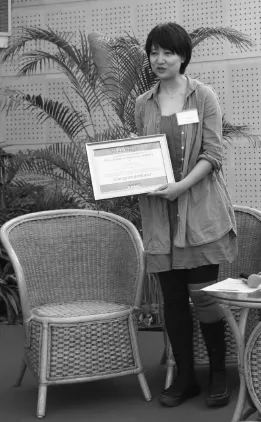
Not too many young Chinese women could land $4 million from a big-time venture capital firm for their first startup—and on their own terms. But then, Si Shen, 29, is far from average. At age 16, she entered the MIT of China—Beijing’s Tsinghua University—to study computer science and then went on to ace two master’s degrees at Stanford University within three years. Next stop: Google. Shen moved to Beijing in 2007 to run Google’s Northeast Asia mobile business, expanded the team to 40 staffers, and a year later, started Papaya Mobile. This tech superstar, who looks fashionably cool and dresses in an artistic style, describes her brand in geeky terms as the “mobile Facebook on Android.”
By 2009, 3.5 million users downloaded apps for Papaya Farm, where as Papayans they could raise virtual animals and grow virtual crops, send instant messages and photos, and buy avatars with an online currency. Revenues poured in, and so did profits. That progress put quick-study venture capitalist David Chao on alert. In mid-2010, his U.S.-based firm DCM invested $4 million in the startup Shen had founded with former classmate and chief technology officer Wenjie Qian. Chao made sure the business named after the tasty fruit was set up offshore in the Cayman Islands, a prelude to going public on Wall Street, following the lead of DCM-backed online bookseller Dangdang and social network Renren. With the top-tier venture firm on board, Shen got coaching from DCM’s entrepreneur-turned-venture maven Hurst Lin, the chief operating officer who had guided China’s largest portal SINA to a ground-breaking NASDAQ IPO during the dotcom era.
Fast-forward one year, and Payapa Mobile has nearly tripled to 10 million users, thanks to loads of popular games and its iPhone killer, Android software for smart phones. In May 2011, Keytone Ventures’ Joe Zhou, best known for his winning investment in leading Chinese gaming company Shanda, put $18 million in Papaya Mobile, and DCM joined in again. Strong-willed Shen says she set the deal terms in the contract negotiations.
Every day, her fast-track experience in China is being repeated by Web 3.0 upstarts in Shanghai and Beijing. Inspired and motivated by the hero status of Robin Li of search engine Baidu and Jack Ma of online marketplace Alibaba, thousands of bright, ambitious talents are jumping into the entrepreneurial pool and creating a big splash.
Quick pivots, shrewd tactics, first-mover jumps, flawless timing, venture capital checks, mini-innovations—it’s all a part of their playbook to get ahead of the pack. Assertive and confident, these upstarts are claiming their stake in China’s vast entrepreneurial revolution.
Over the past decade, China has bolted ahead with its own Silicon Valley. China has become the world’s second-largest startup investor1 and the world’s second-largest market for venture funds.2 Plus, China has developed its own local currency funds that, since 2008, outnumber U.S. dollar funds for startup investing in China. Search engine Baidu and instant-messaging service Tencent are now among the 10 most highly market-valued Internet companies in the world. (See Table 1.1.) Back in 2005, there were no Chinese companies in the ranks.3
Table 1.1 Most Valuable Internet Companies
Source: Bloomberg.
| December 31, 2005 |
| Rank | Company | Market Capitalization |
| 1 | Google | $122.50 |
| 2 | eBay | $60.24 |
| 3 | Yahoo! Japan | $60.09 |
| 4 | Yahoo! | $55.59 |
| 5 | Amazon | $19.54 |
| 6 | Rakuten | $16.51 |
| 7 | Apollo (UOP) | $10.67 |
| 8 | IAC | $9.04 |
| 9 | E∗Trade | $8.55 |
| 10 | Expedia | $8.22 |
| December 31, 2010 |
| Rank | Company | Market Capitalization |
| 1 | Google | $191.50 |
| 2 | Amazon | $82.02 |
| 3 | Tencent | $40.55 |
| 4 | eBay | $36.67 |
| 5 | Baidu | $34.59 |
| 6 | Yahoo! | $21.85 |
| 7 | Yahoo! Japan | $20.35 |
| 8 | Priceline | $19.85 |
| 9 | Salesforce | $17.38 |
| 10 | Activision Blizzard | $15.16 |
A Silicon Dragon tech economy began in 2002 with Chinese returnees—so-called sea turtles who came home to lay their eggs—cloned Google, YouTube, and Amazon, grabbed Sand Hill Road money, and scored on NASDAQ and the NYSE. A lot has changed over the last decade as China has progressed from this first stage of startups to a bolder, more distinct Chinese-centric style of entrepreneurship. Today, homegrown Chinese entrepreneurs are snapping up venture capital from Chinese currency funds for even more clones—Beijing techie Wang Xing alone has cloned Facebook, Twitter, and a Chinese Groupon—and taking their startups public on NASDAQ-like local stock exchanges in China. But as GSR Ventures’ Kevin Fong observes, “Going public in the U.S. has that Gucci status.”
The needle is gradually moving from “made in China” to “invented in China.” Microinnovations tweaked for the local culture are cropping up more often. Sina’s Weibo, a hybrid Twitter-Facebook, layered in video and photo sharing before Twitter did. The long-awaited promise of disruptive technology from China is coming, too, symbolized by China’s climb to fourth place worldwide for new patent applications.4 GSR Ventures–funded LatticePower in Nanchang counts more than 150 patents for making low-cost, efficient LED lightbulbs for households and businesses.
Venturing in China has transitioned from its roots along Sand Hill Road to hubs such as Tsinghua Science Park in Beijing. Over the past five years, Sequoia Capital and Kleiner Perkins have set up shops in Beijing and Shanghai with Mandarin-speaking partners to scout for deals in mobile communications, the Internet, health care, cleantech, e-commerce, and retail—an area that’s exploding judging by lines at Ikea furniture outlet and at Apple’s store for the iPad 2.5 Angel investors such as William Bao Bean of the L.L. Bean family in Maine and Baidu co-founder Eric Xu are the Ron Conways of Valley angel investor fame. Ex-Google China honcho Kai-Fu Lee has powered up Innovation Works thanks to funds from YouTube co-founder Steve Chen and other elite investors to coach smart young Chinese coders and jump-start projects from serial entrepreneurs—an echo of IdeaLab during the Internet boom and Y Combinator and TechStars for the Web 2.0 generation.
The Zhongguancun district of Beijing, where Innovation Works is based, is home to 10,000 high-tech startups, 150 incubators, more than 1,000 research and development centers, three leading universities—Tsinghua, Beida, and Beihang—and China’s 10-year-old university and science center known as TusPark.6 That’s according to Chris Evdemon, general manager of incubation projects at Innovation Works and prin...