Part I
Coming to Grips with the Basics of Managed Funds
Glenn Lumsden
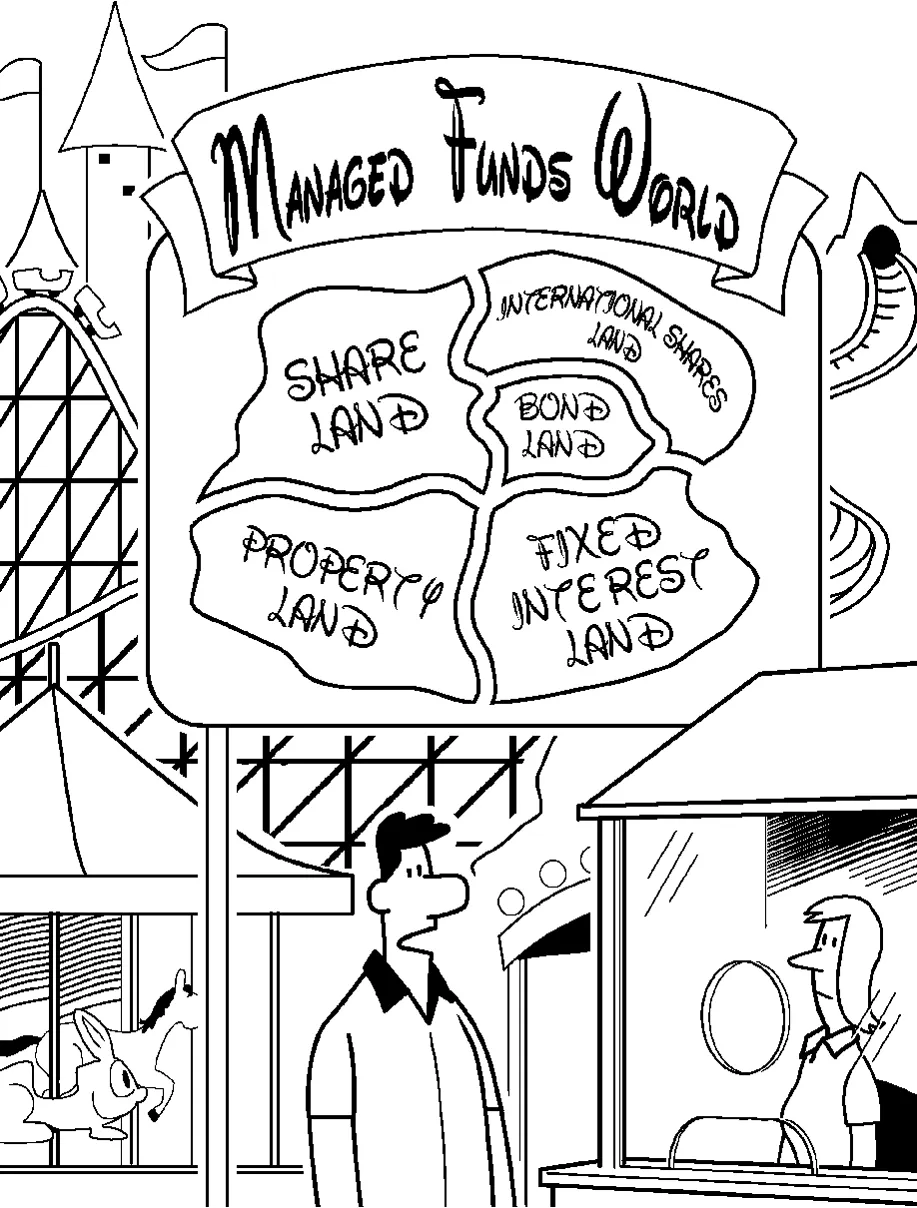
‘Which part of the park has the least scary rides?’
In this part . . .
Whether you know it or not, managed funds are very likely a part of your investing landscape. Contributing to a superannuation fund? Chances are you’re investing in managed funds. So, if for no other reason, getting to know managed funds could help you achieve a better retirement. Part I introduces managed funds, what to look out for and how to choose them.
As much as I’m a big fan of managed funds, you get to look at the cons as well as the pros of using managed funds here, and a dose of the legal stuff of how funds are structured, with a pinch of technical guff on top. This part also introduces some of the investing techniques used by professional financial planners and gets down to what we all want to know — how much it costs.
Chapter 1
Getting Started with Managed Funds
In This Chapter
Understanding the basics of managed funds Finding out what fund managers actually do Doing the research before leaping into managed funds Making sure you know what to look out for I’m going to indulge the accountant in me and throw around a few statistics about the size of the managed funds industry. The Australian industry has $1.7 trillion-plus in funds under management, with 10,000 and more funds available from over 130 fund managers, making it the fourth-largest managed funds industry in the world.
All sounds pretty impressive but what does it really mean for the average investor? That lots of advisers and people in the finance industry are raking it in with all the fees being charged? Possibly, but what is important is that the numbers show Australia has a thriving and world-class fund management industry offering a wide choice for investors, despite the effects of the global financial crisis.
Australia’s superannuation (often simply referred to as super) system drives much of the managed funds industry, and managing super drives much of people’s investing decisions. Saving for retirement is big business and that’s because it affects most of us in one way or another. Super should be front and centre of most people’s investment strategies. Understanding that managed funds can make up a fair chunk of your super, the need to know about managed funds becomes important.
In this chapter, I cover how managed funds can play a part in your investment portfolio — whatever your investment plans, whether saving for retirement or for a deposit on a house. Understanding what managed funds are, how to choose one and what to look out for can help make your investment decisions a whole lot simpler.
Making a Start with Managed Funds
A managed fund is a way of pooling together money from many investors into one big pot, called a trust. Investors then buy units in that trust. The company or person looking after the money in the trust — the fund manager — invests the money across a host of different types of investments, from cash and property to bonds and shares. Most managed funds are unlisted, meaning that they’re not traded on the stock exchange. However, a small number of funds are traded on the Australian Securities Exchange (ASX) as listed investment companies.
Considering managed funds beyond the GFC
The global financial crisis of 2008 to 2009 not only rocked the financial world; it also seemed to affect just about every aspect of our lives, including mine in setting out to write this book.
In investing terminology, writing a book on managed funds in early 2010 was the equivalent of buying at the bottom of the market. Things couldn’t get much worse — for the industry or for investors. Many funds, especially those in the property and mortgage sectors, were badly hit, freezing investors’ money. Many of these funds remain frozen while managers wait for the good times to return. So why would you even consider going back into the managed funds market after all that chaos?
The point is that markets go up and down, and the good times do return. Managed funds can and should have a place in people’s investment portfolios regardless of the fallout from the GFC. The superannuation industry in Australia is worth around $1.3 trillion and relies completely on markets that work and fund managers that perform well. As long as people and their employers are contributing to superannuation, skilled money managers and their managed funds will always be needed.
If there is a good side to the GFC, it is the lessons that might be learned by fund managers and investors alike. Poorly managed funds didn’t survive. Fund managers do make mistakes and do lose money, sometimes a lot. But occasionally you come across a manager who knocks your socks off performance-wise and who can deliver again and again. As an investor, these managers are the ones you want to seek out to manage your money, because these are the guys who genuinely add value to your investments over time.
Discovering that you’re probably using managed funds already
Before thinking about investing with managed funds, take a step back and look at the investments you have already. ‘Not a lot,’ you may think. But hold on. For many people — and I include myself in this — aside from the family home, superannuation is probably the largest, single a...