The Transformational CIO
eBook - ePub

The Transformational CIO

Leadership and Innovation Strategies for IT Executives in a Rapidly Changing World

  1. English
  2. ePUB (mobile friendly)
  3. Available on iOS & Android
eBook - ePub

The Transformational CIO

Leadership and Innovation Strategies for IT Executives in a Rapidly Changing World

About this book

The Transformational CIO is chock full of stimulating thought leadership and useful knowledge that will help you leverage new and existing technologies to create business value, generate more revenue, increase profits and improve customer relationships in rapidly changing global markets. This book is a practical guide for senior executives seeking optimal returns on technology investments, now and in the future.

Hot-button issues and essential topics covered in the book include:

  • Vision and Organization
  • Culture and Change
  • Partnering with the Business
  • The Art and Science of IT Leadership
  • Team Building
  • Cloud Computing
  • Enterprise Collaboration
  • Strategic Sourcing
  • Executive Career Development

The Transformational CIO features real-world stories and revealing anecdotes from CIOs and IT thought leaders at leading organizations as Disney, Kimberly-Clark, Kaiser Permanente, Dell, Flextronics, Wipro, Boston Scientific, Salesforce.com, General Motors, Shell Oil, Pitney Bowes, IBM, Cisco, Siemens, Citigroup, Microsoft, CVS Caremark, Frontier Communications and the U.S. Tennis Association.

Written in straightforward business language, The Transformational CIO is a concise guide for staying ahead of the competition and seizing opportunities for success in a turbulent global economy.

Frequently asked questions

Yes, you can cancel anytime from the Subscription tab in your account settings on the Perlego website. Your subscription will stay active until the end of your current billing period. Learn how to cancel your subscription.
No, books cannot be downloaded as external files, such as PDFs, for use outside of Perlego. However, you can download books within the Perlego app for offline reading on mobile or tablet. Learn more here.
Perlego offers two plans: Essential and Complete
  • Essential is ideal for learners and professionals who enjoy exploring a wide range of subjects. Access the Essential Library with 800,000+ trusted titles and best-sellers across business, personal growth, and the humanities. Includes unlimited reading time and Standard Read Aloud voice.
  • Complete: Perfect for advanced learners and researchers needing full, unrestricted access. Unlock 1.4M+ books across hundreds of subjects, including academic and specialized titles. The Complete Plan also includes advanced features like Premium Read Aloud and Research Assistant.
Both plans are available with monthly, semester, or annual billing cycles.
We are an online textbook subscription service, where you can get access to an entire online library for less than the price of a single book per month. With over 1 million books across 1000+ topics, we’ve got you covered! Learn more here.
Look out for the read-aloud symbol on your next book to see if you can listen to it. The read-aloud tool reads text aloud for you, highlighting the text as it is being read. You can pause it, speed it up and slow it down. Learn more here.
Yes! You can use the Perlego app on both iOS or Android devices to read anytime, anywhere — even offline. Perfect for commutes or when you’re on the go.
Please note we cannot support devices running on iOS 13 and Android 7 or earlier. Learn more about using the app.
Yes, you can access The Transformational CIO by Hunter Muller in PDF and/or ePUB format, as well as other popular books in Business & Business Strategy. We have over one million books available in our catalogue for you to explore.

Information

Publisher
Wiley
Year
2011
Print ISBN
9780470647554
eBook ISBN
9781118019320
Edition
1

Chapter 1

Vision and Organization

Executive Summary

Defining the vision is the essential first step in any successful transformation plan. As CIO, you should be able to describe the vision and convey its critical importance to the organization in as few words as possible. The next key step is building or restructuring an effective IT leadership team that will support your transformational efforts—and watch your back.

Bringing the Vision to Life

In this chapter, we look primarily at three successful transformation scenarios to get a better idea of why it’s critical to define a vision—clearly and unambiguously—before moving forward. After defining the vision, the next logical step is building the leadership team you'll need to turn the vision into reality.
One of the key takeaways from this chapter is that the transformational vision doesn't have to be overly complex or wildly ambitious—in fact, it helps if the vision is simple, straightforward, and easy to describe in a couple of short sentences.
And the vision doesn't have to emerge full-blown from the mind of the CIO. What counts is that the vision is tethered firmly to a business objective—or to an “end state”—that can be described in terms that everyone understands.
For a decade, Roger Berry served as senior vice president and chief information officer at Walt Disney Parks and Resorts, a division of the Walt Disney Company. The division operates nine theme parks, a cruise line business, and more than 30 major resorts and hotels in locations around the world.
Roger played a key leadership role in the division’s transformation from a very effective but traditionally focused hospitality business into a truly guest-centric organization. He credits Allen “Al” Weiss, the executive who brought him to Disney, with the original vision that guided the transformation.
The vision of a guest-centric organization was initially expressed in 2000 by Al, who was president of Walt Disney World at that time. I'll let Roger tell the story in his own words:
Al had a vision of transforming the focus of the Disney theme park experience to ensure the brand was in step and aligned with the emerging personalized service trend. At that time, we offered what was pretty much a “one size fits all” experience. Al wanted to change that, but he knew instinctively that he couldn't transform and deliver the vision without the right technology strategy in place.
The key to making it work technically was creating an incredibly tight alignment of all the various guest-focused core business processes and IT systems. The electronic integration would allow Disney to engage and personalize the guest experience from the first call to the customer contact center to the bus ride back to the airport. It was a tall order, but with great people and strong executive support, Roger’s team got it done.
As suggested in the book’s introduction, the real hurdles weren't posed by the technology. The hardest obstacles to overcome were cultural. As in many companies, the division had grown accustomed to the traditional role of IT as a back-office function. A big part of Roger’s job was changing the way people looked at IT.
I determined very quickly that most of the people in the business didn't understand the scale, diversity, and complexity of the technology that was in place at Disney World or what it takes to manage it. More importantly they didn't realize what it would take from the business to achieve the level of integration required to realize the vision. Consequently, IT was taken for granted by some and naturally, the staff in IT felt as though they were underappreciated.
We were doing some good things in IT, but we were performing in the traditional mode. The key business areas set the strategy and decided what it needed, came up with a proposed solution and handed it to IT to execute. In some situations they would even pursue the execution themselves.
In that model, IT had little strategic influence on the direction of the business and was sometimes handed an almost impossible situation to deliver. Consequently, the view of IT’s strategic value was underestimated. If the systems came up on time in the morning and the key reports were out . . . IT was doing a good job. . . .
Roger knew that he had to correct these misperceptions if IT had any chance of enabling the vision.
“The first thing we had to do was help the business understand the role of IT in enabling this transformation,” says Roger. “Then the next thing was making sure the IT organization understood the essential role they would play in the future of the business, and that the business was counting on them.”

Lesson

The vision doesn't have to emerge full-blown from the mind of the CIO. What counts is that the vision is tethered firmly to a business objective—or to an “end state”—that can be described in terms that everyone understands.
Roger started out by explaining how the trend toward digital and process convergence, which was still a relatively new concept at the time, was opening opportunities for technology to advance process speed and efficiency across the business. Further, it required IT influence to expand beyond the “back office” and out onto the front lines of guest service. In other words, IT had to be a key player in the strategy and how it was to be designed and implemented.
Roger also knew that he would need an emotional appeal to “win the hearts and minds” of the 600 people working in the division’s IT organization.
In a brainstorming session with his IT executive team focused on cast communication, a slide was put up of Mickey Mouse holding the hand of a small child walking blissfully down Main Street at the Magic Kingdom.
I pointed to the slide and said, “That connection between Mickey and a child is the essence of our business. That is the magic and the magical memory the child and the family will carry with them forever, in their minds, their hearts and in their photo albums. . . .”
Finally, after a couple of hours of brainstorming, one member of the IT team said, “We may not make the magic but we play an essential role in making that magical connection happen!” That was the emotional connection we were searching for!
We then came up with the tagline for IT: “We don't make the magic . . . we make Magical Connections.” We then revised it to “IT . . . Making Magical Connections.”
Roger and his executive team then set out to build a brand identity for IT. They designed an IT logo depicting an image of the world adorned with Mickey’s distinctive ears. The design is set against Mickey’s official colors—red, black, and yellow—and appears to be breaking out of the background. The purpose of the design was to emphasize the relationship between IT and the core business, and to show that IT was thinking “outside the box” to deliver innovative services.
The IT logo was eventually printed on signs, placards, and T-shirts. Being part of Disney, they even put the logo on a pin, which is now considered a collector’s item. These items were then awarded to the IT cast for recognition of a job well done and to continually reinforce the critical role they play in the business . . . every day!
The new logo was officially introduced at a “brand launch” for IT. The event was held in the largest ballroom at Disney’s ultra-modern Contemporary Resort near the Magic Kingdom in Orlando. Roger recalls the moment when the new logo was unveiled:
The impact was powerful and immediate. I have to tell you, it was instant alignment. When people saw it, they made the connection and they understood the new role of IT. And they understood why we were focusing on methodology, best practices, and standards. Everything began falling into place because of that single step.

Lesson

Find simple images or simple phrases that will help you generate the emotional tidal waves you will need to overcome the natural tendency of people to stick with the status quo.
There’s a great lesson here. When you're trying to get the ball rolling, be imaginative. Be positive, be happy, and be courageous. Find simple images or simple phrases that will help you generate the emotional tidal waves you will need to overcome the natural tendency of people to stick with the status quo.
For the IT organization at Disney, the IT logo was like Dumbo’s magic feather—it helped them clear a cultural hurdle s...
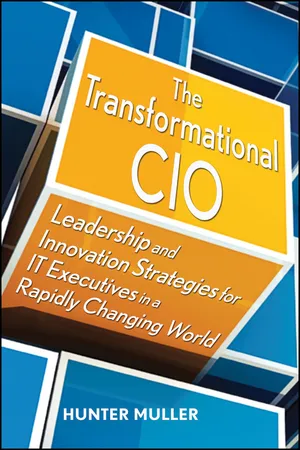
Table of contents

  1. Cover
  2. Table of Contents
  3. PREFACE
  4. ACKNOWLEDGMENTS
  5. INTRODUCTION
  6. Chapter 1: Vision and Organization
  7. Chapter 2: Culture and Change
  8. Chapter 3: Partnering with the Business
  9. Chapter 4: The Art and Science of IT Leadership
  10. Chapter 5: Mapping Your Future
  11. Chapter 6: The First 30 Days
  12. Chapter 7: CIO Evolution
  13. Chapter 8: The Road Ahead
  14. RECOMMENDED READING
  15. ABOUT THE AUTHOR
  16. ABOUT HMG STRATEGY, LLC
  17. INDEX
  18. End User License Agreement