![]()
Chapter 1
The Chemistry of Arsenic, Antimony and Bismuth
Neil Burford, Yuen-ying Carpenter, Eamonn Conrad and Cheryl D.L. Saunders
Department of Chemistry, Dalhousie University, Halifax, Nova Scotia, B3H 4J3, Canada
Arsenic, antimony and bismuth are the heavier pnictogen (Group 15) elements and consistent with their lighter congeners, nitrogen and phosphorus, they adopt the ground state electron configuration ns2np3. Arsenic and antimony are considered to be metalloids and bismuth is metallic, while nitrogen and phosphorus are non-metals. Arsenic and antimony are renowned for their toxicity or negative bioactivity [1, 2] but bismuth is well known to provide therapeutic responses or demonstrate a positive bioactivity [3]. As a background to the biological and medicinal chemistry of these elements, the fundamental chemical properties of arsenic, antimony and bismuth are presented in this introductory chapter.
1.1 Properties of the Elements
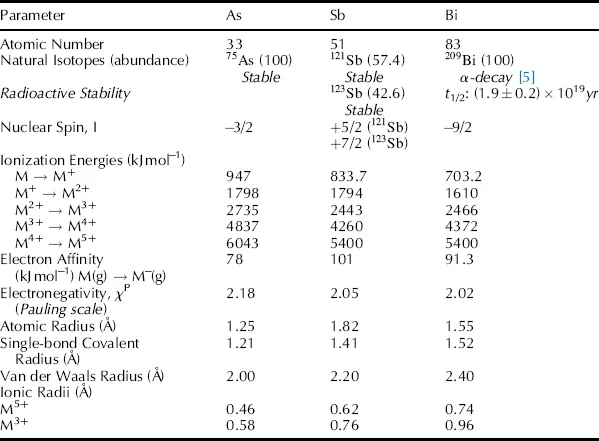
Selected fundamental parameters that define the heavier pnictogen elements are summarized in Table 1.1 [4]. While arsenic and bismuth are monoisotopic, antimony exists as two substantially abundant naturally occurring isotopes. All isotopes of the heavy pnictogens are NMR active nuclei, indicating that the nuclear spin will interact with an applied magnetic field. However, as the nuclear spins of these isotopes are all quadrupolar, NMR spectra generally consist of broad peaks and provide limited information. The atoms As, Sb and Bi all have the same effective nuclear charge (Zeff = 6.30, Slater), which estimates the charge experienced by a valence electron taking into account shielding by the other electrons. As a consequence, the ionization energies and electron affinities for As, Sb and Bi are very similar. The ionization energy is the energy required to remove a valence electron from an atom or an ion in the gas phase. The ionization energies are predictably greater for ions with higher positive charge and are typically lower for atoms or ions with higher principal quantum number (n). The electron affinity is the energy released when an atom gains an electron to form an anion in the gas phase. The electronegativity (χP), defining the relative ability of an atom to attract electrons to itself in a covalent bond, is sufficiently larger for arsenic than for antimony and bismuth. The atomic radii, covalent radii and ionic radii are smallest for arsenic and largest for bismuth atoms consistent with the relative atomic mass and number of electron shells.
Table 1.1 Elemental parameters for arsenic, antimony and bismuth (adapted with permission from [4]). Copyright Springer Science + Business Media
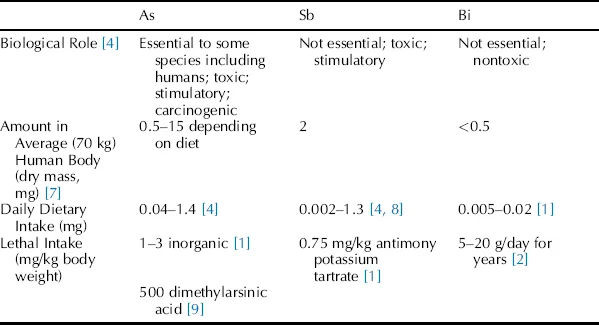
Selected biological and toxicity data for As, Sb and Bi are summarized in Table 1.2. While some arsenic compounds are essential to certain animal species [4], most arsenic compounds display toxic biological effects even when present in only small amounts. Some compounds, such as Salvarsan 606 [6], are therapeutic, although there are reported side effects, including death in high dosages. Neither antimony nor bismuth has any known natural biological function. While antimony has toxicity comparable with that of arsenic, bismuth can be tolerated in large quantities. Bismuth compounds have been used for more than two centuries to treat many medical disorders and are now commonly available in the preparations known commercially as Peptobismol and DeNol [3].
Table 1.2 Biological and toxicity data for arsenic, antimony and bismuth
1.2 Allotropes
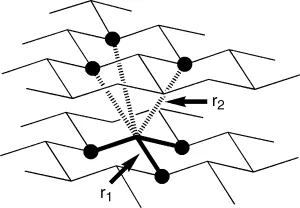
Elemental antimony and bismuth are most stable in the αform, which is rhombohedral and typically grey in appearance, while the most common form of arsenic is β-arsenic (grey arsenic). The α-allotropic forms are analogous to black phosphorus, composed of layers of hexagonally connected sheets, as shown in Figure 1.1. The interatomic distances (r1, r2) are predictably larger for the heavier elements due to their larger atomic radii. The difference in the interlayer distance (r2) between each adjacent pnictogen atom decreases from P to As to Sb to Bi (Table 1.3).
Table 1.3 Comparative structural parameters for α-rhombohedral arsenic, antimony and bismuth at 298 K
Arsenic is observed to exist in two (yellow and black) [10, 11] additional allotropic forms, while antimony adopts five allotropes [11, 12] and bismuth adopts at least three allotropes [11]. Most of these alternate allotropes are only nominally stable or require high temperature or pressure conditions [11, 13].
1.3 Bond Energies
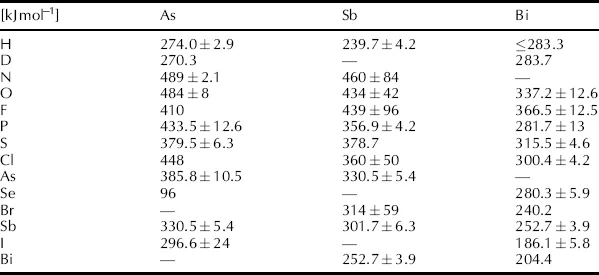
Arsenic, antimony and bismuth form stable covalent bonds with most elements. For direct comparison, Table 1.4 lists experimentally determined bond energies for the dissociation of selected pnictogen-element diatomic species in the gas phase. While these energies are not representative of pnictogen element bonds in larger molecules, the same relative trends are exhibited. Bond energies are dependent on the molecular environment in the specific compound studied. For a particular element, Pn-element bond energies generally decrease from As to Sb to Bi. For example, the Pn–H bonds in AsH3 and SbH3 are 319.2 kJ mol−1 and 288.3 kJ mol−1, respectively [18]. Moreover, bonds involving lighter elements are generally stronger. For example, the Bi–X bonds in BiF3 and BiBr3 are 435 kJ mol−1 and 297.1 kJ mol−1, respectively [18]. Similarly, in OAsPh3 and SAsPh3, the As=Ch bond is 429 kJ mol−1 and 293 kJ mol−1, for Ch=O and Ch=S respectively [18].
Table 1.4 Experimentally determined pnictogen-element bond energies of selected diatomic molecules in the gas phase, kJ mol−1 (from reference [19])
1.4 Oxidation States
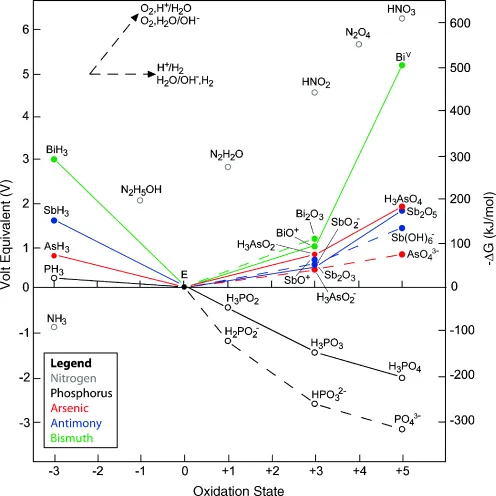
The pnictogen elements access oxidation states ranging from −3 to +5, as summarized in Figure 1.2, which presents the relative energy of each oxidation state in volts (J C−1) and in Gibbs energy. In contrast to nitrogen and phosphorus, arsenic, antimony and bismuth thermodynamically favour the elemental form. While positive oxidation states for phosphorus are stable, compounds containing arsenic, antimony or bismuth in positive oxidation states are unstable with respect to elemental forms. This phenomenon is most dramatic when comparing the relative energy differences for compounds containing pnictogens in +5 oxidation state.
1.5 Relativistic Effects and Orbital Contraction
The property trends observed for the pnictogens can be rationalized by consideration of orbital contr...