- Brings together a collection of new, cutting-edge research exploring a number of different facets of the broad relationship between gender and media
- Moves beyond associating gender with man/woman and instead considers the relationship between the construction of gender norms, biological sex and the mediation of sex and sexuality
- Offers genuinely new insights into the complicated and complex set of relations which exist between gender, sex, sexualities and the media
- Essay topics range from the continuing sexism of TV advertising to ways in which the internet is facilitating the (re)invention of our sexual selves.
- English
- ePUB (mobile friendly)
- Available on iOS & Android
eBook - ePub
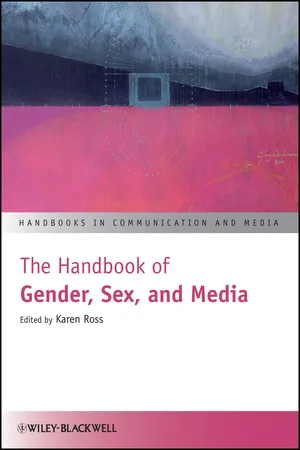
The Handbook of Gender, Sex, and Media
About this book
The Handbook of Gender, Sex and Media offers original insights into the complex set of relations which exist between gender, sex, sexualities and the media, and in doing so, showcases new research at the forefront of media and communication practice and theory.
Information
Part I
Mediated Women
1
The Geography of Women and Media Scholarship
Knowledge work is full of complexities. Knowledge workers deal with the ideas that can free minds or shackle them. Knowledge workers are individuals, each with his or her own story, but all live their lives within networks of power and control.
(Mosco and McKercher, 2008, p. ix)
Mapping the Terrain
The goal of this chapter is to revisit what is usually referred to as the ‘women and media’ literature, not to comprehensively review all that has been done to date – that would be too big a task for the space allotted – but rather to map it, historically and currently. The discussion will seek to define what might be called the international geography of the women and media literature, to scope out some of the strands (or paths) that its scholars have followed, and to point out some of the major promontories (or developments) along the way. In the process, I will situate the collection of new articles in the present section of this book, calling attention to the ways they move women’s media scholarship forward. The discussion will also identify some of the roads less traveled by feminist media scholars, including those needing further exploration. The main media that I will be concerned with throughout the discussion is news media, though the Internet, advertising, music, film, and entertainment television will occasionally also be mentioned.
Early Formations
The women and media research landscape took shape in the 1970s as issues moved from popular political fronts into the academies of Europe, the US, Canada, Latin America, India, and elsewhere. The issues had erupted locally as smaller-scale skirmishes that led to larger campaigns. The most vigorous attention was generated by women’s opposition to certain imagery of females. Women in locales as far apart as Bombay, India and Los Angeles, California, for example, were protesting publishers’ use of graphics featuring over-sexualized and abused women in their advertisements (Ellis, 1990; Byerly and Ross, 2006). Simultaneously, women across Europe and the US were holding ‘take back the night’ marches to protest the explosion of hardcore pornography in mainstream media. They demanded that media companies stop showing bruised, bleeding, and dismembered females in films, advertisements, magazines, and other forms of popular culture. In the process, they were also calling for an end to the exploitation of real-life women who worked as pornography models by an increasingly visible and lucrative industry. These activities served to advance a feminist analysis of sexual violence as a primary instrument of women’s subjugation by men, a forerunner to media effects research on the impact of hardcore pornography on users (Lederer, 1980; Ellis, 1990).
On a different front, women’s organizations were seeking to increase visibility in the news for women’s political campaigns to achieve equality through legislative reforms related to rape and domestic violence, equal pay, job discrimination, and other civil rights (Barker-Plummer, 2010). To be sure, those engaged in women’s rights movements since the nineteenth century had recognized that their political success required getting into the mainstream news of the day if they were to succeed (Kielbowicz and Scherer, 1986). As Barker-Plummer (2010) has observed more recently, the news has historically played a critical role in the circulation and mediation of ideas that challenge the status quo, ultimately helping to legitimize social movements and set new policy agendas (p. 145). Addressing the news coverage of women’s activities, therefore, has been an indispensable part of feminist strategies for change.
The global context for women’s advancement had been set in motion by a series of earlier events, among them the United Nations’ establishment of the Commission on the Status of Women in 1947. The commission was given the role of setting standards for women’s rights and encouraging governments to remove obstacles to women’s education and participation in their societies (United Nations, 1995, pp. 14–15). The advancement of women proceeded slowly through the post-World-War-II years of the 1950s, but mobilization built rapidly during the 1960s, according to Boulding (1992, p. 317). In the industrialized nations, women were seeking to enter paid workforces in ever greater numbers in the midst of mobilizing feminist movements. In the emerging independent states that either just had or were still in the process of throwing off their colonial yokes, women were finding their own political ground. Energized by participation in liberation movements, women in India and across Africa, for example, had begun to take a more active part in public life through the process of nation building. Women gained increased political sophistication through these activities, one aspect of which was to set forth specific agendas for gender equality within their nations. By the 1970s, women had formed loose networks across nations through anti-war movements, national development, women’s business, and other activities.
As the United Nations Decade for Women (1976–1985) began, women in most nations had established non-governmental organizations aimed at empowering and advancing women’s social, economic, and political agendas (Boulding, 1992, pp. 314–316). The program for action that emerged from the first meeting of the United Nations Decade for Women, held in Mexico City in summer 1976, set forth a feminist media critique that would define practical remedies as well as scholarly agendas for years to come. First, it noted, women were ignored by the serious media (i.e. news). Second, when women were included in media content, their experiences and images were often stereotyped or distorted. Third, women were blocked from entry into media professions and thereby unable to affect the production of content with regard to gender (Byerly, 1995). The essential three-part critique (i.e. absence, representation, employment/production) came to include a fourth – consumption – when feminist media scholars in the 1970s began to ask how women engage with and respond to what they see and hear in the media.
Major Strands
Representation
Inquiry into women’s media representation has come to form the broad avenue down which the majority of feminist media scholars have taken their work. There is a kind of logic operating in this tendency. Content is, after all, what establishes the fundamental media–audience relationship – it is what is seen and heard that communicates facts, ideas, values, and meanings. Objectionable content was what motivated grassroots women’s groups to protest and take action several decades ago, and it remains a major impetus for both popular and academic feminist responses today.
Most research on women’s media representation is concerned with stereotypes of women that have pervaded the imagery of popular culture for decades. It is conducted mainly using an interpretive (qualitative) approach associated with cultural studies, as pioneered by the Birmingham Centre for Contemporary Cultural Studies in the UK in the 1970s. Textual analysis, framing analysis, semiotics, ethnography, and social critique are among the most common methodologies in representational research. These approaches, according to Kellner (2011), enable scholars to ‘show how media articulate the dominant values, political ideologies, and social developments and novelties of the era’ (p. 8).
Concern about masculine ideology, which in various ways manifests itself in image or story to reinforce longstanding values of men’s superiority over (and dominance of) women, is central to representational research. Masculine ideology references patriarchy (i.e. hegemonic masculinity), something that has seemed to perpetuate itself in cultural products through the years in spite of active women’s popular movements that challenge it and feminist scholarship that lays bare its presence.
One line of such research focuses on what more recently has been called the ‘pornographication of women’; that is, everyday erotic depictions of women being sexually subordinated and denigrated, depictions that have increased in their prevalence on television, in advertising and video games, and in other popular genres (Caputi, 2008; Meyers, 2008). Caputi’s (2008) cross-cultural examination of sex and violence in media revealed there is no shortage of these objectionable images, some of which are both sexist and racist. Collins (2004) similarly problematizes the sexualized images of black and Latina women, which she says
persist through a disconnected mélange of animal skins, sexually explicit lyrics, breast worship, and focus on the booty. [Hip-hop group] Destiny’s Child may entertain and titillate; yet, their self-definitions as ‘survivors’ and ‘independent women’ express female power and celebration of the body and booty. (2004, p. 29)
Collins’ work is particularly important to contemporary interpretive analyses of gender and race in women’s media stereotypes in that she examines these in relation to the economic interests of a wealthy, nearly all-white male class. She recognizes, for instance, that ‘the women in Destiny’s Child are also wealthy,’ and she asks, ‘Just who is being “controlled” in these arenas? For what purpose?’ (p. 29). Collins likens today’s popular images of black female sexuality to the historical images of slave women dominated by their white male owners – familiar images in the Americas, Africa, and elsewhere that can still be marketed today. While recognizing that ‘black popular culture is indicative of larger political and economic forces on the macro level that in turn influence the micro level of everyday behavior among African Americans’ (p. 17), Collins avoids offering a political economic analysis, relying instead on discourse analysis to engage a study of black sexual politics in today’s mass media (p. 17).
In studying the representation of women in media, Parameswaran (2002) and Riordan (2004) are among the feminist postcolonial and Marxist scholars, respectively, who do factor in the continued colonization of women of color by white men through film and other cultural products today. What they bring to their research on women’s representation in media is a useful, complex methodology that moves beyond the interpretive methods of cultural studies to place colonial relations and capitalist economic structures centrally in their examinations. Parameswaran and Riordan are part of an emerging group of feminist media scholars who consider both micro-level (i.e. content) and macro-level (i.e. structural) aspects of problems associated with women’s media representation. For example, in their separate, complementary critiques of the internationally acclaimed film Crouching Tiger, Hidden Dragon (2000), both authors, in their own ways, take film companies to task for subverting strong female characters by making them ultimately familiar stereotypes of feminine prowess, while at the same time packaging Asian culture as exotic, oriental – a western hegemonic representation. Riordan’s political economy analysis calls attention to the power of today’s media conglomerates that finance and distribute such films to ‘put forth a particular world view […] one that minimizes the achievements of feminism […] and creates women as desirable objects for men.’ (2004, p. 99).
A significant amount of representational research has concerned women as the subjects of news, a media genre long considered to confer legitimacy on women’s issues and political goals. One oft-quoted study is Rakow and Kranich’s (1991) investigation of television news in the late 1980s to determine both the number of women used as sources in news stories and the ways that women function within story narratives. Their semiotic analysis of more than 1200 television programs drew from conceptual work in anthropology, psychoanalysis, and film studies that had already posed the notion that women serve ‘as signifier for the male other’ within a symbolic system in which men are permitted to live out their fantasies of domination both linguistically and through images they create. Rakow and Kranich found that women were most likely to appear as private (not public) individuals, serving as ‘signs of the times’ or as ‘signs of support’ (i.e. for new public policies) but seldom as experts or leaders in public roles.
One of the more ambitious undertakings aiming to determine the representation of women in news about a woman-related event – the annual celebration of International Women’s Day on March 8 – was the 10-nation study coordinated by French sociologists Bonnafous and Coulomb-Gully (2007). Using critical discourse analysis, their collaborators in European and North American nations found that the amount, as well as the type, of coverage the event received relied on a range of variables that included the status of women’s rights in a given nation and the relationship that the nation had to socialism. International Women’s Day was originally posed a...
Table of contents
- Cover
- Series page
- Title page
- Copyright page
- Notes on Contributors
- Acknowledgments
- Editor’s Introduction
- Part I: Mediated Women
- Part II: Rugged Masculinity and Other Fables
- Part III: Queering the Pitch
- Part IV: Women, Men, and Gender
- Part V: All about Sex
- Index
Trusted by 375,005 students
Access to over 1.5 million titles for a fair monthly price.
Study more efficiently using our study tools.
Frequently asked questions
Yes, you can cancel anytime from the Subscription tab in your account settings on the Perlego website. Your subscription will stay active until the end of your current billing period. Learn how to cancel your subscription
No, books cannot be downloaded as external files, such as PDFs, for use outside of Perlego. However, you can download books within the Perlego app for offline reading on mobile or tablet. Learn how to download books offline
Perlego offers two plans: Essential and Complete
- Essential is ideal for learners and professionals who enjoy exploring a wide range of subjects. Access the Essential Library with 800,000+ trusted titles and best-sellers across business, personal growth, and the humanities. Includes unlimited reading time and Standard Read Aloud voice.
- Complete: Perfect for advanced learners and researchers needing full, unrestricted access. Unlock 1.5M+ books across hundreds of subjects, including academic and specialized titles. The Complete Plan also includes advanced features like Premium Read Aloud and Research Assistant.
We are an online textbook subscription service, where you can get access to an entire online library for less than the price of a single book per month. With over 1.5 million books across 990+ topics, we’ve got you covered! Learn about our mission
Look out for the read-aloud symbol on your next book to see if you can listen to it. The read-aloud tool reads text aloud for you, highlighting the text as it is being read. You can pause it, speed it up and slow it down. Learn more about Read Aloud
Yes! You can use the Perlego app on both iOS and Android devices to read anytime, anywhere — even offline. Perfect for commutes or when you’re on the go.
Please note we cannot support devices running on iOS 13 and Android 7 or earlier. Learn more about using the app
Please note we cannot support devices running on iOS 13 and Android 7 or earlier. Learn more about using the app
Yes, you can access The Handbook of Gender, Sex, and Media by Karen Ross in PDF and/or ePUB format, as well as other popular books in Languages & Linguistics & Communication Studies. We have over 1.5 million books available in our catalogue for you to explore.