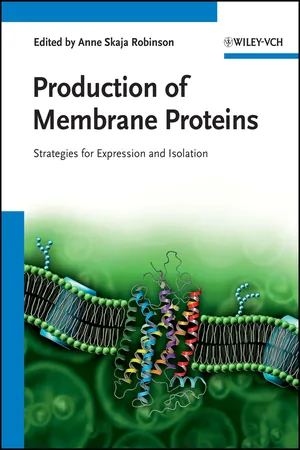
Designed as a research-level guide to current strategies and methods of membrane protein production on the small to intermediate scale, this practice-oriented book provides detailed, step-by-step laboratory protocols as well as an explanation of the principles behind each method, together with a discussion of its relative advantages and disadvantages.
Following an introductory section on current challenges in membrane protein production, the book goes on to look at expression systems, emerging methods and approaches, and protein specific considerations.
Case studies illustrate how to select or sample the optimal production system for any desired membrane protein, saving both time and money on the laboratory as well as the technical production scale.
Unique in its coverage of "difficult" proteins with large membrane-embedded domains, proteins from extremophiles, peripheral membrane proteins, and protein fragments.
eBook - ePub
Production of Membrane Proteins
Strategies for Expression and Isolation
- English
- ePUB (mobile friendly)
- Available on iOS & Android
eBook - ePub
About this book
Trusted by 375,005 students
Access to over 1.5 million titles for a fair monthly price.
Study more efficiently using our study tools.
Information
Part One: Expression Systems
1
Bacterial Systems
1.1 Introduction
The study of membrane protein structure and function is limited by various challenges. In native cells, membrane protein copy number is often very low, so the study of individual proteins is often not feasible. Alternatively, overexpression of these hydrophobic molecules in heterologous hosts is not a routine endeavor as it is for many water-soluble proteins. Most modern bacterial expression systems have been engineered for maximal output of recombinant protein. This characteristic is ideal for well-behaved soluble proteins, but less desirable when the target protein normally resides within a lipid environment. A compounding problem in the study of membrane proteins is that the isolated target protein may exhibit polydispersity, meaning that diverse oligomeric complexes can spontaneously accumulate. This latter concern may be influenced by the expression method, but primarily depends on the detergent/lipid and buffer used for solubilization. This chapter highlights preferred strategies for membrane protein expression in bacteria that will increase the likelihood of isolating adequate amounts of homogenous target protein. Many sections will also detail the features of expression strains that are relevant to the yield and quality of expressed protein.
In this chapter, the term membrane protein will generally be used to represent α-helical membrane proteins that reside within a phospholipid bilayer environment of either eukaryotic or prokaryotic cells. Such integral membrane proteins are the most difficult to manipulate since each contains hydrophobic transmembrane (TM) regions as well as hydrophilic extramembrane regions or domains. In the case of single-spanning membrane proteins, often the catalytic domain is a water-soluble entity that may be studied by expression of a ΔTM variant. However, multispanning membrane proteins such as ion channels must be expressed without gross deletions of hydrophobic residues.
Membrane proteins with β-barrel structure such as those found in the Gram-negative bacterial outer membrane or the mitochondrial outer membrane are typically expressed at high levels as inclusion bodies within the Escherichia coli cytoplasm. Isolation and washing of these inclusion bodies often leads to a relatively pure sample of recombinant protein and the literature contains many examples of refolding of β-barrel proteins, such as Omp proteins from E. coli [1]. In contrast, refolding of α-helical integral membrane protein is quite a difficult challenge, although some successes have been reported [2–4]. The default method of expressing α-helical membrane proteins should be to direct them to the membrane fraction of the host cell and to perform purification procedures beginning with isolation of the cellular membrane fraction.
1.2 Understanding the Problem
Each recombinant membrane protein clone should be assumed to be “toxic” to the host cell. This is particularly true when bacterial hosts are employed. It is well established that uncontrolled expression of most membrane proteins in E. coli will lead to induction of cellular stress responses and occasionally cell death. In some cases, the plasmid transformation step may fail because the transformed cell cannot recover due to the uncontrolled expression of membrane protein. Therefore, the first bit of advice in designing expression clones is to use a vector that propagates at 40 copies or less per cell (pMB1+rop, oriV, p15A, pSC101 replication origins). Accordingly, a vector with a pUC-derived origin should be avoided. Secondly, the promoter driving protein expression should be controllable (inducible). Much of this chapter is allocated to describing appropriate host/vector/promoter combinations (see Table 1.1 for a summary).
Table 1.1 Recommended E. coli strains for membrane protein expression.


In bacteria, passage through the inner membrane Sec translocase [5] is recognized as the primary bottleneck during the overexpression of recombinant membrane protein. Yet, many other factors may contribute to a limited expression yield. There are reports of Sec-independent membrane translocation, but true host protein-independent membrane assembly by a heterologous protein has not been clearly substantiated in the literature. For example, membrane assembly of Mistic fusion proteins [6] may be initiated by the affinity of the Mistic protein for the cytoplasmic face of the E. coli inner membrane; however, proper membrane assembly of the fused protein of interest must still require assistance from the Sec translocase when large extracellular hydrophilic domains need to be translocated across the inner membrane.
Our lab has investigated several possible modes of Sec-independent membrane assembly without arriving at any evidence that a heterologous integral membrane protein can bypass the Sec translocase (unpublished data). Furthermore, we have attempted to increase the efficiency of membrane integration by overexpressing the endogenous YidC protein that is thought to aid the Sec translocase or act independently as a membrane insertase [7]. We specifically chose to study the effect of YidC on the membrane integration of phage M13 p8 fusion proteins, as p8 protein by itself requires YidC for inner membrane assembly [8]. To our surprise, a 10-fold increased level of YidC had no effect on the membrane translocation of p8-derived fusion proteins containing a C-terminal PhoA domain as a reporter. One conclusion of this experiment is that the activity of SecA ATPase may be the limiting factor for the translocation of the large hydrophilic PhoA domain. Recently we determined that the p8 fusion partner (p8CBDek described in Luo et al. 2009 [9]) utilizes the cotranslational signal recognition particle (SRP) pathway [10–12], the route traveled by most endogenous membrane proteins. During cotranslational membrane protein assembly, there is less opportunity for hydrophobic amino acid segments to aggregate after emerging from the ribosome tunnel. Perhaps the limiting factor in p8 fusion protein expression and the overexpression of most membrane proteins is simply the rate of protein translation (or efficiency of translation initiation) at the ribosome. With this thought in mind, we tested various ribosomal binding sites (RBSs) and found a distinct difference in the efficiency of p8CBDek-mediated polytopic membrane protein assembly. Strikingly, the clone containing the much weaker RBS (AGGACGGCCGGatg) produced a greater level of protein per cell after a 20-h expression period at 20 °C. In contrast, the stronger RBS provided more protein per cell in the first stage of expression, but also resulted in jamming of the translocation pathway and cessation of culture growth. Thus, the take-home message from our recent work is to express recombinant membrane proteins “in moderation.” This advice may seem obvious, but many expression systems do not allow for careful control of expression. The solution of genetically engineering the appropriate RBS for the protein of interest may not be a preferred method of optimization. Instead, a much simpler solution for expression optimization is to employ a promoter that allows fine control of the level of mRNA encoding the membrane protein of interest.
1.3 Vector/Promoter Types
The most-studied bacterial promoters are those controlling operons for sugar metabolism (lacZYA, araBAD, rhaBAD). Many variants of the lac promoter have been isolated but all suffer to some degree from the inability to completely shut off expression with the LacI repressor protein. The wild-type lac promoter is a good choice for membrane protein expression due to its moderate strength. However, very few expression vectors encode the unmodified lac promoter. Vectors pUC18/pUC19 carry a simple lac promoter, but again pUC derivatives are not good choices due to high copy number and overproduction of β-lactamase (AmpR) that enables the growth of cells lacking plasmid. Vectors utilizing modified lac promoters are highlighted in Table 1.2. The lacUV5 promoter has two mutations within the −10 region of the lac promoter. In addition, a mutation is present at −66 within the catabolite gene activator protein (CAP) binding site. These mutations increase the promoter strength relative to the wild-type lac promoter and expression from lacUV5 is less subject to catabolite repression [13]. The tac promoter was first described by deBoer et al. [14–15]. This strong promoter is a hybrid of the −10 region of the lacUV5 promoter and the −35 region of the trp promoter. Amann et al. reported that the tac promoter is at least 5 times more efficient than the lacUV5 promoter [16]. The trc promoter is equivalent to the tac promoter since the 1-bp difference in spacing between the −35 and −10 consensus sequences does not affect promoter strength [17]. Note that the tac and trc promoters are not subject to catabolite repression as the CAP binding site is missing. Ptac and Ptrc systems are generally well controlled by LacI repression. When employing any type of modified lac promoter, LacI should be overexpressed from a lacI or lacIq gene carried by the expression vector. Also, isopropyl-β-D-thiogalactopyranoside (IPTG) induction should be tested in the low range (e.g., 0, 10, 100 versus 400 µM). The lacIq mutant was reported by Calos in 1978 and this mutation is simply an “up” promoter mutation resulting in a 10-fold enhancement of LacI repressor expression [18].
Table 1.2 Common vectors/promoters/types of regulation (for more options, a comprehensive vector database is maintained by the EMBL Protein Expression and Purification Core Facility: http://www.pepcore.embl.de/strains_vectors/vectors/bacterial_expression.html).

The pQE vectors from Qiagen utilize the phage T5 promoter that is controlled by two lac operator sequences. The T5 promoter is recognized by the E. coli RNA polymerase and induction is accomplished by IPTG addition to release the Lac repressor from the dual operator sequence. Since pQE vectors do not carry the lacI gene, the host strain must supply an excess of Lac repressor. Two options exist for LacI supplementation: copropagation of multicopy pREP4 (QIAexpress manual) or use of a strain that carries the lacIq gene. Many K-12 strains (e.g., JM109) carry the lacIq gene, but few B strains offer LacI overexpression. One recommendation is NEB Express Iq, which is a BL21 derivative that carries a miniF-lacIq which does not require antibiotic selection (Table 1.1).
Guzman et al. characterized the araBAD promoter in exquisite detail in 1995 [19], and the resulting the pBAD vector series offers many options for gene cloning and expression using L-arabinose induction. Note that some pBAD vectors do not encode RBS sites, so the gene insert must contain an appropriate translation init...
Table of contents
- Cover
- Related Titles
- Title page
- Copyright page
- Preface
- List of Contributors
- Introduction
- Part One: Expression Systems
- Part Two: Protein-Specific Considerations
- Part Three: Emerging Methods and Approaches
- Index
Frequently asked questions
Yes, you can cancel anytime from the Subscription tab in your account settings on the Perlego website. Your subscription will stay active until the end of your current billing period. Learn how to cancel your subscription
No, books cannot be downloaded as external files, such as PDFs, for use outside of Perlego. However, you can download books within the Perlego app for offline reading on mobile or tablet. Learn how to download books offline
Perlego offers two plans: Essential and Complete
- Essential is ideal for learners and professionals who enjoy exploring a wide range of subjects. Access the Essential Library with 800,000+ trusted titles and best-sellers across business, personal growth, and the humanities. Includes unlimited reading time and Standard Read Aloud voice.
- Complete: Perfect for advanced learners and researchers needing full, unrestricted access. Unlock 1.5M+ books across hundreds of subjects, including academic and specialized titles. The Complete Plan also includes advanced features like Premium Read Aloud and Research Assistant.
We are an online textbook subscription service, where you can get access to an entire online library for less than the price of a single book per month. With over 1.5 million books across 990+ topics, we’ve got you covered! Learn about our mission
Look out for the read-aloud symbol on your next book to see if you can listen to it. The read-aloud tool reads text aloud for you, highlighting the text as it is being read. You can pause it, speed it up and slow it down. Learn more about Read Aloud
Yes! You can use the Perlego app on both iOS and Android devices to read anytime, anywhere — even offline. Perfect for commutes or when you’re on the go.
Please note we cannot support devices running on iOS 13 and Android 7 or earlier. Learn more about using the app
Please note we cannot support devices running on iOS 13 and Android 7 or earlier. Learn more about using the app
Yes, you can access Production of Membrane Proteins by Anne Skaja Robinson in PDF and/or ePUB format, as well as other popular books in Biological Sciences & Molecular Biology. We have over 1.5 million books available in our catalogue for you to explore.