Authored by an experienced writer and a well-known researcher of stellar evolution, interstellar matter and spectroscopy, this unique treatise on the formation and observation of organic compounds in space includes a spectroscopy refresher, as well as links to geological findings and finishes with the outlook for future astronomical facilities and solar system exploration missions. A whole section on laboratory simulations includes the Miller-Urey experiment and the ultraviolet photolysis of ices.
The term organic matter was originally created to refer to compounds derived from natural living things which are fundamentally different from those derived from nonliving substances (inorganic matter). It was believed that living things posses a “vital force” which is absent in nonliving things. By the early nineteenth century, advances in chemical techniques had led to the isolation and discovery of an increasing number of organic molecules from living biological organisms. These included amino acids such as asparagine (isolated from asparagus in 1806), cysteine (extracted in 1810 from urinary calculi), leucine (1819, from fermenting cheese), and glycine (1820, from gelatin), fatty acids (1823), proteins (1838), DNA (1869, from yeast nuclei), and the nucleic acid bases guanine (1882), thymine (1883), adenine (1886), cytosine (1894), and uracil (1900) as well as deoxyribose (1909). These and other organic molecules represent the building blocks of life.
At the same time, it was commonly and firmly believed by many chemists that these molecules could only be produced by living organisms. While inorganic matter could be produced in the laboratory by chemical means, scientists thought organic matter could not be synthesized from inorganic matter because it lacked the “vital force”. Although the form of this “vital force” was never precisely described or defined, it was believed to be electrical in nature and involved in the rearrangement of molecular structures. In 1823, Friedrich Wöhler (1800–1882) heated an inorganic salt ammonium cyanate (NH4NCO) and turned it into urea [(NH2)2CO], an organic compound isolated from urine. Although ammonium cyanate and urea are made up of the same atoms, their molecular structures are different. This experiment suggested that it was possible to convert an inorganic molecule into an organic one by artificial means, without the magic of “vitalism”. This was the beginning of the disappearance of the concept of “vital force” from the scientific arena.
This pioneering work on abiotic synthesis was followed by the laboratory synthesis of the amino acid alanine (from a mixture of acetaldehyde, ammonia, and hydrogen cyanide) by Adolph Strecker (1822–1871) in 1850 and the synthesis of sugars (from formaldehyde) by Aleksandr Mikhailovich Butlerov (1828–1886) in 1861. However, it was not until the 1960s that the first nucleobase adenine (C5H5N5) was synthesized abiotically (from HCN and NH3) [1]. This was followed by the synthesis of guanine [2] and cytosine [3].
Biochemistry developed as the systematic study of biological forms and functions in terms of chemical structures and reactions. In the mid-nineteenth century, it was thought that “vitalism” from living yeast cells was the key to the fermentation of sugar into alcohol. In 1897, Eduard Büchner (1860–1917) discovered that yeast extracts could ferment sugar into alcohol and living cells were not necessary. This marked the beginning of the realization that biomolecules (which we now call enzymes), not the “vital force”, are responsible for fermentation. Enzymes have since been shown to be the catalysts that accelerate chemical reactions in biological systems.
In 1926, James Sumner found that urease, an enzyme that catalyzes the hydrolysis of urea into CO2 and NH3, is a protein. Shortly after, it was found that several other crystallized digestive enzymes are also proteins. The basis of one of the key elements of life – enhancing the rates of chemical reactions efficiently and selectively – was reduced to the study of the structures and functions of protein molecules.
Now, our definition of organic matter has evolved from something that possesses a special nonphysical element such as the “vital force” to a group of molecules and compounds based on the chemical element carbon (C). The element carbon is unique in its versatility for forming different chemical bonds. Not only is carbon able to connect with other C atoms to form different structures (see Chapter 2), it can also combine with other elements such as hydrogen (H), oxygen (O), nitrogen (N), sulfur (S), and phosphorus (P) to form a great variety of molecular forms. This group of molecules forms the basis of living organisms.
We note that four elements – hydrogen, oxygen, carbon, and nitrogen – make up more than 99% of the mass of most cells. These four elements are also the first, third, fourth, and fifth most abundant elements in the Universe. The existence of biomolecules is therefore built upon chemical elements that are abundantly available. The first step in molecular synthesis depends on the creation and distribution of chemical elements in the Universe.
1.1 Origin of Chemical Elements
Studies on stellar nucleosynthesis in the 1950s have led to the current realization that most of the chemical elements are synthesized in stars [4]. Helium is made by fusing hydrogen into helium in the core during the main sequence and in a shell above the core in the red giant phase. The element carbon is created by helium-burning1) (the triple-α process), first through core burning and later through shell burning above an electron-degenerate carbon-oxygen core. For massive (
) stars, direct nuclear burning continues with the production of oxygen, neon, magnesium, silicon, and so on, culminating in the synthesis of iron, the heaviest element that can be formed through direct nuclear burning. The other heavy elements, from yttrium and zirconium to uranium and beyond, are produced by neutron capture followed by β decay [5].
For the majority of stars (~95%, corresponding to stars with initial masses less than
), direct nuclear burning does not proceed beyond helium, and carbon is never ignited. Most of the nucleosynthesis occurs through slow neutron capture (the s process) during the asymptotic giant branch (AGB), a brief phase (~106yr) of stellar evolution where hydrogen and helium burn alternately in a shell. These newly synthesized elements are raised to the surface through periodic “dredge-up” episodes, and the observation of short-lived isotopes in stellar atmospheres provides direct evidence that nucleosynthesis is occurring in AGB stars [6].
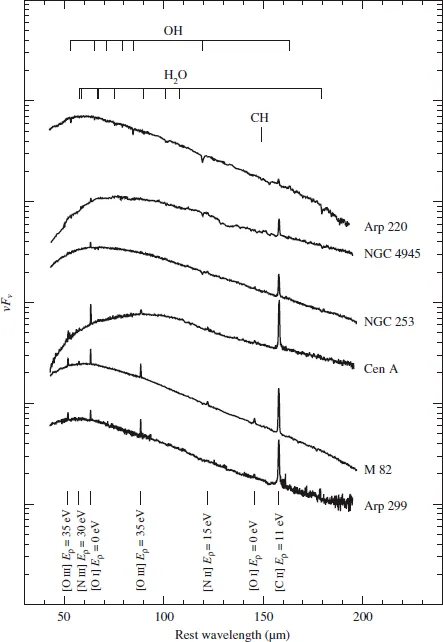
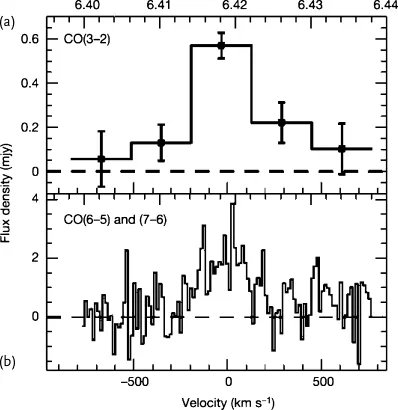
Other than the light elements H, He, D, and Li, which were produced in significant quantities during the Big Bang, all the other natural chemical elements are made in stellar furnaces. They are made in or near the core of stars, brought to the surface by convection, and ejected into interstellar space by stellar winds and supernovae explosions. With spectroscopic observations of distant galaxies (which means also looking back in time), we can detect the same elements through their atomic transitions. The element hydrogen (H) can be detected through its recombination lines (e.g., Lyman α, n =2−1) to a distance of redshift (z) of 7 [7], corresponding to more than 10 billion years back in time.2) The fine-structure lines of oxygen have been detected in galaxies with z = 3.9 [8]. In the far infrared, fine-structure lines of C, N, and O and rotational lines of simple molecules such as CH, OH, and H2O can be seen in emission and absorption respectively in the spectra of galaxies (Figure 1.1 ). With modern radio telescopes equipped with sensitive receivers, the molecule carbon monoxide (CO) has been detected in very distant quasars and galaxies [9, 10]. The most distant detection of molecular gas is in the quasar J1148+5251 at the redshift of 6.42 [11] (Figure 1.2 ). Photometric observations at the infrared and submillimeter wavelengths have detected excess infrared emission from galaxies and quasars at even similar distances [12]. This infrared excess cannot be due to starlight and is generally interpreted to be due to reemission by interstellar solid-state particles heated by starlight. Since these solids must be made of heavy elements,3) we know that the synthesis of chemical elements occurred soon (<109 yr) after the Big Bang.
Figure 1.1 ISO LWS spectra of six infrared bright galaxies showing that external galaxies have the same atomic and molecular spectra as in the terrestrial laboratory. Emission lines due to ions of C, O, and N can be seen in the spectrum. Absorption features due to simple molecules such as OH, CH, and H2O can also be seen. All spectra have been shifted in wavelength to rest wavelengths.
Figure adapted from [13].
Figure 1.2 The redshifted CO rotational transitions J = 4−3 and J = 5−4 from the quasar J1148+5251 at the redshift of 6.42, showing that molecular synthesis was already happening over 10 billion years ago. (a) The spectrum for CO J = 3−2 line was obtained at the Very Large Array (VLA) and (b) is an average of the CO J = 6−5 and J = 7−6 line obtained at Plateau de Bure Interferometer (PdBI).
Figure adapted from [11].
This tells us that the laws of physics and chemistry are spatially universal over the Universe and also through time. Chemical elements were made in the first generation of stars, and the heavy elements created by these stars are used as raw materials to form the next generation of stars.
We can derive the relative abundances of chemical elements from the strengths of atomic lines in the photospheric spectra of stars by making use of atomic parameters from laboratory measurements and models of stellar atmospheres [14]. Assuming hydrostatic and thermodynamic equilibrium and using the equations of radiation transfer, the observed fluxes of atomic lines can be translated into column densities, from which the relative abundances are obtained. The most abundant element is H (71% by mass), followed by He (27%), O (1%), C (0.3%), and N (0.1%). The derived chemical abundances (primarily from solar observations) are called cosmic abundances.4...
Table of contents
Cover
Half Title page
Title page
Copyright page
Preface
Abbreviations
Chaprter 1: History and Introduction
Chaprter 2: The Chemistry of Organic Matter
Chaprter 3: Interstellar Molecules
Chaprter 4: Organic Molecules in the Interstellar Medium
Chaprter 5: Organic Compounds in Galaxies
Chaprter 6: Synthesis of Organic Compounds in the Late Stages of Stellar Evolution
Chaprter 7: Organic Compounds in the Solar System
Chaprter 8: Organic Compounds as Carriers of Unsolved Astronomical Phenomena
Chaprter 9: Chemical Structures of Organic Matter in Space
Chaprter 10: Laboratory Simulations of Molecular Synthesis
Chaprter 11: Origin of Life on Earth
Chaprter 12: Lessons from the Past and Outlook for the Future
Appendix A: Glossary
Appendix B: Astronomical Infrared and Submillimeter Spectroscopic Observational Facilities
Appendix C: Unit Conversions
References
Color Plates
Index
Trusted by 375,005 students
Access to over 1.5 million titles for a fair monthly price.
Study more efficiently using our study tools.
Frequently asked questions
Yes, you can cancel anytime from the Subscription tab in your account settings on the Perlego website. Your subscription will stay active until the end of your current billing period. Learn how to cancel your subscription
No, books cannot be downloaded as external files, such as PDFs, for use outside of Perlego. However, you can download books within the Perlego app for offline reading on mobile or tablet. Learn how to download books offline
Perlego offers two plans: Essential and Complete
Essential is ideal for learners and professionals who enjoy exploring a wide range of subjects. Access the Essential Library with 800,000+ trusted titles and best-sellers across business, personal growth, and the humanities. Includes unlimited reading time and Standard Read Aloud voice.
Complete: Perfect for advanced learners and researchers needing full, unrestricted access. Unlock 1.5M+ books across hundreds of subjects, including academic and specialized titles. The Complete Plan also includes advanced features like Premium Read Aloud and Research Assistant.
Both plans are available with monthly, semester, or annual billing cycles.
We are an online textbook subscription service, where you can get access to an entire online library for less than the price of a single book per month. With over 1.5 million books across 990+ topics, we’ve got you covered! Learn about our mission
Look out for the read-aloud symbol on your next book to see if you can listen to it. The read-aloud tool reads text aloud for you, highlighting the text as it is being read. You can pause it, speed it up and slow it down. Learn more about Read Aloud
Yes! You can use the Perlego app on both iOS and Android devices to read anytime, anywhere — even offline. Perfect for commutes or when you’re on the go. Please note we cannot support devices running on iOS 13 and Android 7 or earlier. Learn more about using the app
Yes, you can access Organic Matter in the Universe by Sun Kwok in PDF and/or ePUB format, as well as other popular books in Physical Sciences & Astronomy & Astrophysics. We have over 1.5 million books available in our catalogue for you to explore.