- Use of Treated Wastewater (TWW) for irrigation is increasingly important as the world's population increases
- Chapters prepared by leading scientists in the field
- Comprehensive coverage of current knowledge and advances in the area of TWW
- Focus on possible environmental impacts (positive and negative)
eBook - ePub
Treated Wastewater in Agriculture
Use and Impacts on the Soil Environment and Crops
- English
- ePUB (mobile friendly)
- Available on iOS & Android
eBook - ePub
Treated Wastewater in Agriculture
Use and Impacts on the Soil Environment and Crops
About this book
As the world's population increases and the demand for water increases apace there is a rising demand for information concerning the reuse of wastewater, particularly for the irrigation of key food crops worldwide. This important new book addresses in detail the use of treated wastewater in agricultural situations, its impact on crops and the soil environment. Coverage includes the composition and treatment of wastewater, health considerations, regulations and economic aspects. Major sections of the book also concentrate on crop management and the soil environment. This book is an essential purchase for all those working in irrigation, water management and crop production worldwide.
Trusted by 375,005 students
Access to over 1.5 million titles for a fair monthly price.
Study more efficiently using our study tools.
Information
Part I
General Aspects
Chapter 1
Sources and composition of sewage effluent; treatment systems and methods
1.1 Sources of usable wastewater
From an ideal point of view, all kinds of wastewater can be reused if they undergo appropriate reclamation treatments. At present, available technologies allow removal of almost all detectable contaminants from wastewaters, making them suitable for every use, despite their original pollution levels. However, selection of the usable wastewater source is the first, and most important, aspect of every reclamation project.
Quality, quantity and location are three important characteristics for the possible use of wastewater. The quality of wastewater defines the required treatment level and related costs. Quantity considerations are strictly related to scale economies for reclamation costs and returns; but, are also related to the comparison between the available wastewater to be reclaimed and the demand for usable water. The location of the source is an important factor that affects the costs related to transport of wastewater from the source to the reclamation plant and then to the final reuse destination. This can be a reason to opt for a reclaimed wastewater source rather than primary water to be transported from a distant location.
Comparison between the cyclic behaviors of potentially usable wastewater and water demand is another aspect of significant relevance in terms of required exploitation costs. As neither produced wastewater nor water demand are usually constant in time, the assessment should include a comparison of cyclic variations of available wastewater with that of water demand. If the two variation shapes match, the construction of compensation tanks/reservoirs can be avoided or significantly reduced, with remarkable cost savings. Conversely, non-matching shapes result in a requirement for compensation tanks/reservoirs, the volume of which depend on the differences between the shapes. Specifically, cycles with long periods (as, for instance, the annual cycle of the agricultural water demand, which is required only during the irrigation season) require the construction of storage reservoirs of extremely large volumes if the production of usable wastewater is constant all year round, as in the case of urban wastewater.
The main sources of usable wastewater can be basically classified into domestic, industrial, and a combination of the two, as often found in urban sewer systems.
1.1.1 Domestic and municipal wastewater
Domestic wastewaters are discharged from residential areas, commercial areas (offices, hotels, restaurants, shopping centers, theaters, museums, airports, etc.), and institutional facilities (schools, hospitals, old people's homes, prisons, etc.). The contaminants in domestic wastewaters are almost the same all over the world, although some differences can be found between developed and underdeveloped countries, particularly related to chemicals used in personal care and housekeeping products. The average concentration of contaminants mainly depends on the water supply per capita, which varies with water availability and climatic regions. According to different conditions, we can have weak, medium or strong sewage effluent. Moreover, the quantity of domestic wastewater depends also on the water supply per capita. The temporal variability of both wastewater flow and concentration of contaminants is due to the habits of community residents and seasonal conditions.
Municipal wastewater often includes both domestic and industrial wastewaters that are collected in the same sewer system. The variable, and sometimes partially unknown, incidence of the industrial component can result in significant variations of wastewater composition, with relevant effects on complexity, effectiveness, and reliability of the reclamation treatment.
1.1.2 Municipal, combined, and dedicated stormwater sewers
For combined sewer systems, municipal wastewater also includes urban stormwater. Both flow rate and pollution level can increase significantly during storm events. If urban stormwater is collected in dedicated sewer systems, it can also be reused. The amount of urban stormwater runoff has progressively increased in recent decades as a result of urban expansion; large areas of vegetated and forested land have been replaced by impervious surfaces. In the past, stormwater was commonly collected for direct water reuse, especially in the countryside, but recently it has been recognized that urban stormwater can be significantly polluted, especially during the first flush, thus requiring specific reclamation processes. Certain land uses and activities, sometimes referred to as stormwater "hotspots" (e.g., commercial parking lots, vehicle service and maintenance facilities, and industrial rooftops), are known to produce high loads of pollutants such as metals and toxic chemicals. Table 1.1 presents the principal pollutants found in urban stormwater and typical pollutant sources.
1.1.3 Industrial wastewater
Most scientific papers, technical guidelines (e.g. the U.S. Environmental Protection Agency (EPA) guidelines for water reuse, EPA, 1992), and published case studies deal with the use of municipal wastewaters. Nevertheless, around 20% of worldwide water production is used in the industrial sector, compared to 7% in the municipal sector (Kretschmer et al., 2002), therefore the potential of using industrial wastewater for irrigation should be carefully evaluated.
Table 1.1 Principal pollutants found in urban stormwater and typical pollutant sources (adapted from CDEP, 2004)
| Stormwater pollutants | Potential sources |
| Excess nutrients | |
| Nitrogen, phosphorus (soluble) | Animal waste, fertilizers, failing septic systems, landfills, atmospheric deposition, erosion and sedimentation, illicit sanitary connections |
| Sediments | |
| Suspended, dissolved, deposited, sorbed pollutants | Construction sites, stream bank erosion, wash off from impervious surfaces |
| Pathogens | |
| Bacteria, viruses | Animal waste, failing septic systems, illicit sanitary connections |
| Organic materials | |
| Biochemical oxygen demand (BOD), chemical oxygen demand (COD) | Leaves, grass clippings, brush, failing septic systems |
| Hydrocarbons | |
| Oil and grease | Industrial processes; commercial processes; automobile wear, emissions, and fluid leaks; improper oil disposal |
| Metals | |
| Copper, lead, zinc, mercury, chromium, aluminum (soluble) | Industrial processes, normal wear of automobile brake linings and tires, automobile emissions and fluid leaks, metal roofs |
| Organic micropollutants | |
| Pesticides, VOCs, SVOCs, PCBs, PAHs (soluble) | Residential, commercial, and industrial application of herbicides, insecticides, fungicides and rodenticides; industrial processes; commercial processes |
| Deicing constituents | |
| Sodium, calcium, potassium chloride, ethylene glycol, other pollutants (soluble) | Road salting and uncovered salt storage. Snowmelt runoff from snow piles in parking lots and roads during the spring snowmelt season or during winter rain on snow events |
PAHs, polycyclic aromatic hydrocarbon; PCBs, polychlorinated biphenyls; SVOCs, soluble volatile organic carbon; VOCs, volatile organic carbon.
Industrial wastewater can come from a single industrial plant or from industrial districts, and its quantity and characteristics are highly variable with respect to the industrial processes involved. The temporal variability of industrial wastewater is mainly due to the phases of the industrial processes (startup, production, cleaning and cyclic maintenance). Moreover, the presence of internal water recycling can affect both the amount and composition of the wastewater.
Wastewater from food processing industries probably presents the highest potential for use in agriculture, as this is often rich in nutrients useful for crop development. Moreover, factories are often located near crops, thus resulting in lower transportation costs for the reclaimed water. Fortser and colleagues (1988, cited in Kretschmer et al., 2002) have studied the impact on soil, plants, and crops irrigated with wastewater from food processing industries. Table 1.2 lists some food processing industries from which wastewater may be potentially employed. There is also some evidence of other industrial sources for wastewater use (Into et al., 2004; Chen et al., 2005; Gerhart et al., 2006; Qin et al., 2006; Wang et al., 2006; Galil and Levinsky, 2007).
Table 1.2 Treatment and composition of wastewater from selected food industries (Kretschmer et al., 2002)
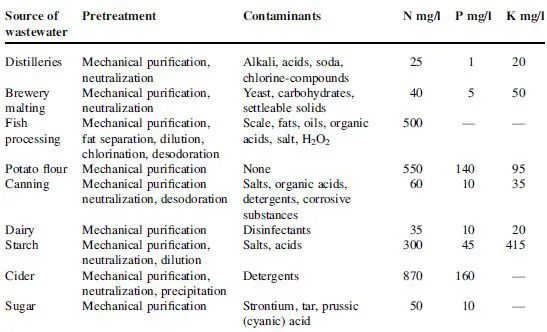
Compared to municipal wastewater, industrial wastewater presents a higher variability of required reclamation treatments, ranging from the peculiar reuse problems of unpolluted cooling water to the very specific treatments required for heavy polluted and strongly time-varying waters used inside the industrial processes and in washing cycles.
Finally, industrial wastewater is more case-specific, thus dedicated studies for choosing the best reclamation technology are often necessary, which, in turn, increase the complexity and reduce the generality of reclamation projects and concepts.
1.2 Main characteristics of usable wastewater
Typical compositions of untreated domestic wastewater (weak, medium, strong) are reported in Table 1.3. These data can also represent untreated municipal sewages, if the industrial component is not relevant. Table 1.4 provides average pollutant concentrations in urban stormwater. Conventionally treated wastewater presents a lower contamination level; however, secondary effluents can still contain contaminants that are of particular concern for reuse applications. Table 1.5 summarizes the most important quality parameters of wastewater and their significance, especially with regard to agricultural use. As reported in the table, some parameters appear to be beneficial for irrigation purposes (organic matter, nutrients), therefore they should not be removed from wastewater over a certain level. However, their presence in the reclaimed water should be carefully controlled, as they can become harmful for agricultural reuse if not properly supplied. Other contaminants are always detrimental; for some others (e.g. stable trace organic contaminants) negative effects are only suspected and further investigations are required.
Table 1.3 Typical composition of untreated domestic wastewater (after Tchobanoglous et al., 2003)
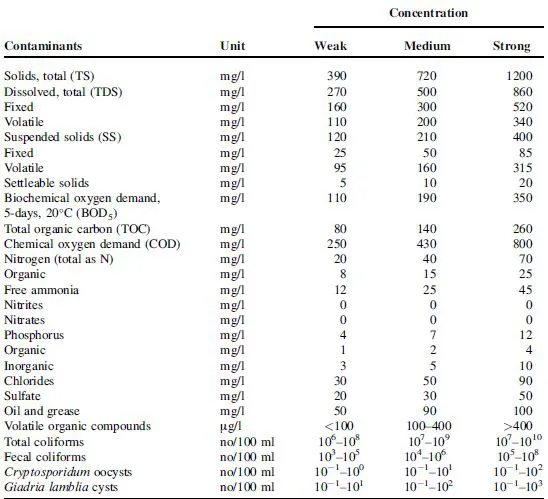
Table 1.4 Average pollutant concentrations in urban stormwaters (CDEP, 2004)
| Constituent | Units | Concentration |
| Total suspended solids | mg/l | 54.5 |
| Total phosphorus | mg/l | 0.26 |
| Soluble phosphorus | mg/l | 0.10 |
| Total nitrogen | mg/l | 2.00 |
| Total Kjeldahl nitrogen | mg/l | 1.47 |
| Nitrite and nitrate | mg/l | 0.53 |
| Copper | mg/l | 11.1 |
| Lead | mg/l | 50.7 |
| Zinc | mg/l | 129 |
| Biological oxygen demand | mg/l | 11.5 |
| Chemical oxygen demand | mg/l | 44.7 |
| Organic carbon | mg/l | 11.9 |
| Polycyclic aromatic hydrocarbon | mg/l | 3.5 |
| Oil and grease | mg/l | 3.0 |
| Fecal coliform | colonies/100 ml | 15000 |
| Fecal strep | colonies/100 ml | 35400 |
| Chloride (snowmelt) | mg/l | 116 |
Table 1.5 Main water quality parameters and their significance (adapted from Kretschmer et al., 2002)
| Parameter | Significance |
| Total suspended solids (TSS) | TSS can lead to sludge deposition and anaerobic conditions. Excessive amounts cause clogging of irrigation systems. Measures of particles in wastewater can be related to microbial contamination and turbidity. Can interfere with disinfection effectiveness |
| Organic indicators | Measure of organic carbon. |
| Total organic carbon Degradable organics (chemical oxygen demand, biological oxygen demand) | Their biological decomposition can lead to depletion of oxygen. For irrigation only excessive amounts cause problems. Low to moderate concentrations are beneficial |
| Nutrients N, P, K | When discharged into the aquatic environment they lead to eutrophication. In irrigation they are beneficial, nutrient source. Nitrate in excessive amounts, however, may lead to groundwater contamination |
| Stable organics (e.g. phenols, pesticides, chlorinated hydrocarbons) | Some are toxic in the environment, accumulation processes in the soil |
| pH | Affects metal solubility and alkalinity and structure of soil, and plant growth |
| Heavy metals (Cd, Zn, Ni, etc.) | Accumulation processes in the soil, toxicity for plants |
| Pathogenic organisms | Measure of microbial health risk due to enteric viruses, pathogenic bacteria and protozoa |
| Dissolved inorganic compounds, total dissolved solids (TDS), electrical conductivity (EC) and sodium adsorption ratio (SAR) | Excessive salinity may damage crops. Chloride, sodium and boron are toxic to some crops, extensive sodium may cause permeability problems |
1.2.1 Potentially beneficial substances
The main beneficial components for agricultural reuse are nutrients such as nitrogen, phosphorus, potassium, and other elements in minimal concentrations. A low to moderate concentration of biodegradable organic carbon can also be beneficial in controlled situations, specifically in degraded soils. As these components are not required to be removed by treatments above a certain level, the cost for wastewater reclamation can be reduced, with benefits for economic sustainability of reclamation projects.
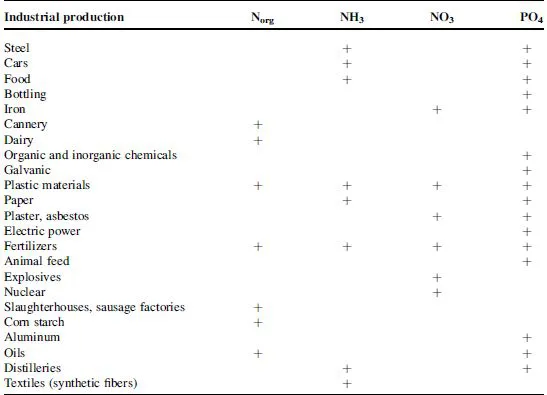
Nitrogen is found in domestic sewage as a product of human or animal metabolic activity; nitrogen production can be roughly estimated in the range of 9.4-13.8 gN/person/d (Beccari et al., 1993). Untreated domestic sewage contains nitrogen, mainly in organic and ammonia forms; nitrates are found in secondary effluents only after conventional by homogeneous industrial processes. However, the typical variability of industrial sources does not allow a numerical estimation of nitrogen production.
Table 1.6 Qualitative estimation of nitrogen and phosphorus production by homogeneous industrial processes (Beccari et al., 1993)
Despite the fact that nitrogen is the main nutrient for crop development, an excessive amount may delay maturity and adversely affect harvest quality and quantity. This phenomenon affects some crops more than others and, in some cases, specific periods of their growing cycles (such as delayed ripening in citruses and sugar cane). However, this is not usually a concern for municipal reclaimed water, as nitrogen concentration is commonly insufficient to produce satisfactory crop yields, leading to requirement for supplemental fertilization (EPA, 1992). In any case, it is recommended to continuously control the overall supply of nitrogen so as to match the crop requirements.
Nitrogen mass applied with reclaimed water should not exceed the amount required for crop production, as excess nitrate can rapidly leach below the root zone (Feigin et al., 1991; also see Chapter 5 (5.1), thus contaminating underlying groundwater. Presently, the increasing presence of nitrates in groundwater exploited for human consumption is a cause of great concern.
Phosphorus, like nitrogen, is mostly found in domestic sewage as a product of human and animal metabolic activity, or as a consequence of the use of detergents. Phosphorus production can be roughly estimated within the range of 2.2-4.9 gP/person/d. Domestic sewage contains phosphorus mainly as orthophosphate, but the balance between orthophosphate and polyphosphate can greatly vary during a single day. The presence of organic phosphorus in sewage is very limited (approximately 10% of total P), as it is easily degraded to inorganic forms. Industrial processes are another possible source of phosphorus (Table 1.6), but their contributions are usually difficult to assess because most industrial processes produce phosphorus concentrations and loads that can vary significantly with time, making estimations particularly difficult. Phosphorus in reclaimed water is often lower than crop requirements, and there is no evidence of negative effects on the crop coming from excessive phosphorus in wastewater used for irrigation (Chapter 5 (5.2).
1.2.2 Harmful substances in sewage effluent
Below is a summary of the types of particular contaminants that can be found in domestic and industrial wastewater, with a brief description of their possible adverse effects on crops, soil, irrigation systems, workers, consumers, and groundwater. These issues are covered in detail in various chapters of this volume.
Pathogenic microorganisms (viruses, bacteria, protozoa, and helminth ova) represent the most common threat to the agricultural use of wastewater, both for workers and end consumers of crops. These microorganisms are found in wastewater as a result of the excreta from infected populations. Water disinfection treatments can minimize the pathogenic threat, but disinfection byproducts should be carefully controlled as they can be themselves a risk to both animal and human life. In addition, in the agricultural use of wastewater, a proper irrigation system provides a complementary treatment that significantly limits associated health risk (Chapter 2).
Suspended solids in wastewater occur as a result of the anthropic use and hydrological cycle of water. The main problem of these solids for agricultural reuse of water is the clogging of irrigation systems, related to both the amount and particle size of the suspended solids and the type of the irrigation system (surface irrigation, sprinkler irrigation, surface drip or trickle irrigation, subsurface drip, etc.). Suspended so...
Table of contents
- Cover
- Tilte
- Copyright
- Preface
- Contributors list
- Part I: GENERAL ASPECTS
- Part II: IMPACTS ON THE SOIL ENVIRONMENT AND CROPS
- Index
Frequently asked questions
Yes, you can cancel anytime from the Subscription tab in your account settings on the Perlego website. Your subscription will stay active until the end of your current billing period. Learn how to cancel your subscription
No, books cannot be downloaded as external files, such as PDFs, for use outside of Perlego. However, you can download books within the Perlego app for offline reading on mobile or tablet. Learn how to download books offline
Perlego offers two plans: Essential and Complete
- Essential is ideal for learners and professionals who enjoy exploring a wide range of subjects. Access the Essential Library with 800,000+ trusted titles and best-sellers across business, personal growth, and the humanities. Includes unlimited reading time and Standard Read Aloud voice.
- Complete: Perfect for advanced learners and researchers needing full, unrestricted access. Unlock 1.5M+ books across hundreds of subjects, including academic and specialized titles. The Complete Plan also includes advanced features like Premium Read Aloud and Research Assistant.
We are an online textbook subscription service, where you can get access to an entire online library for less than the price of a single book per month. With over 1.5 million books across 990+ topics, we’ve got you covered! Learn about our mission
Look out for the read-aloud symbol on your next book to see if you can listen to it. The read-aloud tool reads text aloud for you, highlighting the text as it is being read. You can pause it, speed it up and slow it down. Learn more about Read Aloud
Yes! You can use the Perlego app on both iOS and Android devices to read anytime, anywhere — even offline. Perfect for commutes or when you’re on the go.
Please note we cannot support devices running on iOS 13 and Android 7 or earlier. Learn more about using the app
Please note we cannot support devices running on iOS 13 and Android 7 or earlier. Learn more about using the app
Yes, you can access Treated Wastewater in Agriculture by Guy Levy, P. Fine, A. Bar-Tal, Guy Levy,P. Fine,A. Bar-Tal in PDF and/or ePUB format, as well as other popular books in Technology & Engineering & Agriculture. We have over 1.5 million books available in our catalogue for you to explore.