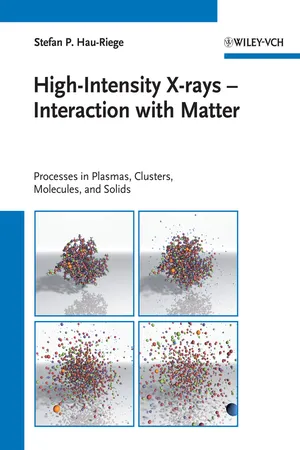
Filling the need for a book bridging the effect of matter on X-ray radiation and the interaction of x-rays with plasmas, this monograph provides comprehensive coverage of the topic. As such, it presents and explains such powerful new X-ray sources as X-ray free-electron lasers, as well as short pulse interactions with solids, clusters, molecules, and plasmas, and X-ray matter interactions as a diagnostic tool.
Equally useful for researchers and practitioners working in the field.
eBook - ePub
High-Intensity X-rays - Interaction with Matter
Processes in Plasmas, Clusters, Molecules and Solids
- English
- ePUB (mobile friendly)
- Available on iOS & Android
eBook - ePub
High-Intensity X-rays - Interaction with Matter
Processes in Plasmas, Clusters, Molecules and Solids
About this book
Information
Chapter 1
Introduction
Wilhelm Conrad Röntgen discovered x rays at the University of Würzburg in 1895, and published his results in a groundbreaking report entitled Über eine neue Art von Strahlen (On a new kind of rays) [1]. In the twentieth century, x rays have played an important role in gaining an understanding of matter on the atomic scale and quantum mechanics in general. Table 1.1 shows some of the key events in this fast-paced journey of discoveries. The discovery of x rays sparked a new era of science. One of the major accomplishments, has been the exploration of the microscopic structural details of molecules, liquids and solids at length scales of interatomic distances.
Table 1.1 An abbreviated history of x-ray physics.
| Year | Event |
| 1895 | Wilhelm Röntgen takes first medical x ray of his wife's hand |
| 1901 | Wilhelm Röntgen receives Nobel prize for producing and detecting x rays |
| 1909 | Charles Barkla and Charles Sadler observe characteristic x rays by electron bombardment of pure elements |
| around 1910 | Discovery that x rays are electromagnetic waves of shorter wavelength and higher energy than normal light |
| 1912 | Discovery of x-ray diffraction by Max von Laue, Walter Friedrich, and E. Paul Knipping |
| 1913 | William H. and William L. Bragg build an x-ray spectrometer |
| 1913 | William L. Bragg observes the first x-ray spectrum |
| 1913 | Henry Moseley establishes the relation between atomic number and the specific x-ray wavelength of the elements |
| 1914 | Max von Laue receives Nobel prize for the discovery of diffraction of x rays by crystals |
| 1915 | William H. and William L. Bragg receive the Nobel prize for determining crystal structures with x rays |
| 1916 | Karl Siegbahn and W. Stenstroem observe x-ray emission satellites |
| 1917 | Charles Barkla receives the Nobel prize for the discovery of the characteristic x-ray radiation of the elements |
| around 1920 | Wave–particle duality generally accepted |
| 1922 | Lise Meitner discovers Auger electrons |
| 1924 | Karl Siegbahn receives Nobel prize for his discoveries and research in the field of x-ray spectroscopy |
| 1927 | Arthur Compton receives the Nobel prize for demonstrating the particle concept of electromagnetic radiation |
| 1936 | Peter Debye receives the Nobel prize for his contributions to the study of molecular structure (by x-ray diffraction) |
| 1962 | Max Perutz and John Kendrew receive the Nobel prize for determining the structure of hemoglobin and myoglobin |
| 1964 | Dorothy Crowfoot Hodgkin receives the Nobel prize for determining the structure of penicillin and other important biochemical substances |
| 1964 | Synchrotron radiation available down to 0.1 Å |
| 1976 | William Lipscomb receives the Nobel prize for his studies on the structure of boranes illuminating problems of chemical bonding |
| 1979 | Allan Cormack and Godfrey Hounsfield receive the Nobel prize for the development of computerized tomography |
| 1981 | Kai Siegbahn receives the Nobel prize for his contributions to the development of high-resolution electron spectroscopy |
| 1985 | Herbert Hauptman and Jerome Karle receive the Nobel prize for developing direct methods for x-ray structure determination |
| 1988 | Johann Deisenhofer, Robert Huber, and Hartmut Michal receive the Nobel prize for the determination of the protein structures crucial to photosynthesis |
| 1994 | First soft x-ray scanning transmission microscope (STXM) |
| 1999 | Chandra x-ray observatory in use |
| 2009 | First hard-x-ray free-electron laser in use |
X rays can penetrate thick objects that are opaque to visible light. On the basis of this property, atomic-resolution three-dimensional real-space imaging methods are used to obtain the at-first invisible interior structure of objects. Several x-ray imaging techniques have been developed for this purpose. For example, real-space x-ray microscopy is similar to visible light microscopy, except that traditional refractive lenses are replaced by x-ray lenses such as zone plates. Lensless imaging does away with lenses altogether [2], and instead reciprocal-space coherent diffraction patterns are recorded. They are subsequently inverted using computational algorithms to obtain a real-space image. These techniques allow the recording of high-resolution images that can be sensitive to elemental composition, chemical state, and state of magnetism.
With the advent of high-intensity short-pulse x-ray sources, ultrafast processes have become accessible for investigations. These sources will allow the study of materials on time scales comparable to the motion of electrons circling around atoms, on spatial scales of interatomic bonds, and on energy scales that hold electrons in correlated motion with their neighbors. Ultrashort electromagnetic radiation sources are a critical tool for studying material properties, with the ultimate outlook of recording femtosecond movies of atomic and chemical processes.
The earliest x-ray sources were x-ray tubes. Even though their light output is of relatively low brightness, x-ray tubes have enabled numerous important discoveries, as laid out in Table 1.1. The laser was invented about 50 years ago and has led to steep progress in the optical sciences. Similarly, the advent of dedicated synchrotron sources around 1970 has enabled enormous advances in the x-ray sciences. We are now witnessing the emergence of short-pulse high-intensity x-ray sources such as x-ray free-electron lasers (XFELs), high-harmonic generators, x-ray lasers, and laser-plasma sources. With these new sources we are at the dawn of a very exciting time in x-ray science. One can expect progress of similar grandeur as resulted from the introduction of lasers and synchrotrons.
Reversible interaction mechanisms of x rays with matter, such as elastic x-ray scattering, are often used to probe materials. Since these interactions are usually relatively weak, large photon fluxes are required to obtain sufficiently intense probe signals. Since the absorption of x rays is typically much stronger than the elastic scattering strength, high-intensity x-ray radiation also modifies the structure of materials, and this is the main topic of this book: How x rays can be used to probe and modify matter.
We will now provide examples for the application of x-ray–matter interaction and discuss methods to produce x-ray radiation. We will then summarize fundamental models to describe x-ray–matter interaction, such as the Maxwell equations, semiclassical methods, and quantum electrodynamics. Subsequently, we will discuss x-ray–matter interaction processes in materials. Finally, we will point to some databases with information relevant to x-ray–matter interaction.
1.1 Examples for the Application of X-Ray–Matter Interaction
X rays find their application in diverse disciplines, including the life sciences, crystallography, atomic physics, plasma physics, materials science, chemistry, and astronomy. We will now discuss some of the key applications of x rays that highlight their versatility and that draw on their various unique properties, including their high penetrating power in materials and their short wavelengths that are comparable to interatomic distances. In addition, x-ray radiation can be prepared to have a high spectral purity, which is useful for x-ray spectroscopy, a very short pulse duration, which enables time-resolved studies, and high intensity, which can lead to nonlinear x-ray–matter interaction phenomena.
X-ray astronomy has enabled detailed studies of supernovae, pulsars, and black holes. Since the Earth's atmosphere is opaque to x-ray radiation, x rays can only be observed from outer space. The first rocket launch carrying a scientific payload that detected a cosmic x-ray source was performed in 1962 by American Science and Engineering (A...
Table of contents
- Cover
- Half Title page
- Title page
- Copyright
- Dedication
- Preface
- Chapter 1: Introduction
- Chapter 2: Atomic Physics
- Chapter 3: Scattering of X-Ray Radiation
- Chapter 4: Electromagnetic Wave Propagation
- Chapter 5: Electron Dynamics
- Chapter 6: Short X-Ray Pulses
- Chapter 7: High-Intensity Effects in the X-Ray Regime
- Chapter 8: Dynamics of X-Ray-Irradiated Materials
- Chapter 9: Simulation of X-Ray–Matter Interaction
- Chapter 10: Examples of X-Ray–Matter Interaction
- Index
Trusted by 375,005 students
Access to over 1.5 million titles for a fair monthly price.
Study more efficiently using our study tools.
Frequently asked questions
Yes, you can cancel anytime from the Subscription tab in your account settings on the Perlego website. Your subscription will stay active until the end of your current billing period. Learn how to cancel your subscription
No, books cannot be downloaded as external files, such as PDFs, for use outside of Perlego. However, you can download books within the Perlego app for offline reading on mobile or tablet. Learn how to download books offline
Perlego offers two plans: Essential and Complete
- Essential is ideal for learners and professionals who enjoy exploring a wide range of subjects. Access the Essential Library with 800,000+ trusted titles and best-sellers across business, personal growth, and the humanities. Includes unlimited reading time and Standard Read Aloud voice.
- Complete: Perfect for advanced learners and researchers needing full, unrestricted access. Unlock 1.5M+ books across hundreds of subjects, including academic and specialized titles. The Complete Plan also includes advanced features like Premium Read Aloud and Research Assistant.
We are an online textbook subscription service, where you can get access to an entire online library for less than the price of a single book per month. With over 1.5 million books across 990+ topics, we’ve got you covered! Learn about our mission
Look out for the read-aloud symbol on your next book to see if you can listen to it. The read-aloud tool reads text aloud for you, highlighting the text as it is being read. You can pause it, speed it up and slow it down. Learn more about Read Aloud
Yes! You can use the Perlego app on both iOS and Android devices to read anytime, anywhere — even offline. Perfect for commutes or when you’re on the go.
Please note we cannot support devices running on iOS 13 and Android 7 or earlier. Learn more about using the app
Please note we cannot support devices running on iOS 13 and Android 7 or earlier. Learn more about using the app
Yes, you can access High-Intensity X-rays - Interaction with Matter by Stefan P. Hau-Riege in PDF and/or ePUB format, as well as other popular books in Technology & Engineering & Nanotechnology & MEMS. We have over 1.5 million books available in our catalogue for you to explore.