![]()
Chapter one
The Aztecs of Mesoamerica
Bernal Díaz del Castillo, The Conquest of New Spain
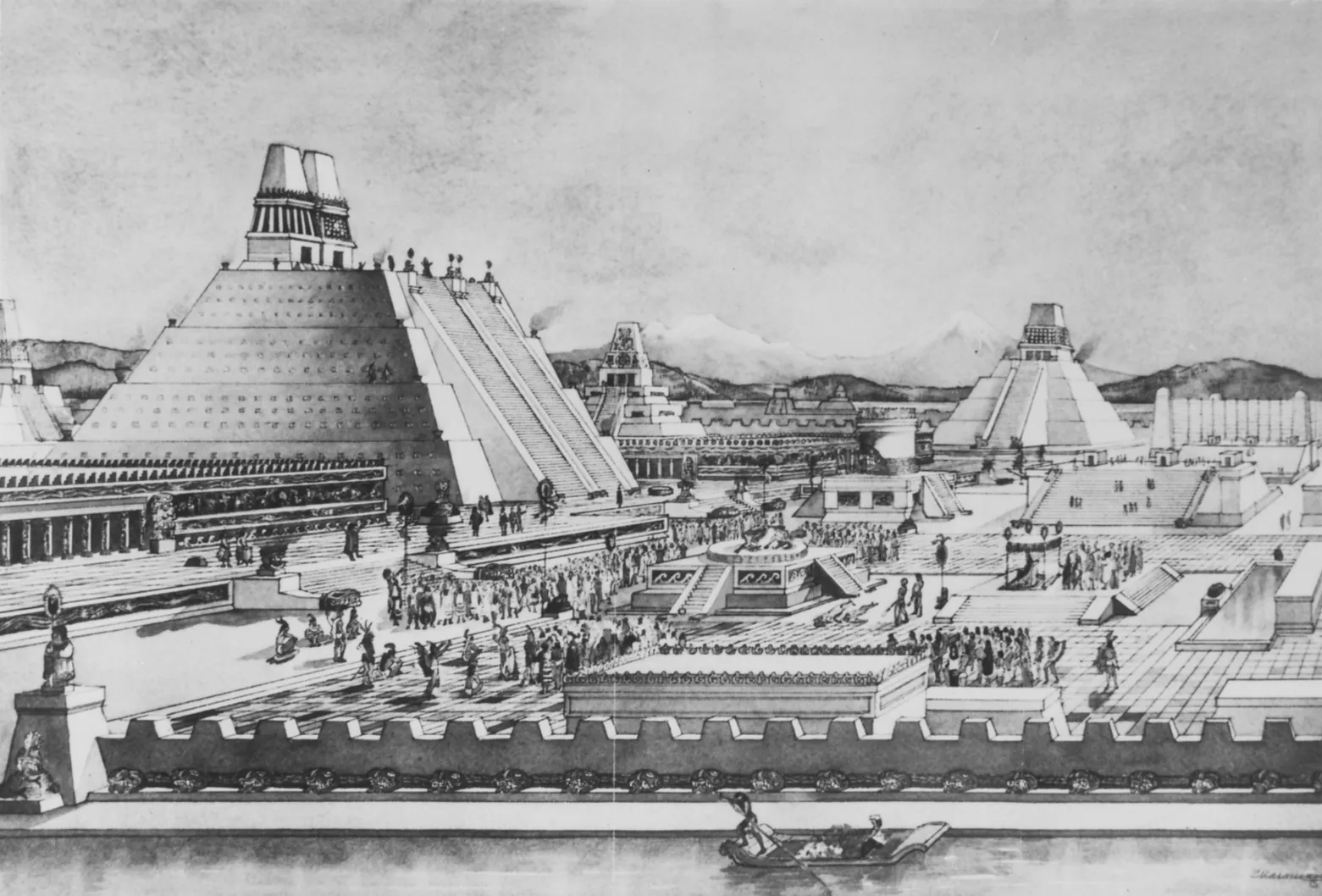
With these words Bernal Díaz del Castillo, a soldier in Hernando Cortés's conquering army, expressed his amazement at the Aztec capital city. When the Spaniards approached Tenochtitlan in 1519, it was one of the most populous cities in the world, the largest ever to flourish in the pre-Hispanic New World, and far richer and more grandiose than any community the Spanish soldiers had ever beheld in their home country (figure 1.1). Expecting to find a simple, backward people, the conquerors were awed by the civilized nature of Aztec society. The kings and royal courts, the huge bustling marketplaces with their orderly layouts, the wealth of the nobility, the detailed scientific and technical knowledge of the priests and artisans, these and many other features of Aztec civilization filled the conquerors with awe.
Much about the Aztecs continues to amaze us today. When workmen in Mexico City accidentally uncovered a huge Aztec sculpture in 1978, the Mexican government quickly mounted one of the largest excavations in the country's history. What emerged from these diggings was the “Templo Mayor,” a huge temple-pyramid that had served as the sacred center of the Aztec Empire. The sculpture was an offering buried in front of the pyramid. This pyramid (figure 1.1) and the thousands of rich and exotic offerings uncovered in and around it are now open to the public, and millions of visitors express their interest and appreciation every year.
Human sacrifice was a central ritual at the Templo Mayor, as it was at most Aztec temple-pyramids. Each year hundreds or perhaps thousands of victims had their chests cut open, and their still-beating hearts ripped out by knife-wielding priests, as throngs of spectators looked on. Today we find these bloody rituals horrifying but morbidly fascinating. Yet the same people who produced this sacrificial blood and gore wrote some of the most beautiful and poignant lyric poetry ever recorded. Here is a poem attributed to the philosopher-king Nezahualcoyotl of Texcoco:
Is it true that on earth one lives?
Not forever on earth, only a little while.
Though jade it may be, it breaks;
though gold it may be, it is crushed;
though it be quetzal plumes, it shall not last.
Not forever on earth, only a little while.
Cantares Mexicanos1
Today we find this contrast intriguing – blood and sacrifice versus beauty and sensitivity.
As an archaeologist, I used to feel a different sort of fascination toward the Aztecs: why was there so little fieldwork at Aztec sites? Spectacular discoveries had been made for over a century at Maya sites in southern Mexico, Guatemala, and Belize, but little effort was directed at the remains of the Aztecs. Nearly all of our information about the Aztecs came from ethnohistoric documents, but these left gaping holes in our reconstructions of Aztec society. Ironically, many of these gaps in the written record were topics for which the methods of modern archaeology were uniquely suited to study. If archaeologists could now provide detailed information on the agricultural systems, craft production, cities, houses, and rituals of other ancient civilizations, why were these methods not being applied toward understanding the Aztecs? This question had two answers: first, most scholars assumed that nearly all Aztec sites had been destroyed, either by the Spanish conquerors or by modern urban expansion; and second, those sites known to have survived were small and unassuming, unlike the large and impressive jungle cities of the Maya.
Two breakthroughs – the excavations of the Templo Mayor starting in 1978 and the work of a group of Mexican and American archaeologists at smaller sites – showed that it was still possible to map and excavate Aztec sites, and the results of recent work have revolutionized our understanding of Aztec civilization. At the Templo Mayor, excavations continue in adjacent lots. A number of books and articles describe this work for specialists and nonspecialists alike. Fieldwork in Tenochtitlan and at smaller Aztec sites continues unabated, but so far most of this research has been described only in technical reports and articles. Although archaeological fieldwork outside of Tenochtitlan has yet to turn up any finds as spectacular as the Templo Mayor, recent discoveries have led to exciting new views of Aztec social, economic, and religious life. My goal in writing this book is to draw upon both the ongoing archaeological study of Aztec sites and the continuing tradition of ethnohistoric scholarship in order to arrive at a more complete and comprehensive picture of Aztec society as it existed on the eve of Spanish conquest. As a participant in Aztec archaeology, I hope to communicate something of the excitement and significance of our work and its contribution to a new understanding of Aztec life before 1519.
Who Were the Aztecs?
I take a wider and more inclusive view of the Aztecs, both geographically and socially, than most authors. For many, the term “Aztec” refers strictly to the inhabitants of Tenochtitlan (the Mexica people) or perhaps the inhabitants of the Valley of Mexico, the highland basin where the Mexica and certain other Aztec groups lived. I believe it makes more sense to expand the definition of “Aztec” to include the peoples of nearby highland valleys in addition to the inhabitants of the Valley of Mexico. In the final few centuries before the arrival of the Spaniards in 1519, Nahuatl (the language of the Aztecs) was the dominant language throughout central Mexico, although other languages were spoken in some areas (see below). People in this area all traced their origins to a mythical place in the north called Aztlan (Aztlan is the origin of the term “Aztec,” a modern label that was not used by the people themselves).2
The several million Aztecs were divided into 20 or so ethnic groups (such as the Mexica, Tepanecs, or Tlahuica). Although people identified themselves by their ethnic group and by the city-state in which they resided, they were tied together by a common language, origin myths, and cultural patterns. Ethnohistorian James Lockhart has found many cultural similarities among these peoples at the time of the Spanish Conquest, and he uses the term “Nahuas” to describe the central Mexican Nahuatl-speaking peoples. My use of the term “Aztecs” parallels Lockhart's term for the period before 1519; after that I switch to “Nahuas” to describe these peoples following the Spanish Conquest.3
This book also takes a more inclusive social perspective than most other works on the Aztecs. Much of the available written documentation of Aztec society is flawed by two biases. First, the lives of nobles are heavily emphasized, whereas commoners are given short shrift. Second, life in Tenochtitlan is described in detail, whereas rural and provincial life is almost ignored. These biases ensure that any account of Aztec society based entirely on historical records will be incomplete. At this point, however, archaeology comes to the rescue. Recent methodological and conceptual changes in the discipline now permit archaeologists to recover rather detailed information on the lives of commoners and social conditions outside of Tenochtitlan.
The archaeological study of the everyday lives of peasants and other commoners is a relatively new development in the history of the discipline. It is understandable that early archaeologists with an interest in the high civilizations – ancient Egypt, Sumeria, the Inca, Maya, and others – chose to devote their energy to the grand monuments of these cultures. For two centuries, archaeologists excavated pyramids, palaces, tombs, and temples, the highly visible remains of ancient power. They searched for artistic masterpieces to bring back to European or American museums. This style of fieldwork, which I call “monumental archaeology,” still goes on today, but it has been supplemented by a newer approach, “social archaeology.”
Social archaeology develops its mission from a close interaction between archaeology and other social sciences, particularly anthropology, and draws its methods from the physical and biological sciences. This approach views archaeology as a social science whose goal is to reconstruct and explain the workings of past cultures. Pyramids and palaces were certainly important parts of ancient cultures, but so were peasant houses, foods and crops, merchants and markets, and other aspects of everyday life that the monumental archaeology approach omits. The social archaeology approach depends upon the principle that the everyday actions of ordinary people are important parts of any culture.4 These things can be reconstructed for the Aztecs or any ancient civilization if the appropriate methods and theories are used to guide archaeological fieldwork and analysis. One of the main tasks of this book is to bring the Aztec people – commoners as well as lords – into the light of modern knowledge, and archaeology is the primary means for accomplishing this.
Mesoamerican Context
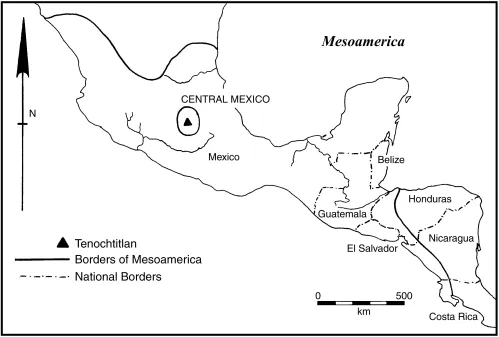
The Aztecs were a Mesoamerican civilization. Mesoamerica is the term for a distinctive cultural area that extends from north-central Mexico to Pacific Costa Rica (figure 1.2). Mesoamerica first took form with the initial spread of farming villages soon after 2000 BC. By the year AD 1519, the area was composed of a large variety of peoples whose cultures resembled one another far more than they resembled other New World cultures. Even in the face of Spanish conquest and colonization, the native Mesoamerican peoples managed to maintain fundamental beliefs and practices. In Mesoamerica today many distinct native languages are still spoken; the most common are Nahuatl, Yucatec Maya (there are many Maya languages), Zapotec, Mixtec, and Otomi. Nevertheless, the different Mesoamerican cultures share many characteristics, and key traits can be traced to their origin several thousand years ago.5
Early definitions of Mesoamerica focused on the identification of cultural traits unique to the area, which included economic features such as periodic markets, obsidian tools, plaster floors, and digging sticks, and religious traits such as human sacrifice, use of 13 as a sacred number, and a 260-day ritual calendar. Today, scholars are less interested in the compilation of lists of Mesoamerican traits and more concerned with the processes and mechanisms by which the diverse Mesoamerican cultures interacted with one another to maintain their cultural similarities and differences.6
Mesoamerican Environments
The hallmark of Mesoamerica as a setting for cultural development is its diversity. The area includes many different environmental zones, from steamy lowland jungles to cold, windy highland plains. This environmental diversity was matched by linguistic and cultural variation. Mesoamerican environments, which set the scene for the expansion of the Aztec Empire, are best discussed in terms of elevation above sea level.7
The tropical lowlands. Mesoamerica lies entirely within the tropical latitudes, and areas of low elevation tend to be hot and humid. Lands under 1,000 m in elevation are referred to by Mexican geographers as tierra caliente or the hot country. Rainfall is heavy in most lowland areas, producing either tropical forest vegetation (figure 1.3) or else savanna grasslands. Two Mesoamerican civilizations that evolved in tropical lowland environments were the Formative-period Olmec and the Classic-period Maya. The Aztecs were a highland civilization, yet they were dependent upon the tropical lowlands for a number of critical goods, including colorful f...