![]()
Chapter 1
Exploring Life with Cathy Baron-Tamraz
Business Wire
“Life is either a daring adventure or nothing.”— Helen Keller
Business Wire is a leading global distributor of corporate news, regulatory filings, and multimedia. Via its patented online delivery platform, thousands of corporate press releases and filings are simultaneously transmitted to news media, financial markets, and information Web sites.
Its distribution network spans 150 countries and 45 languages, and partners with more than 60 international and national news agencies. Business Wire serves approximately 30,000 member companies and disseminates thousands of news releases.
Founded in 1961 by Lorry I. Lokey, a journalist and public relations executive, the company opened in San Francisco with seven presigned members and served local Bay Area media. Within four months, the company began to blossom and made its first profit.
In the 1960s, Business Wire formed affiliations with wires around the world and increased its member list. In 1967, it opened an office in Los Angeles, and by the end of the 1960s, the group had 15 employees and more than 300 member companies. The demand for financial information boomed in the 1970s, and the company opened offices in Seattle and Boston.
It is worth noting that in the late 1960s, 100 words per minute was the maximum speed for wire transmission, but in the 1970s, with satellite-to-computer delivery, news releases could reach end-users at 1,200 words per minute.
The 1980s were a decade of expansion for Business Wire. The company established a New York office, along with offices in 10 other locations. With 150 employees in 16 offices, the company’s revenue base by 1990 was well past $10 million, placing it in the top tier of public relations service companies.
Business Wire entered the Internet age early with pioneering services and technology. It became the first commercial newswire to launch a website in 1995, and the up-to-date information it provided attracted more members. Its news content was featured on virtually every major search engine, web portal, and information service.
By 2000, the company had 26 offices, more than 400 employees and revenue approaching $100 million. In 2003, it even developed its own communication platform, dubbed “NX,” to deliver encrypted corporate releases simultaneously to media and information systems around the globe. This innovation was awarded a U.S. patent in 2006.
When she became CEO of Business Wire in 2005, Cathy Baron-Tamraz, who joined the company in 1979, came upon an article about Warren Buffett in the Wall Street Journal.
The article, headlined “Buffett Unplugged” on November 12, 2005, described the type of companies for which the oracle of Omaha was looking. Inspired by what she read, Tamraz sent Buffett a letter explaining the company and asking whether or not he would be interested. To her surprise, Buffett called her one day and wanted to know more, so founder Lokey, CEO Tamraz, and Buffett met in San Francisco the following month.
Buffett liked the company and made an offer to Business Wire for an undisclosed amount on January 17, 2006. (It was believed that Business Wire had revenue of $127 million in 2005, and its appraised value at that time was about $600 million.) The deal was completed on March 1, 2006.
In Buffett’s 2005 letter to shareholders, he wrote, “By the time I finished Cathy’s two page letter, I felt that Business Wire and Berkshire were a fit. I particularly liked her penultimate paragraph: ‘We run a tight ship and keep unnecessary spending under wraps. No secretaries or management layers here. Yet we’ll invest big dollars to gain a technological advantage and move the business forward .’”
Buffett further wrote that Business Wire, “like those of many entrepreneurs who have selected Berkshire as a home for their life’s work, is an example of what can happen when a good idea, a talented individual and hard work converge.”
As the company approaches its 50th anniversary, it continues to break new ground. Business Wire has been a pioneer in developing new XBRL financial reporting language and corresponding supporting services for corporations. It has also been a driving force in adapting to new channels of communications through its social media and search engine optimization platforms and products.
For this Berkshire star, the news is always breaking.
Cathy Baron-Tamraz, the President and CEO of Business Wire, is one of the few female executives at Berkshire Hathaway. Many see Cathy as a hardworking and determined, yet friendly CEO, but during a meeting at her Manhattan office, she revealed her other qualities and the adventures she has had during her career.
Born in 1953 in Long Island, New York, Cathy had a suburban upbringing in a middle-class household. Her father, Murray Baron, was an engineer and her mother, Lillian, a housewife. Cathy believes she inherited her personality from her parents. She noted that her mother is soft spoken and easy going, and her father is tougher and more disciplined.
“I would say I have my affection for people from my mother and my street sense and principles from my dad,” she said.
“Idle” was never a word Cathy’s parents would use to describe her. Both athletic and an honor student at Mineola Public School in Long Island, she has always felt that life should be eventful and that staying within one’s comfort zone discourages creativity.
With a natural sense of adventure and wanting to see what the world has to offer, Cathy packed her bags after graduating from high school and traveled across America. Upon her return, she attended the State University of New York.
When it came to choosing her college major, Cathy initially wanted to become a psychiatrist, but her parents were against it. They wanted her to study teaching because it is a respectable and stable profession. Cathy listened to their advice. As she also enjoyed reading and writing, Cathy opted for a double major in Education and English.
Cathy’s curiosity and desire to explore the world never waned. She made the most of her summer vacations and traveled to different parts of Europe. Then one summer, she decided to try something different — cab driving.
She explained, “I came back from Europe in midsummer, and I needed a job, so I became a taxi driver in the Long Island area. My parents weren’t very supportive of the idea, but nevertheless it was an interesting experience for me. I even had the distinction of being the only female taxi driver at the time.”
Cathy enjoys looking back at her various memorable experiences during college, some of which she has to laugh about. In fact, even Warren Buffett was impressed by her early adventures, noting that he was proud to have a Berkshire Hathaway executive who started out as a cab driver and eventually became the CEO of Business Wire. That is the American Dream.
Learning by Doing
Cathy realized that her liberal arts education gave her few business skills to apply at work in the beginning. However, she defended her college education and said, “I think a liberal arts education is invaluable in preparing one for the working world. I look at the people I have hired these past 30 years, and to be candid, most of them have had a more general background than a strictly business background.”
She stressed that the college major one pursues is not the key; the whole idea of college is to learn about general principles by taking a variety of courses. Rather than screening for talent strictly on the basis of a person’s college major, Cathy prefers to look for well-rounded, smart, and hardworking individuals who can make a solid contribution at work.
She said, “There is an old adage that goes ‘you learn by doing!’ I think that as you take on business projects and learn from your experiences, you learn new personal skills as your career unfolds.” That said, Cathy believes that one must remain open to new ideas, stay flexible, and treasure teamwork in order to grow.
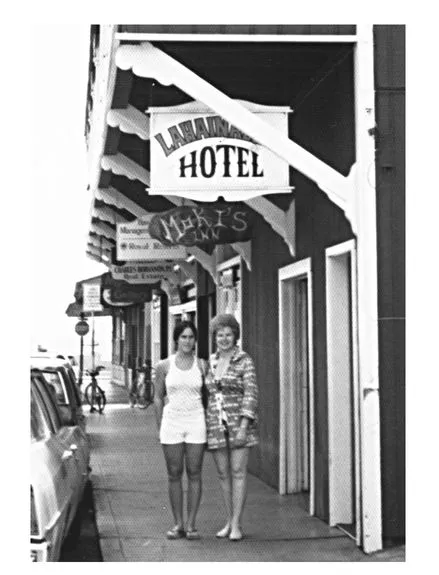
Cathy with Her Mother, Lillian Baron, in Hawaii
SOURCE: Used with the permission of Cathy Baron-Tamraz.
After college, Cathy worked as a high school teacher for some time but did not have a passion for the field, so she left and headed abroad again to search for her ideal career. On a stopover in Hawaii, she instantly fell in love with the island, so much so that she decided to stay there and find a job. She ended up in the tourism industry, becoming the manager of a boutique hotel.
Although she found it interesting to run a hotel business in an exotic location, Cathy ultimately felt that her career opportunities were limited and that she needed to move to a metropolitan area.
She explained, “I always wanted to travel after college, but I also knew I needed to focus on my career. After living in Hawaii, I decided to return home and continue my education. I ended up at Stony Brook University in New York, pursuing a master’s degree in literature, with the thought of teaching at the college level.”
After finishing graduate school, Cathy, along with her future husband, Stephen Tamraz, was asked to return to Hawaii and manage the hotel at which they had both previously worked. Shortly thereafter, the hotel was sold to a new owner, and in late 1979, the couple decided to move to a more traditional environment and settle down. They chose San Francisco — their favorite city — and sought new careers there. They married in 1982.
During her job search in San Francisco, Cathy saw a classified advertisement placed by Business Wire. Knowing that the job would involve editing, she answered the ad and joined the company in 1979. She became one of the editors of financial press releases that were distributed to the news media.
Then, in 1980, Cathy was asked to help open a new office in New York City. As her family lived in the area, and her future husband also had some entrepreneurial interests there, she decided to take up the opportunity and returned to New York. No one at the time would have guessed it, not even Cathy herself, but this was the real beginning of her career adventure.
Learning by Asking
Over the years, Cathy has also learned that the most direct way to learn is to ask. Although many people tend to be less vocal about their ideas, she has never been afraid to speak up and ask questions.
At Business Wire, Cathy not only wanted to do her own job well but also wanted to learn how the business worked. Company owner Lorry Lokey spent a lot of time explaining the industry to Cathy and, in many ways, became her mentor.
Discussing her relationship with Lokey, Cathy admitted that she was probably a pain for her boss at first. She confessed, “Lorry interviewed and hired me. As I was always curious about different decisions the company made or how the company worked, I asked a lot of questions. I was young and new to the business and somewhat ‘feisty.’ That might have annoyed Lorry at first, but it turned out to be very constructive!”
Cathy further added, “Lorry and I now laugh about how I gave him a bit of a hard time, but we both agree that sometimes you tangle with the person you end up having the greatest respect for. Because I was always interested in the business, Lorry must have admired my spunk, as he obviously targeted me for greater responsibility as my career developed.”
Cathy learned from Lokey throughout her career, and she came to realize that it is crucial to build a business or a career one step at a time. Regardless of the pressure from naysayers or competitors, a person needs to be driven by long-term goals and to walk at her own pace. By remaining true to oneself and not being overly aggressive — and by this Cathy does not mean being conservative — one can set realistic goals that are far reaching, yet achievable.
She noted that Lokey taught her to remain competitive and to maintain an entrepreneurial spirit by taking calculated risks and trusting in her instincts. A good example is Lokey’s decision to expand Business Wire in the 1980s. He was careful, yet fearless. He clearly outlined his goals and then pursued them without doubting his decision.
“Listening to your ‘gut’ is important! That does not mean stubbornness, but clearly and logically following your path. That ability requires courage,” Cathy remarked.
Listening to your ‘gut’ is important! That does not mean stubbornness.
Lokey, who is now in his 80s and retired, continues to impress Cathy by setting a good example. He is focused on gi...