- English
- ePUB (mobile friendly)
- Available on iOS & Android
eBook - ePub
Wastewater Microbiology
About this book
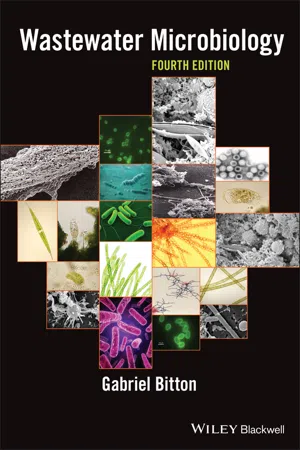
Wastewater Microbiology focuses on microbial contaminants found in wastewater, methods of detection for these contaminants, and methods of cleansing water of microbial contamination. This classic reference has now been updated to focus more exclusively on issues particular to wastewater, with new information on fecal contamination and new molecular methods. The book features new methods to determine cell viability/activity in environmental samples; a new section on bacterial spores as indicators; new information covering disinfection byproducts, UV disinfection, and photoreactivation; and much more. A PowerPoint of figures from the book is available at ftp://ftp.wiley.com/public/sci_tech_med/wastewater_microbiology.
Information
REFERENCES
Aarnisalo, L.K., T.J. Autio, J.M. Lunden, M.H. Saarela, H.J. Korkeala, and M.L. Suihko. 1999. Subtyping of Listeria monocytogenes Isolates from Food Industry with an Automated Riboprinter Microbial Characterization System and Pulse Field Gel Electrophoresis (PFGE), VTT Biotechnology, VTT Technical Research Centre of Finland.
Abad, F.X., R.M. Pinto, and A. Bosch. 1994. Survival of enteric viruses on environmental fomites. Appl. Environ. Microbiol. 60: 3704–3710.
Abad, F.X., R.M. Pinto, C. Villena, R. Gajardo, and A. Bosch. 1997. Astrovirus survival in drinking water. Appl. Environ. Microbiol. 63: 3119–3122.
Abbaszadegan, M., C.P. Gerba, and J.B. Rose. 1991. Detection of Giardia cysts with a cDNA probe and applications to water samples. Appl. Environ. Microbiol. 57: 927–931.
Abbaszadegan, M., M.S. Huber, C.P. Gerba, and I.L. Pepper. 1993. Detection of enteroviruses in groundwater with the polymerase chain reaction. Appl. Environ. Microbiol. 59: 1318–1324.
Abbaszadegan, M., M.S. Huber, C.P. Gerba, and I.L. Pepper. 1997. Detection of viable Giardia cysts by amplification of heat shock-induced mRNA. Appl. Environ. Microbiol. 63: 324–328.
Abbaszadegan, M., M. Lechevallier, and C.P. Gerba. 2003. Occurrence of viruses in U.S. groundwaters. Am. Water Works Assoc. J. 95: 107–120.
Aboytes, R., G.D. Giovanni, F.A. Abrams, C. Rheinecker, W. Mcelroy, N. Shaw, and M.W. Lechevallier. 2004. Detection of infectious Cryptosporidium in filtered drinking water. Am. Water Works Assoc. J. 96 (9): 88–98.
Abraham, J.V., R.D. Butler, and D.C. Sigee. 1997. Ciliate populations and metals in an activated sludge plant. Water Res. 31: 1103–1111.
Abram, J.W., and D.B. Nedwell. 1978. Hydrogen as a substrate for methanogenesis and sulphate reduction in anaerobic salt marsh sediments. Arch. Microbiol. 117: 93–97.
Abu-Ghararah, Z.H., and C.W. Randall. 1990. The effect of organic compounds on biological phosphorus removal. Water Sci. Technol. 23: 585–594.
Acher, A., and B.I. Juven. 1977. Destruction of fecal coliforms in sewage water by dye-sensitized photooxidation. Appl. Environ. Microbiol. 33: 1019–1023.
Acher, A., E. Fischer, R. Zellingher, and Y. Manor. 1990. Photochemical disinfection of effluents: Pilot plant studies. Water Res. 24: 837–843.
Acher, A., E. Fischer, and Y. Manor. 1994. Sunlight disinfection of domestic effluents for agricultural use. Water Res. 28: 1153–1160.
Acher, A., E. Fischer, R. Turnheim, and Y. Manor. 1997. Ecologically friendly wastewater disinfection techniques. Water Res. 31: 1398–1404.
Adal, K.A., C.R. Sterling, and R.L. Guerrant. 1995. Cryptosporidium and related species, pp. 1107–1128. In: Infections of the Gastrointestinal Tract, M.J. Blaser, P.D. Smith, J.I. Ravdin, H.B. Greenberg, and R.L. Guerrant, Eds., Raven Press, New York.
Adams, M.H. 1959. Bacteriophages, Intersciences, New York.
Adams, M.H., and B.H. Park. 1956. An enzyme produced by a phage-bacterial system. Virology 2: 719–736.
Adams, B.L., T.C. Bates, and J.D. Oliver. 2003. Survival of Helicobacter pylori in a natural freshwater environment. Appl. Environ. Microbiol. 69: 7462–7466.
Adcock, P.W., and C.P. Saint. 2001. Development of glucosidase agar for the confirmation of water-borne Enterococcus. Water Res. 35: 4243–4246.
Adey, W.H., and K. Loveland. 1998. Dynamic Aquaria: Building Living Ecosystems, Academic Press, New York.
Aelterman, P., K. Rabaey, P. Clauwaert, and W. Verstraete. 2006. Microbial fuel cells for wastewater treatment. Water Sci. Technol. 54 (8): 9–15.
Aftring, R.P., and B.F. Taylor. 1981. Aerobic and anaerobic catabolism of phtalate acid by a nitrate-respiring bacterium. Arch. Microbiol. 130: 101–104.
Ahel, M., W. Giger, and M. Koch. 1994. Behaviour of alkylphenol polyethoxylate surfactants in the aquatic environment. I. Occurrence and transformation in sewage treatment. Water Res. 28: 1131–1142.
Ahlborg, U.G., and T.M. Thunberg. 1980. Chlorinated phenols: Occurrence, toxicity, metabolism, and environmental impact. Critical Rev. Toxicol. 7: 1–35.
Ahlstrom, S.B., and T. Lessel. 1986. Irradiation of municipal sludge for pathogen control, pp. 1–19. In: Control of Sludge Pathogens, C.A. Sorber, Ed., Water Pollution Control Federation, Washington, D.C.
Ahmed, M.,and D.D. Focht. 1973. Degradation of polychlorinated biphenyl by two species of Achromobacter. Can. J. Microbiol. 19: 47–52.
Ahmed, A.U., and D.L. Sorensen. 1995. Kinetics of pathogen destruction during storage of dewatered biosolids. Water Environ. Res. 67: 143–150.
Ahmed, W., J. Tucker, K.A. Bettelheim, R. Neller, and M. Katouli. 2007a. Detection of virulence genes in Escherichia coli of an existing metabolic fingerprint database to predict the sources of pathogenic E. coli in surface waters. Water Res. 41: 3785–3791.
Ahmed, Z., J. Cho, B.R. Lim, K.-G. Song, and K.-H. Ahn. 2007b. Effects of sludge retention time on membrane fouling and microbial community structure in a membrane bioreactor. J. Membrane Sci. 287 (2): 211–218.
Ahmed, W., J. Stewart, D. Powell, and T. Gardner. 2008a. Evaluation of Bacteroides markers for the detection of human faecal pollution in non-sewered catchments. Lett. Appl. Microbiol. 46: 237–242.
Ahmed, W., J. Stewart, T. Gardner, and D. Powell. 2008b. A real-time polymerase chain reaction assay for quantitative detection of the human-specific enterococci surface protein marker in sewage and environmental waters. Environ. Microbiol. 10: 3255–3264.
Ahmed, W., A. Goonetilleke, D. Powell, and T. Gardner. 2009a. Evaluation of multiple sewage-associated Bacteroides PCR markers for sewage pollution tracking. Water Res. 43: 4872–4877.
Ahmed, W., A. Goonetilleke, D. Powell, K. Chauhan, and T. Gardner. 2009b. Comparison of molecular markers to detect fresh sewage in environmental waters. Water Res. 43: 4908–4917.
Ahrenhotz, I., M.G. Lorenz, and W. Wackernagel. 1994. A conditional suicide system in Escherichia coli based on the intracellular degradation of DNA. Appl. Environ. Microbiol. 60: 3746–3751.
Ahring, B.K., N. Christiansen, I. Mathrani, H.V. Hendriksen, A.J.L. Macario, E.C. De Macario. 1992. Introduction of a de novo bioremediation ability, aryl reductive dechlorination, into anaerobic granular sludge by inoculation of sludge with Desulfomonile tiedjei. Appl. Environ. Microbiol. 3677–3682.
Aieta, E.M. and J.D. Berg. 1986. A review of chlorine dioxide in drinking water treatment. Am. Water Works Assoc. J. 78: 62–72.
Aiking, H., K. Kok, H. van Heerikhuizen, and J. van’t Riet. 1982. Adaptation to cadmium by Klebsiella aerogenes growing in continuous culture proceeds mainly via formation of cadmium sulfate. Appl. Environ. Microbiol. 44: 938–944.
Al-Adhami, B.H., R. A. B. Nichols, J. R. Kusel, J. O’Grady, and H. V. Smith. 2007. Detection of UV-induced thymine dimers in individual Cryptosporidium parvum and Cryptosporidium hominis oocysts by immunofluorescence microscopy. Appl. Environ. Microbiol. 73: 947–955.
Al-Halbouni, D., J. Traber, S. Lyko, T. Wintgens, T. Melin, D. Tacke, A. Janot, W. Dott, and J. Hollender. 2008. Correlation of EPS content in activated sludge at different sludge retention times with membrane fouling phenomena. Water Res. 42: 1475–1488.
Alagappan, A., P.L. Bergquist, and B.C. Ferrari. 2009. Development of a two-color fluorescence in situ hybridization technique for species-level identification of human-infectious Cryptosporidium spp. Appl. Environ. Microbiol. 75: 5996–5998.
Albert, M., E. Biziagos, J.M. Crance, R. Deloince, and L. Schwartzbrod. 1990. Detection des virus enteriques cultivables in vitro et de l’antigene du virus de l’hepatite A dans les boues primaires de stations d’epuration. J. Fr. Hydrol. 2: 275–283.
Alberts, B., D. Bray, J. Lewis, M. Raff, K. Roberts, and J.D. Watson. 1989. Molecular Biology of the Cell, Garland, New York.
Albertson, G.E., and P. Hendricks. 1992. Bulking and foaming organism control at Phoenix, AZ WWTP. Water Sci. Tec...
Table of contents
- Cover
- Title page
- Copyright page
- DEDICATION
- PREFACE TO THE FOURTH EDITION
- PREFACE TO THE THIRD EDITION
- PREFACE TO THE SECOND EDITION
- PREFACE TO THE FIRST EDITION
- PART A: FUNDAMENTALS OF MICROBIOLOGY
- PART B: PUBLIC HEALTH MICROBIOLOGY
- PART C: MICROBIOLOGY OF WASTEWATER TREATMENT
- PART D: BIOTECHNOLOGY IN WASTEWATER TREATMENT
- PART E: FATE AND TOXICITY OF CHEMICALS IN WASTEWATER TREATMENT PLANTS
- PART F: MICROBIOLOGY AND PUBLIC HEALTH ASPECTS OF WASTEWATER EFFLUENTS AND BIOSOLIDS DISPOSAL AND REUSE
- REFERENCES
- Index
- Color Plates
Trusted by 375,005 students
Access to over 1.5 million titles for a fair monthly price.
Study more efficiently using our study tools.
Frequently asked questions
Yes, you can cancel anytime from the Subscription tab in your account settings on the Perlego website. Your subscription will stay active until the end of your current billing period. Learn how to cancel your subscription
No, books cannot be downloaded as external files, such as PDFs, for use outside of Perlego. However, you can download books within the Perlego app for offline reading on mobile or tablet. Learn how to download books offline
Perlego offers two plans: Essential and Complete
- Essential is ideal for learners and professionals who enjoy exploring a wide range of subjects. Access the Essential Library with 800,000+ trusted titles and best-sellers across business, personal growth, and the humanities. Includes unlimited reading time and Standard Read Aloud voice.
- Complete: Perfect for advanced learners and researchers needing full, unrestricted access. Unlock 1.5M+ books across hundreds of subjects, including academic and specialized titles. The Complete Plan also includes advanced features like Premium Read Aloud and Research Assistant.
We are an online textbook subscription service, where you can get access to an entire online library for less than the price of a single book per month. With over 1.5 million books across 990+ topics, we’ve got you covered! Learn about our mission
Look out for the read-aloud symbol on your next book to see if you can listen to it. The read-aloud tool reads text aloud for you, highlighting the text as it is being read. You can pause it, speed it up and slow it down. Learn more about Read Aloud
Yes! You can use the Perlego app on both iOS and Android devices to read anytime, anywhere — even offline. Perfect for commutes or when you’re on the go.
Please note we cannot support devices running on iOS 13 and Android 7 or earlier. Learn more about using the app
Please note we cannot support devices running on iOS 13 and Android 7 or earlier. Learn more about using the app
Yes, you can access Wastewater Microbiology by Gabriel Bitton in PDF and/or ePUB format, as well as other popular books in Biological Sciences & Microbiology. We have over 1.5 million books available in our catalogue for you to explore.