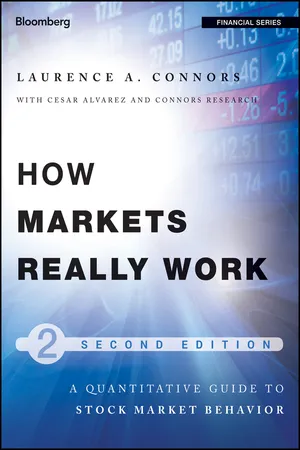
Common wisdom holds that the stock markets are ever changing. But, as it turns out, common wisdom can be wrong. Offering a comprehensive look back at the way the markets have acted over the last two decades, How Markets Really Work: A Quantitative Guide to Stock Market Behavior, Second Edition shows that nothing has changed, that the markets behave the same way today as they have in years past, and that understanding this puts you in a prime position to profit. Written by two top financial experts and filled with charts and graphs that illustrate the market concepts they develop, the book takes a sometimes contrarian view of everything from market edges to historical volatility, and from volume to put/call ratio, giving you all that you need to truly understand how the markets function. Fully revised and updated, How Markets Really Work, Second Edition takes a level-headed, data-driven look at the markets to show how they function and how you can apply that information intelligently when making investment decisions.
eBook - ePub
How Markets Really Work
Quantitative Guide to Stock Market Behavior
- English
- ePUB (mobile friendly)
- Available on iOS & Android
eBook - ePub
About this book
For years, traders and investors have been using unproven assumptions about popular patterns such as breakouts, momentum, new highs, new lows, market breadth, put/call ratios and more without knowing if there is a statistical edge.
CHAPTER 1
Market Edges
The following is verbatim from the first edition of How Markets Really Work. It’s important to get a point of reference of what we wrote and saw in 2004 compared to what we see with the second edition, which was written in late 2011.

For many of us, Michael Lewis’s 1989 best-selling book Liar’s Poker was the first inside look at what day-to-day life was like at a major Wall Street trading firm. Lewis described in detail, the wheeling and dealing of some of the famous (and infamous) Wall Street titans who oversaw billions of dollars of transactions every trading day during the 1980s. The book remains a classic today but 14 years after it was published, Lewis outdid himself. In 2003, he published Moneyball: The Art of Winning an Unfair Game. The book chronicles the success of the Oakland A’s, who under the guidance of their general manager, Billy Beane, used massive amounts of statistical data to help them successfully run their ball team.
The A’s essentially turned their backs on the old school of thinking, much of which was intuitive, and attempted to turn baseball into a science. Players who should have been fifteenth-round draft picks were being chosen by the A’s near the top of the draft (and signed very cheaply). These types of players were chosen not because they looked good or the scouting reports said they couldn’t miss. They were chosen because the statistics said that these players had an edge and that this edge had a better chance of playing itself out than the guessing that had gone into past selections. Essentially, Billy Beane and the A’s turned baseball upside down, and by relying upon numbers instead of opinion, they have been able to successfully compete against teams that had far more money to spend on talent.
The godfather behind this move to relying upon numbers instead of gut is a brilliant gentleman by the name of Bill James. In the 1970s James began publishing studies and then books on player evaluation and baseball strategy. Up until a few years ago, James was all but ignored by mainstream baseball. Hall of Fame manager Sparky Anderson, who is the only manager to win a World Series in both the National League and the American League, referred to James as “a fat guy with a beard who knows nothing about nothing.” And in spite of the success that the A’s and a few other teams have had relying upon statistics, the debate still rages as to its effectiveness. But, as this is being written, baseball has begun the process of turning away from the Sparky Anderson school of knowledge and accepting the thinking of people like Bill James. General managers are being hired by teams not for their baseball playing careers or their baseball prowess, but for their ability to analyze baseball statistics and make correct decisions using these statistics. Teams like the Red Sox and the Dodgers now have GMs who are only in their early thirties. Why are they entrusted with franchises that are valued in the hundreds of millions of dollars? It’s because these guys don’t guess. They know numbers and their understanding of these numbers provides them with an edge.
And in some cases, this edge is substantial.
What does this have to do with trading? A lot. After we read Moneyball, we remarked that it’s amazing that baseball has gone this route yet most of Wall Street still has not. If baseball has quantified mainstream parts of the game such as batting average, on base percentage, errors, steals, walks, and so on, why hasn’t Wall Street done the same with the indicators it relies upon every day? Trading day after trading day, we are bombarded with information from the media. “The market rose for the third straight day as the bulls are taking charge.” What does this mean? It sounds good, doesn’t it? It sure feels as though the market is going to continue to rise. A market rising three days in a row is usually rising because of good news. Isn’t that a precursor of things to come? What about advancing issues and declining issues? On days when the market drops sharply and declining stocks far outnumber advancing stocks, the press and the analysts tell us this is bad. Poor market breadth is supposedly a sign of future weakness. It seems to make sense. But is it true? (You’ll soon see it’s not.)
Just as old school baseball used to think that a guy who was 6′3″ and could run fast and hit the ball a mile was a can’t-miss prospect, much of old-school Wall Street still thinks that good news and market strength is a sign of future upward price movement and bad news and poor market strength is a sign of future downward movement. As you will soon learn, at least looking at the market over the past 15 years (1989–2003), there is nothing further from the truth. This is not our opinion or guess. It’s what the statistics show. And just as baseball had a tough time accepting the fact that on-base percentage is more important than batting average, we suspect that many people on Wall Street, especially the media and the mainstream firms, will have a tough time accepting the fact that it’s better over the near term for the market to have dropped than for it to have risen.
All combined, we have nearly three decades of trading and research experience behind us. Much of what you will learn from this book is a culmination of our work. We looked at a number of the most common ways traders, analysts, and the press look at the market. Even though we went into the tests having a strong clue where the results would end up, even we were surprised at some of these results. The tests included us looking at how the S&P 500 cash market (SPX) and the Nasdaq 100 cash market (NDX) did over a 1-day, 2-day, and 1-week period after they made a 5-period high, 10-period high, 5-period low, and 10-period low (intraday). We also looked at how these markets did after prices rose multiple days in a row (showing strength) and declined multiple days in a row (showing weakness). We looked at the times when the markets made multiple-day higher highs and multiple-day lower lows, again looking at what happened after continuous strength and weakness. From there we looked at the days when the market rose sharply to the upside versus declined sharply to the downside.
Volume was another topic we tackled, as it is one of the most often-used indicators. After volume, you’ll learn about market breadth when we analyze what the market has done after advancing issues outperformed declining issues (and vice versa). The results from many of these chapters may surprise you, and this chapter may be the biggest surprise.
From there, we looked at another common indicator: new 52-week highs and new 52-week lows. There’s a healthy edge here, and again it’s not where the analysts and the press say it is. In the final two chapters, we’ll show you how to use the put/call ratio and the volatility index (VIX)—Chicago Board Options Exchange (CBOE) Volatility Index. Each indicator has shown strong consistent edges, and we’ll teach you where these edges are.
Before we move to the next chapter and start looking at the test results, we’d like to cover a few guidelines to help you better understand how to use this book and how to use the information presented to help gain a greater edge in your trading and investing.
1. We’ll state this again later in the book, but you need to know that there are no assurances that these test results will hold up in the future. Even though many of these tests are independent of one another and basically lead to the same conclusion, it cannot be assumed this conclusion (or any market conclusion) will hold true in the future.
2. Much of Wall Street is made up of opinions. It’s also made up of opinions that are not backed by any statistical evidence. If the baseball world can do it, then Wall Street can do it, too. Hopefully, this book is just the tip of the iceberg in using statistics to help understand how markets behave and how one can make proper and rational decisions on a day-to-day basis.
3. All these tests were run on the cash market and were not actual trades. Also, commissions and slippage were not factored in.
4. All the tests use a benchmark. This means we compared apples to apples. We looked at the results when certain situations occurred versus how the market performed on average during the same time period. We did the same for the percentage of trades that showed gains. In many cases we could have shown more test results, but we didn’t because the number of opportunities that occurred (the sample size) was too low.
5. We tested the S&P 500 and the Nasdaq 100 cash markets throughout the book.
6. Many of the tests run as far back as 15 years. This encompassed a solid bull market, followed by a very severe bear market, followed by a rally in 2003. The net bias was up for the entire time frame, but the market also saw some healthy selling periods, especially from 2000 to 2002.
7. Finding clean market data is not as easy as one would think. There are data vendors whose data we could not trust. Therefore, we used data from sources we trusted, including the CBOE for the put/call ratio tests and the VIX tests. In many cases we tested up to 15 years of data, but in some cases we had to use fewer years in order not to compromise the integrity of the test results. These tests were run multiple times in order to assure the results. If you elect to do your own testing and find different results, it might possibly be due to the data your data vendor is providing.
8. In many chapters we also looked at the market trend. We defined the market trend as being up when the market was above its 200-day moving average (200-day ma) and down when it was below its 200-day moving average.
9. None of these tests are systems, nor should they be traded as systems, nor do we trade them alone as systems. They simply look at how markets behaved over a fixed period of time in specific market conditions.
10. This book can be used by everyone and should provide you with a basic philosophy for looking at the markets. Traders especially will be able to use this information as the focus of the book is on the short-term. But interestingly enough, you will see the same type of statistical evidence in long-term investing using the basic philosophy and concepts from this book at www.TheMachineAdvisor.com (the site is related to us).
11. Please understand that the results you will see are average returns. This means that there were gains and losses in any individual scenario that were far from average. And going forward, there will undoubtedly be situations that occur that will be far from the averages published here.
12. You’ll see one common theme throughout this book: Buying short-term weakness has outperformed buying short-term strength over the past 15 years. Should this trend continue, there is a big edge here for traders to take advantage of. The goal of this work is to show you when these times occurred and what the historical edge has been.
What Has Changed Since We Originally Wrote This
It’s nearly eight years later, and in spite of a market that has since risen significantly, dropped significantly (crashed), and then risen again, much of what we saw back then still holds true today.
Even the baseball analogy discussing how teams that rely upon data outperform teams that don’t rely upon data has continued to prove true. The Red Sox have since won two World Series (2004 and 2007) and the St. Louis Cardinals have also won twice (2006 and 2011).
Data used properly—whether in baseball or in the markets—still works.
In this updated edition, we took the tests we originally published and updated them through the third quarter of 2011 (we wrote this book as soon as the quarter ended and submitted it to our publisher in November 2011). What you will see is that markets have continued to work the way they worked from 1989 to 2003. There is now up to 22¾ years of data here, and the overriding theme is that on a short-term basis, oversold markets tend to move higher over the next few days and overbought markets tend to move lower on a short-term basis over the next few days.
This behavior doesn’t mean ...
Table of contents
- Cover
- Contents
- Title
- Copyright
- fm01
- Disclaimer
- Table Explanation
- Acknowledgments
- Chapter 1: Market Edges
- Chapter 2: Short-Term Highs and Short-Term Lows
- Chapter 3: Higher Highs and Lower Lows
- Chapter 4: Up Days in a Row versus Down Days in a Row
- Chapter 5: Market Breadth
- Chapter 6: Volume
- Chapter 7: Large Moves
- Chapter 8: New 52-Week Highs, New 52-Week Lows
- Chapter 9: Put/Call Ratio
- Chapter 10: Volatility Index (VIX)
- Chapter 11: The Two-Period RSI Indicator
- Chapter 12: Historical Volatility
- Chapter 13: Creating a Sample Strategy from this Research
- Chapter 14: Applying the Information in this Book
- About the Authors
- Index
Trusted by 375,005 students
Access to over 1.5 million titles for a fair monthly price.
Study more efficiently using our study tools.
Frequently asked questions
Yes, you can cancel anytime from the Subscription tab in your account settings on the Perlego website. Your subscription will stay active until the end of your current billing period. Learn how to cancel your subscription
No, books cannot be downloaded as external files, such as PDFs, for use outside of Perlego. However, you can download books within the Perlego app for offline reading on mobile or tablet. Learn how to download books offline
Perlego offers two plans: Essential and Complete
- Essential is ideal for learners and professionals who enjoy exploring a wide range of subjects. Access the Essential Library with 800,000+ trusted titles and best-sellers across business, personal growth, and the humanities. Includes unlimited reading time and Standard Read Aloud voice.
- Complete: Perfect for advanced learners and researchers needing full, unrestricted access. Unlock 1.5M+ books across hundreds of subjects, including academic and specialized titles. The Complete Plan also includes advanced features like Premium Read Aloud and Research Assistant.
We are an online textbook subscription service, where you can get access to an entire online library for less than the price of a single book per month. With over 1.5 million books across 990+ topics, we’ve got you covered! Learn about our mission
Look out for the read-aloud symbol on your next book to see if you can listen to it. The read-aloud tool reads text aloud for you, highlighting the text as it is being read. You can pause it, speed it up and slow it down. Learn more about Read Aloud
Yes! You can use the Perlego app on both iOS and Android devices to read anytime, anywhere — even offline. Perfect for commutes or when you’re on the go.
Please note we cannot support devices running on iOS 13 and Android 7 or earlier. Learn more about using the app
Please note we cannot support devices running on iOS 13 and Android 7 or earlier. Learn more about using the app
Yes, you can access How Markets Really Work by Larry Connors,Cesar Alvarez in PDF and/or ePUB format, as well as other popular books in Business & Finance. We have over 1.5 million books available in our catalogue for you to explore.