![]()
This text will set out the ideal properties of complete dentures, and provide you with techniques for achieving these when carrying out any stage in the production process. Dentures should function well and look good. The denture wearer may value function over aesthetics or vice versa, but failure to establish a minimal requisite will lead to disappointment.
What do we mean by function well? Dentures should be comfortable, retentive, stable when biting together in any position, and restore the speech.
What do we mean by look good? Dentures should replace the teeth and the resorbed bone, resulting in natural looking anterior teeth, support of the soft tissues and restoration of any loss in vertical dimension.
Establishing function and aesthetics may be challenging in some cases, this text aims to provide the solutions to ensure the reader understands and can provide the various elements that are essential for optimum denture provision. This text will help the reader evaluate, design and provide the following requirements.
Fit:
This is a result of impression technique, impression materials, model materials, processing method, denture base material and final fitting.
Retention:
This results from fit and forming a border seal. Providing retention may prove difficult for lower dentures where stability and muscular control must be optimised to compensate.
Stability is Dependent upon Fit and Occlusion.
Establishing a balanced occlusion is key to maintaining stability and in turn the border seal. Lower dentures are particularly vulnerable to instability as a result of poor retention. Here the occlusal table should be designed to provide optimum load distribution in order to seat the denture.
Occlusion of the Denture Teeth
may be established as a conventional balanced occlusion or as a lingualised scheme, each should result in multiple tooth contacts around the denture, providing stability in any position.
Muscular Control
provides long-term retention of the denture and is aided by the positioning of the teeth in the neutral zone and by the considered shaping of the polished surfaces of the denture.
Aesthetics
of dentures are undoubtedly subjective, however examples from nature provide simple rules to follow where no record of the natural teeth exist.
Materials
used for the production of artificial teeth exhibit a range of mechanical properties and as such should be chosen to suit the patient requirements and the desired working life of the denture. Denture base material should also be chosen to suit the required strength and aesthetics.
![]()
Chapter 2
PRE-PROSTHETIC TREATMENT
What’s Wrong with the Old Denture?
Fulfilling the requirements of function and aesthetics is challenging enough, so why not make use of the clues that exist before commencing work? Take a look at the existing denture.
Assess the denture’s Retention
- Has it gradually deteriorated?
- Is the extension of the denture correct?
- Is there a continuous border seal?
- Is there any mobile mucosa?
Is It Stable?
- Is the occlusal table optimally designed?
- Are the teeth in the neutral zone?
- Are there any premature contacts on closing?
- Is the patient functioning from centric relation?
- Is there a balanced occlusion?
- Is there stability in protrusion?
How does It Work Aesthetically?
- Should the anterior aesthetics be duplicated?
- Is there significant wear?
- Has the patient ever liked it?
- Is there a record of the natural teeth?
- Is the vertical dimension correct?
How Well does It Function?
- Is the patient comfortable, stable and functioning from centric relation?
- Is the vertical dimension correct and will any increase be tolerated?
When assessing an existing denture, some features will be simple and quick to assess, confirm or even correct. Others may require further investigation prior to undertaking the task of producing a denture.
Modifying the Denture
Modifying an existing denture to correct basic errors, test new positions or dimensions may be possible even if a number of problems exist. Alternatively, a copy of the existing denture can be made and the modifications tried out on this.
The following simple adjustments can be tried to diagnose problems with retention, stability, function and aesthetics.
Retention
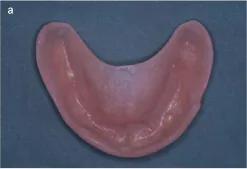
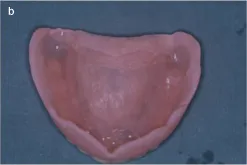
- Extend the denture base to cover the entire denture-bearing area chairside using light-curing material such as Triad VLC. Figure 1a shows an inadequately extended denture and Figure 1b shows extension provided with autopolymerising polymethyl methacrylate (PMMA) resin.
- If the the extension is satisfactory it can be relined either chairside or via the laboratory.
Stability
- Remove premature contacts and establish balanced occlusion. Premature contacts are easily removed chairside; establishing a balanced occlusion may require a check-record procedure on an articulator.
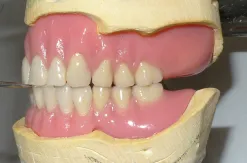
- Decrease the occlusal table by removing the most posterior teeth. This will help in several ways. First, there are fewer tooth contacts to establish, making the dentures easier to adjust. Second, there is less risk of the masticatory contacts being over the slope of the alveolar, which may be acting to dislodge the denture. As shown in Figure 2, leaving off the last molars that would be placed over the sloping parts of the lower ridges will improve stability. Finally, the contacts are further away from the condyles, which allows a greater tolerance when adjusting contacts (i.e. less accuracy is required).
Function
- Increase the vertical dimension on existing dentures. This may serve two purposes. First, it may allow muscles to relax and t...