![]()
1
Adverse Drug Reactions: History, Terminology, Classification, Causality, Frequency, Preventability
Jeffrey K. Aronson
1.1 Introduction
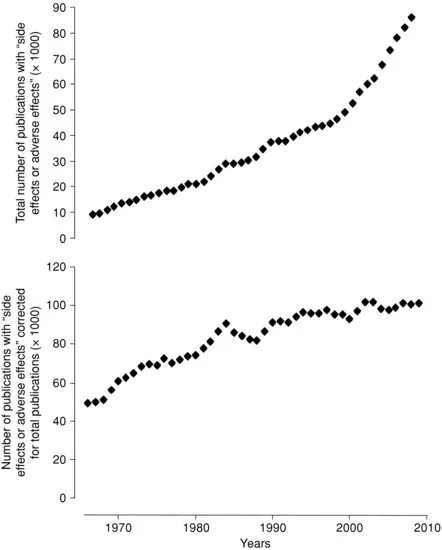
No therapy that is effective is free of adverse effects. The detection of adverse effects of drugs and adverse reactions to drugs and other therapeutic interventions, the scientific basis of which has been delineated since the 1960s is more important than ever before, as therapy becomes increasingly complex and is used in increasingly ageing populations. Figure 1.1 shows the increase in the numbers of publications, culled from Pubmed, that have contained the terms “side effects” or “adverse effects” since 1965. There has been a steady increase in the number of publications from year to year, and the rate of increase has grown since the start of this century and shows no signs of abating (top panel); in the years before 1985–90 the rate of increase even outpaced the rate of increase in the total number of papers published (lower panel).
1.2 Defining pharmacovigilance
The term “pharmacovigilance” first appeared in French in the late 1960s, when the terms “pharmacovigilance intensive” and “pharmacovigilance spontanée” were contrasted [1].
Pharmacovigilance has been defined by the World Health Organization (WHO) as “the science and activities relating to the detection, assessment, understanding and prevention of adverse effects or any other possible drug-related problems” [2]. Its scope includes not only the small molecules that are found in traditional medicinal products, but also biologics, vaccines and other cellular products, blood products, herbal medicines, traditional and complementary medicines, and medical devices.
In a directive of the then European Economic Community (EEC) a pharmacovigilance system was defined as “a system [that is] used to collect information useful in the surveillance of medicinal products, with particular reference to adverse reactions in human beings, and to evaluate such information scientifically” [3]. The directive specified that the purpose of such systems is “to ensure the adoption of appropriate regulatory decisions concerning the medicinal products authorized within the Community, having regard to information obtained about adverse reactions to medicinal products under normal conditions of use” (implying postmarketing surveillance) and that “such information shall be collated with data on consumption of medicinal products”. An amendment to this directive, published in 2000, specified that “[the] system shall also take into account any available information on misuse and abuse of medicinal products which may have an impact on the evaluation of their benefits and risks” [4].
Pharmacovigilance has in the past been regarded as being synonymous with postmarketing surveillance for adverse drug reactions. For example, it has been defined as “the study of the safety of marketed drugs under the practical conditions of clinical usage in large populations” [5] and “the process of evaluating and improving the safety of marketed products” [6]. However, it is now recognized that pharmacovigilance goes further than that, since it also includes premarketing surveillance [7], and this facet has been specifically incorporated in another definition, which states that pharmacovigilance “involves the monitoring, detection, evaluation and responding to drug safety hazards in humans during premarketing development and post marketing” [8].
The aims of pharmacovigilance are:
- the identification and quantification of previously unrecognized adverse effects and reactions;
- the identification of subgroups of patients at particular risk of adverse reactions;
- the continued surveillance of a product throughout the duration of its use, to ensure that the balance of its benefits and harms are and remain acceptable;
- the description of the comparative adverse reactions profile of products within the same therapeutic class;
- the detection of inappropriate prescription and administration;
- the further elucidation of a product's pharmacological and toxicological properties and the mechanism(s) by which it produces adverse effects;
- the detection of clinically important drug–drug, drug–herb/herbal medicine, drug–food, and drug–device interactions;
- the communication of appropriate information to health-care professionals;
- the confirmation or refutation of false-positive signals that arise, whether in the professional or lay media, or from spontaneous reports.
1.3 The modern history of pharmacovigilance
Physicians have been aware that medicines can have unwanted effects since they first started using them therapeutically, and before that recognized the poisonous effects of many other substances; for a detailed account of the history of early developments see [9]. The modern history of the development of pharmacovigilance can be considered to have begun with the German toxicologist Louis Lewin, who published the first book devoted entirely to adverse drug effects in 1881, Die Nebenwirkungen der Arzneimittel [10]. Three subsequent editions appeared in 1893, 1899, and 1909. In 1883 a translation of the first edition in cumbersome English appeared in a so-called “second edition” as The Untoward Effects of Drugs, translated by J J Mulheron, Professor of the Principles of Medicine, Materia Medica, and Therapeutics in the Michigan College of Medicine in Detroit [11].
Also in the 1880s, UK doctors, supported by Ernest Hart, editor of the British Medical Journal, started to campaign against the marketing of patent medicines that contained useless or toxic ingredients, but the Patent Medicine Bill of 1884, which sought to control them, failed because of pressure from the Society of Chemists and Druggists. However, the campaign continued. In America, concern about adulterated and misbranded foods and drugs at the start of the twentieth century culminated in the publication of 11 articles by Samuel Hopkins Adams in Collier's Weekly in 1905, titled “The Great American Fraud,” in which he exposed many of the false claims made about patent medicines. This led directly to the 1906 Pure Food and Drugs Act, which established the forerunner of the Food and Drug Administration (FDA) [12].
The British Medical Association, likewise concerned, started to publish a series of articles in the British Medical Journal in 1905 under the general title “The Composition of Certain Secret Remedies”, dealing with drugs used to treat epilepsy, headache, kidney diseases, and other conditions. In 1906 it started to reprint similar articles from the Deutsche Medizinische Wochenschrift. These articles were then published in a volume titled Secret Remedies in 1909; a second volume appeared in 1912, after the first had sold 62 000 copies [13]. In 1915 the Medical Research Committee (later to become the Medical Research Council), which was established in 1913, called for prescribers to report “therapeutic efficacy and the presence or absence of special incidental symptoms” in relation to formulations of salvarsan [14].
Also in 1915, Otto Seifert published his textbook on adverse drug effects, Die Nebenwirkungen der modernen Arzneimittel [15], a 278-page volum...