- It compiles the most comprehensive and up-to-date treatment available of Eliot's work and career
- It explores the powerful forces that shaped Eliot as a writer and thinker, analyzing his body of work and assessing his oeuvre in a variety of contexts: historical, cultural, social, and philosophical
- It charts the surge in critical interest in T.S. Eliot since the early 1990s
- It provides an illuminating insight into a poet, writer, and critic who continues to define the literary landscape of the last century
- English
- ePUB (mobile friendly)
- Available on iOS & Android
eBook - ePub
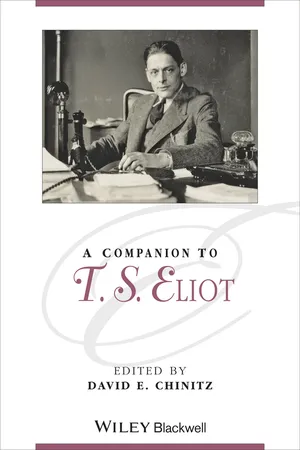
A Companion to T. S. Eliot
About this book
Reflecting the surge of critical interest in Eliot renewed in recent years, A Companion to T.S. Eliot introduces the 'new' Eliot to readers and educators by examining the full body of his works and career. Leading scholars in the field provide a fresh and fully comprehensive collection of contextual and critical essays on his life and achievement.
Information
Part I: Influences
1
The Poet and the Pressure Chamber: Eliot’s Life
Over the course of his long career, T. S. Eliot preferred to think about poetry not as the communication of ideas but as a means of emotional relief for the artist, a momentary release of psychological pressure, a balm for the agitated imagination. In 1919, he called poetic composition an “escape from emotion”; in 1953, a “relief from acute discomfort” (SE 10; OPP 98). At first, poetry alleviated for him the mundane pressures of a bank clerk who lived hand-to-mouth, caring for his sick wife during the day and writing for the Times Literary Supplement at night; later, it lightened the spiritual pressures of a holy man in a desert of solitude with the devils conniving at his back. Most frequently, though, it eased the pressure of an artist doubting his talent, an acclaimed poet who wrote more criticism than poetry, ever fearful that the fickle Muse had permanently left him. The most intensely creative stages of Eliot’s life often coincided with the periods in which he faced the most intense personal disturbances and upheavals.
But where do we, as students of Eliot, begin to account for that pressure? “The pressure,” as he himself called it, “under which the fusion takes place” and from which the work of art emerges (SE 8)? We could begin with the bare facts. Eliot was the youngest of seven children, born on September 26, 1888 in St. Louis, Missouri. His family traced its roots to the early colonies in New England, and his grandfather, a Unitarian minister, moved the family from Boston to St. Louis in 1834 and founded the Church of the Messiah, the first Unitarian church west of the Mississippi. Eliot’s father, Henry Ware Eliot, chose to diverge from his own father’s footsteps in the ministry and pursued a career as president of the Hydraulic-Press Brick Company, while his mother, Charlotte Champe Eliot (a teacher, social worker, and writer) introduced the children to art and culture. But where among these facts, which are barely even “memories draped by the beneficent spider,” does the author of The Waste Land begin to emerge (CPP 49)?
Maybe it’s better to begin in two places at once. For 14 years while Eliot was young, his family divided its time between St. Louis and coastal New England, spending summers near Gloucester, a deep-sea fishing port in Massachusetts where his father eventually built a summer cottage. The yellow fog that winds through “Prufrock” and the brown river-god of “The Dry Salvages” both reflect the time he spent as a boy in the industrialized city of St. Louis. The urban imagery of his early poems, he admitted much later, “was that of St. Louis, upon which that of Paris and London have been superimposed” (“Influence” 422). The peaceful sailing scenes and serene coastal imagery of poems like “Marina” and Ash-Wednesday, on the other hand, arise from his summers in Gloucester, where he learned to sail with his brother. This is where the pressures of Eliot’s creative life seem to begin: somewhere between the hard, claustrophobic inwardness of the city and the open, romantic expanses of the New England shores.
Boston and the Mind of Europe, 1906–1915
Eliot attended private academies as a young man – Smith Academy in St. Louis and then Milton, just south of Boston – before entering Harvard in 1906. Though a lackluster student at first, he joined the editorial board of the Harvard literary magazine, the Advocate, and became increasingly fascinated with literature and philosophy. After three years he went on to pursue graduate work in philosophy, apprenticing himself to influential American intellectuals at Harvard. Josiah Royce, Irving Babbitt, and George Santayana were all among the renowned professors who offered the young student not only footholds in the Western intellectual tradition but also invaluable models of the kind of public intellectual he would eventually strive to become.
Every writer feels the need to tell a conversion narrative, a story that distinguishes “the bundle of accident and incoherence that sits down to breakfast” (in W. B. Yeats’s words) from the artist he or she has become. Eliot was fortunate enough to have two: one literary, the other, religious. The first revolves around a fortuitous discovery at Harvard in December 1908, when he apparently stumbled upon a copy of Arthur Symons’s slim introduction to the nineteenth-century French literary tradition, The Symbolist Movement in Literature (1899), a book that profoundly changed the direction of Eliot’s creative energies. Before then he had read the odes of Keats and Shelley and the dramatic monologues of Browning and Tennyson, and he had imitated the amalgam of violent spiritual energy and demotic speech that he found in late Victorian English poets like John Davidson and Lionel Johnson. He showed a growing interest in Elizabethan drama and a love for Dante’s Commedia, which he learned to read in the original Italian and which remained an imaginative touchstone throughout his career. Under Symons’s influence, however, Eliot’s attention veered toward more recent French poets like Jules Laforgue and Charles Baudelaire, whose laconic wit, ironic pose, and fascination with urban landscapes helped him develop a wry, detached idiom to match his growing interest in philosophical skepticism.
Second in importance only to Symons’s book in Eliot’s early education were his courses with Irving Babbitt, the Harvard professor with whom he was to share a lifelong intellectual kinship. Babbitt’s mistrust of emotional excess and individualism turned Eliot against the romantic literary tradition and toward classicism, which espoused the need for limitations and discipline to curb the natural human appetites and inclinations. The opposition between romanticism and classicism that Eliot encountered in Babbitt’s class deeply influenced his early criticism, especially once he found support for it a few years later in the forceful and uncompromising rhetoric of modernist poet and essayist T. E. Hulme, whose theories he likely first encountered in 1916. Hulme proposed a classicism based on original sin, the Christian doctrine that proposes human nature to be essentially flawed. This was a radically “new attitude of mind,” Eliot wrote when he reviewed Hulme’s Speculations in 1924, and it “should be the twentieth-century mind, if the twentieth century is to have a mind of its own” (“C [Apr. 1924]” 231).
From 1910 to 1911 Eliot spent a crucial year in Paris, studying at the Sorbonne and attending lectures by the well-known, provocative French philosopher Henri Bergson at the Collège de France. In the world of contemporary art and philosophy, he later reflected, “the predominance of Paris was incontestable” (“C [Apr. 1934]” 451). He studied French with novelist Alain-Fournier, plunged into the chilling fiction of Dostoevsky in translation, and wrote poetry that drew from his reading in the social realism of Charles-Louis Philippe (especially Bubu de Montparnasse) and the psychological realism of Henry James (as in Portrait of a Lady). He also met and nurtured a close friendship with a fellow lodger in his Paris pension, Jean Jules Verdenal, whose death in World War I Eliot later memorialized in the dedication to his first book.
Eliot returned to Harvard in 1911 to begin a PhD in philosophy. He undertook an intense study of Eastern literary and philosophical traditions, studied primitive myth and ritual with Josiah Royce, and took a class with Bertrand Russell, a prominent British philosopher visiting at Harvard, whose skepticism and intellectual precision he admired. He began his dissertation and, in the following year, accepted a fellowship to study abroad, first at Marburg University in Germany, then at Merton College, Oxford, where he was to work one-on-one with a prominent expert on the philosophy of F. H. Bradley. Soon after he arrived in Europe, however, Germany declared war, compelling the young American to interrupt his studies and head for England early. The change of plans proved immensely fortunate.
A far more important galvanizing agent than any of the professors he encountered at Oxford was the gregarious American expatriate and avant-garde poet Ezra Pound, whom he met just before classes began in September 1914. Pound had been energetically making his presence known in London’s literary circles for six years by the time the two met, and he immediately brought Eliot under his wing. His judicious eye for the most experimental, provocative literary talent soon fell upon Eliot’s early poem, “The Love Song of J. Alfred Prufrock,” which he promptly sent to the prominent Chicago literary magazine, Poetry. “This is as good as anything I’ve ever seen,” Pound told his new protégé (Hall 263). To Eliot, he offered the guidance and unflagging encouragement that the young poet sorely needed; to others, he sang Eliot’s praises tirelessly.
Friends from this period describe Eliot as grave, bookish, and reticent – one unforgivingly labeled him “the Undertaker” – and this side of his personality does resemble the brooding, cynical personae of his early poems (Gordon 139). But we now know that Eliot was also a great lover of popular culture, and his imagination drew as much from forms of “low” culture like contemporary slang and popular music as from conventionally “high” forms like classical poetry, philosophy, and opera. In London he frequented popular locales like the Old Oxford Music Hall, where he admired the outlandish comedians’ “savage humor” and the self-assured bravado of their performances. In Eliot’s eyes, “lowbrow” entertainment was an art with explosive potential for institutional change.
Eliot’s temporary academic sojourn in Europe soon began to assume the look of permanence. The atmosphere at Oxford was stifling, he told his long-time friend Conrad Aiken, and in the midst of seeking release elsewhere he met Vivien Haigh-Wood, a spirited, adventurous, and artistic young woman six months older than he. They were married in June 1915, only a few months after their first meeting, and within the same few months, his early poems – including “Prufrock,” “Rhapsody on a Windy Night,” and “Portrait of a Lady” – began to emerge in print. Eliot returned to America in 1915 to tell his family the unexpected news – not only of his marriage but also of his decision to abandon a promising academic career for the capricious whims of the literary life.
Toward The Waste Land, 1916–1921
Eliot’s return from America marked the beginning of a low, dark period of his life. He soon learned of Vivien’s lifelong battles with chronic physical and mental illness. His new wife could be vibrant and wildly creative, but she was also prey to nervous collapses, bouts of migraine and exhaustion, prescription-drug addictions, even suicide attempts, all of which grew increasingly severe. Exhausted physically and intellectually from caring for her and teaching a number of ill-paid, evening extension classes (for “continuing education” students, as we would call them), Eliot himself began to sink into depression and physical enervation. His mentor Bertrand Russell, the philosopher whom he met at Harvard and caricatured in “Mr. Apollinax,” had returned to Cambridge and befriended the struggling couple soon after their marriage. When he learned of their financial worries, he offered them a room in his London flat, where in the coming months the notorious womanizer began a sexual affair with Vivien that would continue for four years. Eliot’s discovery of it, likely sometime in 1917, was crushing. It was a double betrayal – by his new wife and his trusted teacher, who treated Eliot “as if he were my son” (Bell 313) – and it exacerbated the disgust and revulsion toward sex and the spirit of savage, biting satire that together pervade the poems composed during this period.
Eliot took a position in the Colonial and Foreign Department at Lloyds Bank, then the second largest bank in England, in March 1917 in the hopes of gaining a degree of economic stability. In addition to continuing his evening lectures, he oversaw the publication of his first book, Prufrock and Other Observations (1917), and assumed an assistant editorship at The Egoist, an avant-garde literary magazine. He worked late into the evenings composing dozens of iconoclastic reviews and essays that aimed at revolutionizing the Victorian and Georgian ideals of artistic decorum and propriety that still dominated the literary establishment. The contentious and authoritative tone of these essays reflects the young American’s desire to break into the “safe” (as he put it) of the insular London literary world (Letters 392). Through his connections ...
Table of contents
- Cover
- Blackwell Companions to Literature and Culture
- Title page
- Copyright page
- Notes on Contributors
- Preface
- Acknowledgments to Sources
- Abbreviations Used for Works by T. S. Eliot
- Part I: Influences
- Part II: Works
- Part III: Contexts
- Bibliography of Works by T. S. Eliot
- Index
Trusted by 375,005 students
Access to over 1.5 million titles for a fair monthly price.
Study more efficiently using our study tools.
Frequently asked questions
Yes, you can cancel anytime from the Subscription tab in your account settings on the Perlego website. Your subscription will stay active until the end of your current billing period. Learn how to cancel your subscription
No, books cannot be downloaded as external files, such as PDFs, for use outside of Perlego. However, you can download books within the Perlego app for offline reading on mobile or tablet. Learn how to download books offline
Perlego offers two plans: Essential and Complete
- Essential is ideal for learners and professionals who enjoy exploring a wide range of subjects. Access the Essential Library with 800,000+ trusted titles and best-sellers across business, personal growth, and the humanities. Includes unlimited reading time and Standard Read Aloud voice.
- Complete: Perfect for advanced learners and researchers needing full, unrestricted access. Unlock 1.5M+ books across hundreds of subjects, including academic and specialized titles. The Complete Plan also includes advanced features like Premium Read Aloud and Research Assistant.
We are an online textbook subscription service, where you can get access to an entire online library for less than the price of a single book per month. With over 1.5 million books across 990+ topics, we’ve got you covered! Learn about our mission
Look out for the read-aloud symbol on your next book to see if you can listen to it. The read-aloud tool reads text aloud for you, highlighting the text as it is being read. You can pause it, speed it up and slow it down. Learn more about Read Aloud
Yes! You can use the Perlego app on both iOS and Android devices to read anytime, anywhere — even offline. Perfect for commutes or when you’re on the go.
Please note we cannot support devices running on iOS 13 and Android 7 or earlier. Learn more about using the app
Please note we cannot support devices running on iOS 13 and Android 7 or earlier. Learn more about using the app
Yes, you can access A Companion to T. S. Eliot by David E. Chinitz in PDF and/or ePUB format, as well as other popular books in Literature & Literary Criticism in Poetry. We have over 1.5 million books available in our catalogue for you to explore.