This second edition of a very successful book is thoroughly updated with existing chapters completely rewritten while the content has more than doubled from 16 to 36 chapters. As with the first edition, the focus is on industrial pharmaceutical research, written by a team of industry experts from around the world, while quality and safety management, drug approval and regulation, patenting issues, and biotechnology fundamentals are also covered. In addition, this new edition now not only includes biotech drug development but also the use of biopharmaceuticals in diagnostics and vaccinations.
With a foreword by Robert Langer, Kenneth J Germeshausen Professor of Chemical and Biomedical Engineering at MIT and member of the National Academy of Engineering and the National Academy of Sciences.
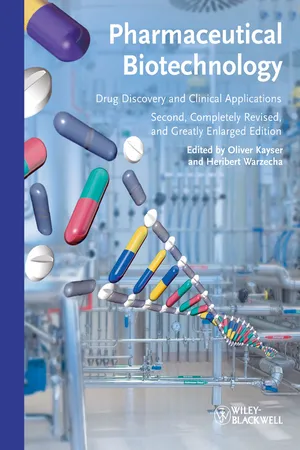
eBook - ePub
Pharmaceutical Biotechnology
Drug Discovery and Clinical Applications
- English
- ePUB (mobile friendly)
- Available on iOS & Android
eBook - ePub
Pharmaceutical Biotechnology
Drug Discovery and Clinical Applications
About this book
Information
Part One
Concepts and Methods for Recombinant Drug Production
Concepts and Methods for Recombinant Drug Production
1
Pharmaceutical Biotechnology and Industrial Applications – Learning Lessons from Molecular Biology
1.1 Introduction
To date, biotechnology has produced more than 200 new therapies and vaccines, including products to treat cancer, diabetes, HIV/AIDS, and autoimmune disorders. There are more than 400 biotech drug products and vaccines currently in clinical trials, targeting more than 200 diseases, including various cancers, Alzheimer’s disease, heart disease, diabetes, multiple sclerosis, AIDS, and arthritis. These few figures demonstrate the importance of biotechnological methods and techniques, which are increasingly dominating the process of drug research and development [1].
An average approval of 10–15 products a year indicates that pharmaceutical biotechnology is a highly active sector. Amongst these, the number of genuinely new biopharmaceuticals is around 40%, indicating the high innovative character of research; some of these products are likely to be future blockbusters (Table 1.1). Examples are monoclonal antibody-based products such as Rituximab (Rituxan®/MabThera®) for the treatment of cancer with $18 billion in sales in 2009, insulin and insulin analogues ($13.3 billion/2009), and finally erythropoietin-based products ($9.5 billion/2009). The global market is growing by 7% per year for protein-based therapeutics and among all blockbuster drugs only one is a classical low molecular drug, the other four top selling drugs (Table 1.2) are derived from the biotechnology sector [3]. In addition to new drug entities (NDE), biosimilars or follow-up-biologicals will continue to increase in market value; this is the focus of Chapter 13. This trend is supported by new or adapted approved routes from the regulatory bodies such as the EMA (European Medicines Agency) and the FDA (Food and Drug Administration) (see Chapter 11).
Table 1.1 Classification of recombinant proteins for human use
(according to [1]).
| Category | Product |
| Genuinely new biopharmaceuticals | Actemra®/Roactrema®, Arcalyst®, Arzerra®, Atryn®, Cervarix®, Cimzia®, Elaprase®, Elonva®, Gardasil®/Silgard®, Ilaris®, Kalbitor®, Lucentis®, Myozyme®, Nplate®, Preotach®, Prolia®, Provenge®, Recothrom®, Removab®, Scintimun®, Simponi®, Soliris®, Stelara®, Vectibix®, Victoza® |
| Biosimilars | Abseamed®, Binocrit®, Biogastrim®, Epoetin-α-heaxal (Erythropoetin)®, Filgastrim hexal®, Filgrastim ratiopharm®, Nivestim®, Omnitrope®, Ratiogastrim®, Valtropin®, Zarzio® |
| Reformulated me-too and related | Accretropin®, Biopin®, Eporatio®, Extavia®, Exubera®a), Fertavid®, Lumizyme®, Mircera®, Novolog mix®, PEGintron/ribetol combo®, Pergoveris®, Opgenra®, Vpriv®, Xyntha® |
| Previously approved elsewhere | Increlex®, Macugen®, Naglazyme®, Orencia®, Tysabri® |
a) No longer available.
Table 1.2 The ten top selling recombinant proteins for human use in 2010
(source: LaMerie Business Intelligence, Barcelona [2]).
| Product | Sales value (US$ billions) | Company |
| Enbrel®, Etanercept | 6.58 | Amgen, Wyeth, Takeda Pharmaceuticals |
| Remicade®, Infliximab | 5.93 | Centocor, Schering-Plow, Mitsubishi Tanabe Pharma |
| Avastin®, Bevacizumad | 5.77 | Genentech, Roche, Chugai |
| Rituxan®, Rituximab | 5.65 | Genentech, Biogen-IDEC, Roche |
| Humira®, Adalimumab | 5.48 | Abott, Eisai |
| Epogen®/Procrit®/Eprex®/EPO®, Etopoetin alpha | 5.03 | Amgen, Ortho, Janssen-Cilag, Kyowa, Hakko Kirin |
| Herceptin®, Trastuzumab | 4.89 | Genentech, Chiguai, Roche |
| Lantus®, Insulin glargine | 4.18 | Sanofi-Aventis |
| Neulasta®, Pegfilgastrim | 3.35 | Amgen |
| Aranesp®/Nespo®, Darbepoetin alfa | 2.65 | Amgen, Kyowa, Hakko Kirin |
Established molecular biology techniques for protein engineering, such as phage display, construction of fusion proteins or synthetic gene design, have matured to the level where they can be transferred to industrial applications in recombinant protein design. Traditional engineering has focused on the protein backbone, while modern approaches take the complete molecule into account. We want to discuss recent advances in molecular engineering strategies that are now paying off with respect to engineered proteins with improved pharmacokinetic and pharmacodynamic profiles, as reviewed in Chapter 14. In designing muteins, glycoengineering and post-translational modification with non-natural polymers such as polyethylenglycol (PEG) have affected around 80% of approved protein therapeutics [1].
1.2 Research Developments
1.2.1 Protein Engineering
The term protein engineering refers to the controlled and site specific alteration of a gene sequence encoding the transcription to a polypeptide to a mutated protein with introduced changes in the amino acid sequence. In principle, deletions and insertions of one or more triplet codes and amino acids are possible, but mostly alteration of a protein sequence is limited to exchange of amino acids at calculated sites. Since the first experiments in molecular biology to obtain insights into diseases, protein engineering has been introduced successfully into drug development of recombinant proteins to improve pharmacodynamics and pharmacokinetic profiles [4]. At the biotechnology level, tailoring of proteins has been documented for commercially relevant proteins such as insulin, erythropoietin, growth hormones, and various antibodies. Today the important objectives for protein engineering are:
- improving the pharmcodynamic profile to obtain a drug that acts faster or slower;
- alteration of the pharmacological half-life and development of controlled release kinetics;
- alteration of receptor binding specificity;
- reducing the immunogenicity of the protein;
- increasing physical and chemical protein shelf half-life.
From the 25 genuine new biological entities (NBEs) approved in Europe and the USA until 2009, 17 proteins have already been engineered. The dominant group are antibodies (11), and of these six are fully human, and one is bispecific (Revomab®); out of 25 drugs 17, or in other words around 70%, are modified from a total number of 25 NBEs, and four are humanized antibodies. Among the 25 products, two are fusion proteins (rilonacept, Arcalyst and romiplostim, Nplate). Romiplostin is a so-called peptibody consisting of the Fc fragment of the human antibody IgG1 and the ligand-binding domains of the extracellular portions of the human interleukin-1 receptor component (IL-1RI). It is used for the treatment of Familial Cold Auto-inflammatory Syndrome (FCAS) or Muckle-Wells Syndrome (MWS). Interestingly the functional domain consists of peptide fragments designed by protein modeling to bind highly specifically on the thrombopoetin receptor.
1.2.2 Muteins
Based on the genetic code, a significant number of proteins, which have been approved for clinical use, are subjected to directed change and amino acid substitution to improve the pharmacokinetic and pharmacodynamic activity, and also to develop antagonist functionality. These derived proteins with site directed mutations are called “muteins” and show interesting pharmacological features, which is why a bright future is in prospect. As in classical recombinant biotechnology, insulin was the first candidate with site directed mutations. Insulin lispro was approved in May 1996 as the first mutein, and only a few months later, in November 1996, Reteplase was also approved as a tissue plasminogen activation factor. The number of muteins has since increased significantly and is now dominated by recombinant antibodies. Briefly we want to discuss the potential of muteins for analogs of insulin, tissue plasminogen activator (tPA), and humanized antibodies.
Native insulin associates from dimers up to hexamers at high local concentrations are what are usually found at the site of injection, leading to retarded dissolution and activity in the body. As a result of structure elucidation, proline and lysine at positions 28 and 29, respectively, in the B chain were identified to play a crucial role and were therefore subjected to site directed mutagenesis. Switching B28 and B29 of proline and lysine reduced the association affinity 300-fold, resulting in faster uptake and action, as well as shorter half-life [5]. In contrast, to increase the time of action towards a retarded drug delivery profile, the same concept of site-directed mutation was also applied. Insulin glargin (Lantus®) is a mutein where in the A chain A21 glycine is introduced instead of asparagine, and in the B chain two more ariginines are added at the C-terminal end [6]. As a physicochemical consequence, the isoelectric point is shifted towards the physiological pH at 7.4, resulting in precipitation and slow dissolution into the blood stream.
Tissue plasminogen activators (tPA) play an important role in the breakdown of blood clots. As with insulin, tPA is converted from plasminogen into plasmin, the active enzyme responsible for clot breakdown. tPA is manufactured by recombinant biotechnology, and is used extensively in clinics, but a disadvantage is fast elimination from the body. To overcome this problem a deletion mutant was constructed to reduce binding of the protein at hepatocytes via the EGF-domain (epidermal growth factor) encoded by an amino acid sequence starting from position 4 to 175. The remaining 357 of the 527 amino acids in Reteplase (Retavase®, Rapilysin®) showed increased half-lives of 13–16 min and, interestingly, increased fivefold activity [5, 7]. The historic development with a brief outline of the near future, for example, non-invasive delivery systems, has been described well by Heller et al. [8].
The beauty of antibodies can be addressed through the ability of binding to highly specific surface structures and a fairly uniform structure. Apart from vaccinations, antibodies were introduced early on in the therapy of neoplastic diseases and for the prevention of acute tissue rejection in patients with organ transplants. Muromonab CD3, with the tradename Orthoclone OKT3®, is an immunosuppressant monoclonal antibody that targets the CD3 receptor on the surface of T cells. It is approved to prevent acute rejection of renal transplants. As an adverse reaction, anti-mouse antibodies can be formed leading to reduced efficacy after repeated injection. To improve tolerance, chimera between mouse and humans were designed. From the protein sequence of the established murine antibodies, the genetic code was deciphered and substituted in the conserved Fc region by the respective human genetic code. These antibodies are called chimeric, in contrast to humanized antibodies where the framework regions are also substituted. Examples are Daclizumab, Zenapax (humanized) [9], Abciximab in ReoPro® (chimeric) [10], and Rituximab in Mabthera® (chimeric) [11] as antineoplastic antibodies for non-Hodgkin lymphoma.
1.2.3 Post-translational Engineering
Several approved recombinant therapeutic products are engineered post-biosynthesis. From the molecular biology background, post-translational engineering is associated with glycosylation or lipidation post-biosynthesis. Post-translational biosynthesis today is the covalent attachment of a chemical group, not a mandatory glycosylation, but attaching fatty acids or PEG-chains alteration of a pre-existing post-translational modification, and has been reviewed best by Walsh [9]. Novo Nordisk′s Victoza® (liraglutid) is an example of a non-insulin once-daily medication that may help improve blood sugar levels in adults with type II diabetes. It contains the glucagons-like peptide 1 (GLP-1) analog with 97% sequence homology and with an attached C16 fatty acid (N-ε-(γ-Glu[N-α-hexadecanoyl]) at Lys26 [10].
Glycosylation is the most complex and widespread form of post-translational modification. Glycoengineering therefore becomes of greater interest, and by directed and targeted alteration of the glycosylation pattern at the protein backbone, significant changes tof the pharmacokinetic profile can be enforced. Approximately 40% of the approved proteins are glycosylated and the use of mammalian cell lines is dominating the manufacturing process (e.g., Chinese hamster ovary (CHO) cells, baby hamster kidney (BHK) cells). A recent trend in engineering the glycocomponent is to also use plant systems (such as carrot cells for β-glucocerebrosidase) or Saccharomyces cerevisiae and Pichia pastoris. The production of the glucocerebrosidase analog imiglucerase (Cerezyme®) for the treatment of Morbus Gaucher has been carried out in CHO cells. Alternatively, recent interesting advances by the company Protalix showed that glucocerebrosidase for oral administration can be produced in the carrot cells (Daucus carota, Apiaceae) (Figure 1...
Table of contents
- Cover
- Related Titles
- Title page
- Copyright page
- Preface to the 2nd Edition
- List of Contributors
- Part One: Concepts and Methods for Recombinant Drug Production
- Part Two: Bringing the Drug into Action – From Downstreaming to Approval
- Part Three: Vaccines
- Part Four: Recent Applications in Pharmaceutical Biotechnology
- Index
Trusted by 375,005 students
Access to over 1.5 million titles for a fair monthly price.
Study more efficiently using our study tools.
Frequently asked questions
Yes, you can cancel anytime from the Subscription tab in your account settings on the Perlego website. Your subscription will stay active until the end of your current billing period. Learn how to cancel your subscription
No, books cannot be downloaded as external files, such as PDFs, for use outside of Perlego. However, you can download books within the Perlego app for offline reading on mobile or tablet. Learn how to download books offline
Perlego offers two plans: Essential and Complete
- Essential is ideal for learners and professionals who enjoy exploring a wide range of subjects. Access the Essential Library with 800,000+ trusted titles and best-sellers across business, personal growth, and the humanities. Includes unlimited reading time and Standard Read Aloud voice.
- Complete: Perfect for advanced learners and researchers needing full, unrestricted access. Unlock 1.5M+ books across hundreds of subjects, including academic and specialized titles. The Complete Plan also includes advanced features like Premium Read Aloud and Research Assistant.
We are an online textbook subscription service, where you can get access to an entire online library for less than the price of a single book per month. With over 1.5 million books across 990+ topics, we’ve got you covered! Learn about our mission
Look out for the read-aloud symbol on your next book to see if you can listen to it. The read-aloud tool reads text aloud for you, highlighting the text as it is being read. You can pause it, speed it up and slow it down. Learn more about Read Aloud
Yes! You can use the Perlego app on both iOS and Android devices to read anytime, anywhere — even offline. Perfect for commutes or when you’re on the go.
Please note we cannot support devices running on iOS 13 and Android 7 or earlier. Learn more about using the app
Please note we cannot support devices running on iOS 13 and Android 7 or earlier. Learn more about using the app
Yes, you can access Pharmaceutical Biotechnology by Oliver Kayser,Heribert Warzecha in PDF and/or ePUB format, as well as other popular books in Biological Sciences & Biotechnology. We have over 1.5 million books available in our catalogue for you to explore.