- Presents descriptions of most common forms of developmental and intellectual disorders
- Provides practical methods of caring for patients with these disabilities, including how to guide and model behavior
- Offers practice management tips to accommodate patients with special needs, particularly those with autism
- Includes instructions to give caregivers for home oral therapy
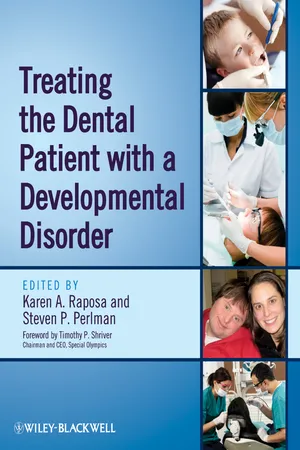
eBook - ePub
Treating the Dental Patient with a Developmental Disorder
- English
- ePUB (mobile friendly)
- Available on iOS & Android
eBook - ePub
Treating the Dental Patient with a Developmental Disorder
About this book
Treating the Dental Patient with a Developmental Disorder provides a basic understanding of patients with developmental and intellectual disorders and offers help in communicating with and treating with developmental disabilities, including autism spectrum disorders, Down Syndrome, attention deficit, cerebral palsy, spina bifida, learning disabilities, and others.
Information
1
Overview: defining developmental disorders
H. Barry Waldman, DDS, MPH, PhD and
Steven P. Perlman, DDS, MScD, DHL (Hon)
Steven P. Perlman, DDS, MScD, DHL (Hon)
It was not that long ago when children with developmental disabilities and adults with a range of disorders did not exist. We never saw them in our schools, movies, or communities. President Roosevelt may have had an attack of poliomyelitis, but everyone knew he had no problem standing and walking. At least it all seemed that way.
It took a long time to find out that tens of millions of youngsters and the not so young with a vast range of disabilities were concealed out of sight in institutions or in family homes. Somehow it was disgraceful, shameful, embarrassing, and a reflection on other family members to have a relative with some type of developmental or intellectual disability—except maybe a 95-year-old great-grandmother. Only later did we find out that the press and just about everyone in Washington was involved in the cover-up to ensure that the president of the country did not appear weak during the years of the Depression and World War II.
But that was the middle and the final decades of the twentieth century. In this second decade of the twenty-first century, we have learned that there are more than half a billion people in the world who are disabled as a consequence of mental, physical, and sensory impairment (United Nations 2010). “Disability is a complex phenomenon, reflecting an interaction between features of a person’s body and features of the society in which he or she lives” (World Health Organization 2008). In the United States, there are more than fifty million individuals with developmental disabilities, complex medical problems, significant physical limitations, and a vast array of other conditions under the rubric of “disabilities” who live in local communities; many as a result of deinstitutionalization and mainstreaming them into community housing, education, and employment (U.S. Census Bureau 2010a).
The U.S. Census Bureau reported for 2006, among the total population:
- 5 years and over—6.8% had one disability. 8.3% had two or more disabilities.
- Five–15 years—536,400 had a sensory disability, almost 500,000 had a physical disability, and 2.8 million had an intellectual disability.
- Adults—37 million had a hearing disability, 21 million had a vision disability, and 15 million had a physical functioning disability. Specifically for seniors, 14.6 million had one or more disabilities (U.S. Census Bureau 2010a).
Among the non-institutionalized U.S. population 5 years and older:
- A larger number of females than males had physical, mental, and self-care disabilities—particularly in the older years, reflecting the greater longevity of females.
- A larger number of males than females had sensory disabilities (Table 1.1).
The number of persons with disabilities is projected to increase dramatically as the population 65 years and over reaches 1 in 5 residents during the next 2 decades (U.S. Census Bureau 2010b, 2010c). Media reports abound with references to the increasing numbers of older individuals with disabilities and government efforts to control the potential costs to service their mounting needs. By contrast, attention to the costs for youngsters with disabilities generally is centered on supportive education programs. Health financial issues, particularly during the years when youngsters enter adulthood, tend to be underreported.
It is estimated that the lifetime costs for all people with intellectual disabilities who were born in the United States in 2000 will total $51.2 billion (in 2003 dollars). These costs include both direct and indirect costs. Direct medical costs, including physician visits, prescription drugs, and inpatient hospital stays, account for 14% of these costs. Direct nonmedical expenses, such as home modifications and special education, make up 10% of the costs. Indirect costs, which include the value of lost wages when a person dies early, cannot work, or is limited in the amount or type of work that can be done, make up 70% of costs. These estimates do not include expenses such as hospital outpatient visits, emergency room visits, residential care, and family out-of-pocket expenses. The actual economic costs of intellectual disabilities are, therefore, even higher (CDC 2010e). Specifically, the average per capita society lifetime cost for individuals with autism through 66 years of age is $3.1 million (Ganz 2007).
Table 1.1 Non-institutionalized U.S. residents (in thousands) with disabilities by gender and age: 2006 (U.S. Census Bureau 2010a).
| Male | Female | |
| Sensory disabilities: | ||
| 5–15 yrs | 292 | 229 |
| 16–20 | 155 | 126 |
| 21–64 | 2,926 | 2,215 |
| 65–74 | 1,028 | 835 |
| 75+ | 1,674 | 2,347 |
| Total | 6,075 | 5,752 |
| Physical disabilities: | ||
| 5–15 yrs | 289 | 218 |
| 16–20 | 172 | 179 |
| 21–64 | 6,346 | 7,433 |
| 65–74 | 1,828 | 2,515 |
| 75+ | 2,346 | 4,453 |
| Total | 10,981 | 14,798 |
| Mental disabilities: | ||
| 5–15 yrs | 1,529 | 758 |
Table of contents
- Cover
- Table of Contents
- Title
- Copyright
- Dedication
- Contributors
- Foreword
- Preface
- Introduction
- 1 Overview: defining developmental disorders
- 2 Patient/personal interview
- 3 Medical/developmental review/interview
- 4 Treatment considerations
- 5 Overall health
- 6 Treatment accommodations
- 7 The exam/hygiene appointment
- 8 Preventing oral health problems
- 9 Restorative appointments
- 10 Office-based sedation
- 11 Hospital dentistry/general anesthesia
- 12 Practice management tips
- 13 Improving oral health through community-based interventions
- 14 Long-term impact
- Epilogue
- Index
- End User License Agreement
Trusted by 375,005 students
Access to over 1.5 million titles for a fair monthly price.
Study more efficiently using our study tools.
Frequently asked questions
Yes, you can cancel anytime from the Subscription tab in your account settings on the Perlego website. Your subscription will stay active until the end of your current billing period. Learn how to cancel your subscription
No, books cannot be downloaded as external files, such as PDFs, for use outside of Perlego. However, you can download books within the Perlego app for offline reading on mobile or tablet. Learn how to download books offline
Perlego offers two plans: Essential and Complete
- Essential is ideal for learners and professionals who enjoy exploring a wide range of subjects. Access the Essential Library with 800,000+ trusted titles and best-sellers across business, personal growth, and the humanities. Includes unlimited reading time and Standard Read Aloud voice.
- Complete: Perfect for advanced learners and researchers needing full, unrestricted access. Unlock 1.5M+ books across hundreds of subjects, including academic and specialized titles. The Complete Plan also includes advanced features like Premium Read Aloud and Research Assistant.
We are an online textbook subscription service, where you can get access to an entire online library for less than the price of a single book per month. With over 1.5 million books across 990+ topics, we’ve got you covered! Learn about our mission
Look out for the read-aloud symbol on your next book to see if you can listen to it. The read-aloud tool reads text aloud for you, highlighting the text as it is being read. You can pause it, speed it up and slow it down. Learn more about Read Aloud
Yes! You can use the Perlego app on both iOS and Android devices to read anytime, anywhere — even offline. Perfect for commutes or when you’re on the go.
Please note we cannot support devices running on iOS 13 and Android 7 or earlier. Learn more about using the app
Please note we cannot support devices running on iOS 13 and Android 7 or earlier. Learn more about using the app
Yes, you can access Treating the Dental Patient with a Developmental Disorder by Karen A. Raposa, Steven P. Perlman, Karen A. Raposa,Steven P. Perlman in PDF and/or ePUB format, as well as other popular books in Medicine & Dentistry. We have over 1.5 million books available in our catalogue for you to explore.