•
Technical vs. Fundamental Analysis Fundamental analysts of stocks study the values of listed companies. In the futures markets they explore the supply-demand equations for commodities. Technicians, by contrast, believe that the sum of knowledge about any stock or future is reflected in its price. Technicians study chart patterns and indicators to determine whether bulls or bears are winning the current round of the trading battle. Needless to say, there is some overlap between the two methods. Serious fundamentalists look at charts, while serious technicians like to have some idea about the fundamentals of the market they are trading.
•
Trend vs. Counter-Trend Trading Almost every chart shows a mix of directional moves and choppy trading ranges. Powerful trends fascinate beginners: if you were to buy at a bottom, so clearly visible in the middle of the chart, and hold through the entire rally, you would make a ton of money. Experienced traders know that big trends, so clearly visible in the middle of a chart, become foggy near the right edge. Following a trend is like riding a wild horse that tries to shake you off at every turn. Trend trading is a lot harder than it seems.
One of the very few scientifically proven facts about the markets is that they oscillate. Markets continuously swing between overvalued and undervalued levels. Counter-trend traders capitalize on this choppiness by trading against the extremes.
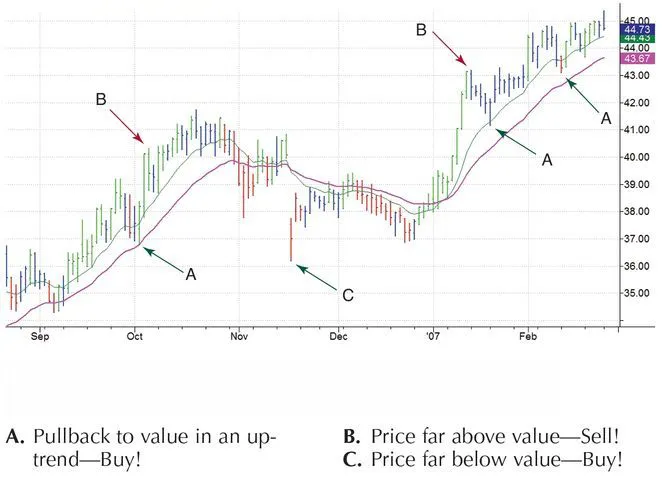
Take a look at the chart in Figure 1.1, and the arguments for and against trend or counter-trend trading will leap at you from the page. You can easily recognize an uptrend from the lower left to the upper right corner. It seems appealing to buy and hold—until you realize that a trend is clear only in retrospect. If you had a long position, you’d be wondering every day, if not every hour, whether this uptrend was at an end. Sitting tight requires a great deal of mental work!
Swing trading—buying below value and selling above value—has its own pluses and minuses. Trading shorter moves delivers thinner returns, but the trades tend to last just a few days. They require less patience and make you feel much more in control.
In his brilliant book Mechanical Trading Systems: Pairing Trader Psychology with Technical Analysis, Richard Weissman draws a clear distinction between three types of traders: trend-followers, mean-reversal (counter-trend) traders, and day-traders. They have different temperaments, exploit different opportunities, and face different challenges.
Most of us gravitate towards one of these trading styles without giving our decision much thought. It is much better to figure out who you are, what you like or dislike and trade accordingly.
•
Discretionary vs. Systematic Trading A discretionary trader looks at a chart, reads and interprets its signals, then makes a decision to buy or sell short. He monitors his chart and at some point recognizes an exit signal, then places an order to exit from his trade. Analyzing charts and making decisions is an exciting and engaging process for many of us.
Figure 1.1 Moving Averages Identify Value Daily chart of MW, 26-day and 13-day EMAs
The slow EMA (exponential moving average) rarely changes direction; its angle identifies the increase or the decrease of value. The faster EMA is more volatile. When prices dip into the zone between the two lines during an uptrend, they identify good buying opportunities. Prices are attached to values with a rubber band; you can see that prices almost always get only so far away from the EMA before they snap back. When a rubber band extends to the max, it warns you to expect a reversal of the latest move away from value.
A systematic trader cannot stand this degree of uncertainty. He does not want to keep making decisions every step of the way. He prefers to study historical data, design a system that would have performed well in the past, fine-tune it, and turn it on. Going forward, he lets his system track the market and generate buy and sell signals.
Systematic traders try to capitalize on repeating market patterns. The good ones know that while patterns repeat, they do not repeat perfectly. The most valuable quality of a good system is its robustness. We call a system robust when it continues to perform reasonably well even after market conditions change.
Both types of trading have a downside. The trouble with discretionary trading is that it seduces beginners into making impulsive decisions. On the other hand, a beginner attracted to systematic trading often falls into the sin of curve-fitting. He spends time polishing his backward-looking telescope until he has a system that would have worked perfectly in the past—if only the past repeated itself perfectly, which it almost never does.
I am attracted to the freedom of discretionary trading. I like to study broad indexes and industry groups and decide whether to trade from the long or short side. I work to establish entry and exit parameters, apply money management rules, determine the size of a trade, and finally place my order. There is a sense of thrill in monitoring the trade and making a decision to exit as planned, jump a little sooner, or hold a little longer.
The decision to be a discretionary or a systematic trader is rarely based on cost/benefit analysis. Most of us decide on the basis of our temperament. This is not different from deciding where to live, what education to pursue, and whether or whom to marry—we usually decide on the basis of emotion.
Paradoxically, at the top end of the performance scale there is a surprising degree of convergence between discretionary and systematic trading. A top-notch systematic trader keeps making what looks to me like discretionary decisions: when to activate System A, when to reduce funding of System B, when to add a new market or drop a market from the list. At the same time, a savvy discretionary trader has a number of firm rules that feel very systematic. For example, I will never enter a position against the ...