![]()
Part I
Define the Opportunity
Taking thousands of shots at an undefined target (unfocused ideation) won't result in an innovation goal. Yet, the very nature of innovation seems to imply that the target is hazy and disguised–but this is a myth. Those who know how to clear the haze will see that the front edge of innovation isn't as elusive as it may seem; it's only unreachable by those who don't know how to find it and bring it into focus for their own advantage.
This first phase of innovation enables you to bring the aims of organic growth into focus and create viable innovation opportunities. Use the Jobs to be Done (JTBD), Job Mapping, Outcome Expectations, and Value Quotient techniques to identify actionable innovation gaps, or high-potential innovation projects based on the identification of unmet customer needs and new market territory. Also, use the Ethnography technique to directly observe how customers struggle with existing solutions so you can understand their unarticulated needs.
Once you've defined your opportunity, you can scope and focus your innovation projects. The Scenario Planning technique will facilitate your thoughts about the future, so you put some stakes in the ground about the developments you expect to occur in your environment. The Heuristic Redefinition technique will help you do this by identifying all the elements of your current solution and how they relate to one another. The Nine Windows technique will do this as well, adding the dimensions of time and scale to your innovation problem. Then, Job Scoping is a simple but powerful technique for either narrowing or broadening your project's focus.
Also in Part I, we give you techniques to manage people, projects, and return on innovation investment. Specifically, the Stakeholder Management technique helps get all pertinent people lined up to support organic growth projects. The Cognitive Style technique ensures your team is staffed with the right people. The Project Charter technique is a living document used to keep the project on time and on task. And the Innovation Financial Management technique keeps you on the straight-and-narrow fiscal path,
![]()
Technique 1
Jobs to be Done
A job to be done (JTBD) is a revolutionary concept that guides you toward innovation and helps you move beyond the norm of only improving current solutions. A JTBD is not a product, service, or a specific solution; it's the higher purpose for which customers buy products, services, and solutions.
For instance, most people would say they buy a lawnmower to “cut the grass,” and this is true. But if a lawnmower company examines the higher purpose of cutting the grass, say, “keep the grass low and beautiful at all times,” then it might forgo some efforts to make better lawnmowers in lieu of developing a genetically engineered grass seed that never needs to be cut.
This is the power of the JTBD concept and technique: It helps the innovator understand that customers don't buy products and services; they hire various solutions at various times to get a wide array of jobs done. You may need light survey design and sampling help from a statistician to apply this technique, but for the most part, it requires no expert assistance.
Background
Harvard Business School professor Clayton Christensen and coauthors articulated the JTBD concept in a Sloan Management Review article (Spring 2007) as follows: “Most companies segment their markets by customer demographics or product characteristics and differentiate their offerings by adding features and functions. But the consumer has a different view of the marketplace. He simply has a job to be done and is seeking to ‘hire’ the best product or service to do it.”
Therefore, if you understand the jobs your customers want done, you gain new market insights and create viable growth strategies. Sometimes a good solution for a JTBD, or a family of JTBDs, does not exist; when this is the case, you have a great opportunity to innovate.
Jobs to be Done Breakdown
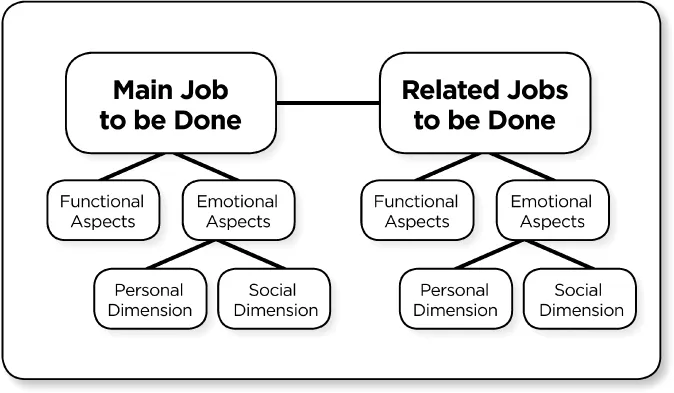
There are two different types of JTBDs:
1. Main jobs to be done, which describe the tasks that customers want to achieve.
2. Related jobs to be done, which customers want to accomplish in conjunction with the main jobs to be done.
Then, within each of these two types of JTBDs, there are:
- Functional job aspects—the practical and objective customer requirements.
- Emotional job aspects—the subjective customer requirements related to feelings and perceptions.
Finally, emotional job aspects are further broken down into:
- Personal dimension—how the customer feels about the solution.
- Social dimension—how the customer believes he or she is perceived by others while using the solution.
- See Exhibit 1.1 for a visual representation of the different types of jobs to be done and breakdown into aspects and dimensions.
Let's develop an example. Say the main JTBD is to clean one's teeth and gums. Then related jobs might be to create lasting fresh breath, whiten one's teeth, and even achieve such other grooming objectives as a clean face and/or neat eyebrows.
We can break the main and related JTBDs into their functional and emotional aspects. One wants to remove foreign particles from one's teeth, along with any bacteria and associated odor. These are some functional aspects of the JTBD. A customer also wants his or her teeth and gum cleaning experience to be pleasant. It should feel good, not painful. It should make the customer feel good about him- or herself (personal dimension), as well as help him or her be perceived as a person who has clean teeth, healthy gums, and fresh breath.
The better a solution can fulfill all of these job levels and layers, the better chance it has in the marketplace. Also, the better the solution either achieves or nicely dovetails with related JTBDs, the better chance of success it has. In short, the JTBD concept is a guide for thinking beyond to make your current solutions, and your competitors' solutions, obsolete.
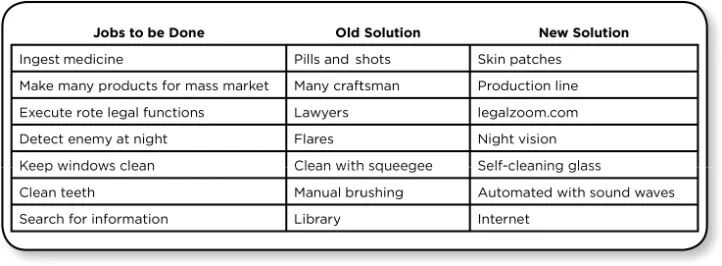
You can tell when a company thinks in terms of JTBDs because the result not only fulfills a need, but is often quite innovative. Consider the recent developments in self-cleaning glass for cars and high-rise buildings, or in car paint that heals itself and, thereby, removes the need to paint over scratches. While you could think of painting scratches as a JTBD, it really isn't. Painting scratches is actually a solution for accomplishing the JTBD called maintain a blemish-free vehicle.
Consider the examples of new solutions for old JTBDs in Exhibit 1.2. Then, ask not how you can make your current products and services better, but instead, ask how you can fulfill your customers' JTBDs in unexpected and more effective ways.
The Triune Brain
Metaphorically speaking, our brains have three parts as per the triune brain model: reptilian, emotional, and intellectual. The reptilian part is related to our basic survival and biological needs; we eat when we're hungry, and we either fight or flee when we are threatened. The emotional (or paleomammalian) part of our brain, directed by the limbic system, guides many or most decisions we make in life. The intellectual (or neomammalian) part, guided by the neocortex, is the logical, methodical, and analytical part of the brain.
Psychologists have discovered that when these three parts are in conflict, the reptilian takes precedent over the other two. When there is a conflict between the emotional and intellectual parts, the emotional part wins over. This is why people often make poor, emotionally based decisions, and then find an intellectual alibi to justify themselves.
So what is the implication for companies that want to innovate? One, make solutions that appeal to all three parts of the brain—especially the emotional and intellectual since only a small set of solutions are truly a matter of life or death (reptilian). Apple does a good job of this. Its products are functionally sound (intellectual)—plus, they're cool and stylish (emotional). Although we know one iPod user who returned the product six times due to functional challenges, the customer was willing to tolerate this because the product was so emotionally appealing.
But there's another interesting implication. If your industry is mainly focused on the functional aspects of the JTBD, then differentiate yourself with the emotional aspect. Make the surgical instrument look really cool with an appealing design and shape that fits the hand better. Or, start to emphasize the functional aspects of your products in industries that are typically driven by image and emotion. Many Body Shop products, for example, are organic (noncarcinogenic), and they improve the quality of one's skin (anti-aging properties)—blending function with emotion.
This is the story of innov...