eBook - ePub
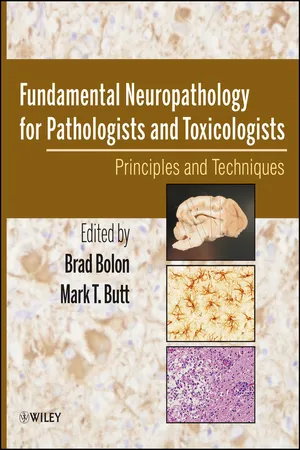
Fundamental Neuropathology for Pathologists and Toxicologists
Principles and Techniques
- English
- ePUB (mobile friendly)
- Available on iOS & Android
eBook - ePub
Fundamental Neuropathology for Pathologists and Toxicologists
Principles and Techniques
About this book
This book offers pathologists, toxicologists, other medical professionals, and students an introduction to the discipline and techniques of neuropathology – including chemical and environmental, biological, medical, and regulatory details important for performing an analysis of toxicant-induced neurodiseases. In addition to a section on fundamentals, the book provides detailed coverage of current practices (bioassays, molecular analysis, and nervous system pathology) and practical aspects (data interpretation, regulatory considerations, and tips for preparing reports).
Information
Part 1
Fundamentals of Neurobiology
Chapter 1
Fundamental Neuropathology for Pathologists and Toxicologists: An Introduction
The Importance of Neurotoxicological Research
Neurotoxicology is the study of the undesirable consequences that develop in the central nervous system (CNS) or peripheral nervous system (PNS) or both after an organism is exposed to a neurotoxic agent during development or adulthood. Such agents may be exogenous materials such as chemicals contaminating the external habitat (e.g., agrochemicals, pesticides, solvents) or introduced purposely into the internal environment (i.e., drugs); metals; or peptides/proteins (e.g., microbial toxins, biopharmaceuticals). Alternatively, neurotoxic agents may be produced endogenously (e.g., ammonia, unconjugated bilirubin) during the course of certain diseases. Thus, the nervous system is likely to experience constant exposure to a range of neurotoxic agents, although in many instances the level of exposure will be insignificant.
The potential scope of toxicant-induced neuropathology is immense. Each year in the United States, industries manufacture about 85,000 chemicals and register another 2000 to 3000 new compounds.1 Approximately 3 to 5% of chemicals (between 2500 and 5000 entities) are estimated to be neurotoxic to some degree.2 This estimate has serious implications for human, animal, and environmental health, because up to two-thirds of high-production-volume chemicals (those made yearly in quantities exceeding 1 million pounds) have never been tested sufficiently for neurotoxic potential.3 The recognition that neurological dysfunction is a major occupational hazard for adults4, 5 and a common congenital occurrence in children6 has engendered a wide-ranging global effort to identify and eliminate possible sources of neural damage—principally, sources of neurotoxicant exposure.
Neurotoxicity can present as aberrations in neural structure (i.e., toxicological neuropathology) or function (including altered behavior, biochemistry, cognition, or impulse conduction), or both.7–11 All structural changes and any persistent functional deficits associated with xenobiotic exposure are judged to be neurotoxic because such effects cannot be countered by the meager regenerative capabilities of the CNS.12 Reversible functional deficits linked to a recognized neurotoxicological mechanism (e.g., outright neurodegeneration or exaggerated neuropharmacological activity) or that might jeopardize occupational health (for adults) or scholastic performance (especially for children) are also considered to be neurotoxic manifestations. The current “best practice” in conducting risk assessments for potential neurotoxicants is to integrate all available structural and functional evidence in reaching a verdict.9, 13, 14 Nevertheless, the permanence of toxicant-induced structural changes in the CNS typically leads regulators to place more emphasis on morphological data rather than on behavioral or biochemical alterations to determine reference doses for managing neurotoxic risk.15 Therefore, a comprehensive toxicological neuropathology evaluation is and will remain a critical element of the risk assessment process for novel xenobiotics.16
The catastrophic outcome of neurotoxic damage to affected persons, and the strain placed on the resources (money, time) of their immediate caretakers and the societal entities that must often fund chronic health care, has led to the expanded use of neurotoxicity endpoints as major criteria for assessing the risks posed by exposure to xenobiotics.17 This approach is a direct result of two factors. First and foremost, an unfortunate aspect of human history from ancient times through the twentieth century is that the neurotoxic effects of many agents [e.g., ethanol, n-hexane, lead, mercury, polychlorinated biphenyls (PCBs)] have been identified first in humans.18 Second, exposure to potential neurotoxicants remains a common feature of human existence. Slightly less than a third of all high-volume industrial chemicals can elicit neurotoxic syndromes in the workplace.19 Similarly, many drugs [antiepileptics (e.g., valproic acid), antineoplastics (e.g., vincristine)] can induce neurotoxic sequelae as an undesirable side effect.18, 20, 21 Thus, a primary goal of current neurotoxicological research is to prospectively recognize the neurotoxic potential of novel compounds in laboratory animals rather than to discover it retrospectively after epidemics of neurotoxicity in humans.
The Evolution of Toxicological Neuropathology
People have exhibited an interest in fundamental neuroscience for millennia (Table 1).22, 23 Initial neurobiology investigations concentrated on gross anatomical characterization of the CNS and its PNS projections as well as the clinical detection and treatment of diseases affecting the nervous system. Neurohistological evaluations were first undertaken in a piecemeal sense early in the eighteenth century, and more systematic assessments of discrete neural regions were begun in the 1840s. These early studies were organized as descriptive studies of the normal nervous system anatomy. The first neuropathology reports examined neuroanatomical alterations resulting from physical disruption (e.g., Wallerian degeneration in transected axons, first described in 1850) rather than toxicant-mediated neural damage. This emphasis reflected the close alliance between neuropathology and clinical neurology in the European (mainly German) medical schools in which neuropathological research was formalized in the modern era.
Table 1 Selected Historical Landmarks in the Evolution of Toxicological Neuropathology.
Source: Adapted in part from Chudler.22
| Date | Event |
| ca. 1700 b.c.e. | First written record about the nervous system |
| ca. 1000 b.c.e. | First written treatise describing surgical treatments for some neurological disorders (Al-Zahrawi, also known as Abulcasis or Albucasis) |
| ca. 500 b.c.e. | First descriptions of nervous system dissection (cranial and sensory nerves) (Alcmaion of Crotona) |
| ca. 80 | First description linking lead exposure to neurological disease (Dioscorides) |
| 1549 | Publication of De Cerebri Morbis, an early book devoted to neurological disease (Jason Pratensis) |
| 1660–1700 | First publications dedicated to neuroanatomy: Cerebri Anatome (Thomas Willis, 1664), Neurographia Universalis (Raymond Vieussens, 1684) and The Anatomy of the Brain (Humphrey Ridley, 1695) |
| 1684 | First record of a special preservation technique for neural tissue (boiling oil as a hardening agent, by Raymond Vieussens) |
| 1717 | First description of the nerve fiber in cross section (Anton van Leeuwenhoek) |
| 1760 | Initial demonstration that cerebellar damage affects motor coordination (Arne-Charles Lorry) |
| 1766 | Earliest scientific description of the cerebrospinal fluid (Albrecht von Haller) |
| 1810–1825 | First functional–structural correlates for many CNS regions are defined |
| 1836 | Neuron nucleus and nucleolus first differentiated by microscopy (Gabriel Gustav Valentin) |
| Myelinated and unmyelinated axons are discerned (Robert Remak) | |
| 1837 | Cerebellar neurons and their processes first investigated (Jan Purkinje) |
| 1838 | Myelin-forming cells in the peripheral nervous system described (Theodor Schwann) |
| 1842 | Spinal cord anatomy first studied in serial sections (Benedikt Stilling) |
| 1844 | First illustration provided of the six cerebrocortical layers (Robert Remak) |
| 1850 | Initial experimental investigation of axonal degeneration (Augustus Waller) |
| 1859 | The term neuroglia is coined (Rudolph Virchow) |
| 1861 | Functional localization in the cerebral cortex is described (Paul Broca) |
| 1865 | Axons and dendrites are first differentiated (Otto Friedrich Karl Deiters) |
| 1873 | First work on the silver nitrate method to enhance neuronal contrast (Camillo Golgi) |
| 1878 | Regular interruptions in the peripheral nerve myelin are first appreciated (Louis-Antoine Ranvier) |
| 1884 | Granular endoplasmic reticulum is discriminated in neurons (Franz Nissl) |
| 1889 | Nerve cells are proposed to be independent functional elements (Santiago Ramón y Cajal) |
| 1891 | The lumbar puncture (spinal tap) is developed (Heinrich Quinke) |
| Journal of Comparative Neurology is founded | |
| 1897 | Formaldehyde is employed as a brain fixative (Ferdinand Blum) |
| 1906 | First description of Alzheimer's disease (Alois Alzheimer) |
| Nobel Prize in Physiology or Medicine awarded to Camillo Golgi and Santiago Ramón y Cajal for their work on neural cytoarchitecture | |
| 1921 | Microglia described (Pío del Río-Hortega) |
| 1929 | Correlation between nerve fiber size and function is identified (Joseph Erlanger and Herbert Spencer Gasser... |
Table of contents
- Cover
- Title Page
- Copyright
- Dedication
- Contributors
- Preface
- Acknowledgments
- Introduction
- Part 1: Fundamentals Of Neurobiology
- Part 2: Toxicologic Neuropathology: Methodology
- Part 3: Toxicological Neuropathology: Current Practices
- Part 4: Applied Toxicological Neuropathology
- References
- Index
- Color Plates
Trusted by 375,005 students
Access to over 1.5 million titles for a fair monthly price.
Study more efficiently using our study tools.
Frequently asked questions
Yes, you can cancel anytime from the Subscription tab in your account settings on the Perlego website. Your subscription will stay active until the end of your current billing period. Learn how to cancel your subscription
No, books cannot be downloaded as external files, such as PDFs, for use outside of Perlego. However, you can download books within the Perlego app for offline reading on mobile or tablet. Learn how to download books offline
Perlego offers two plans: Essential and Complete
- Essential is ideal for learners and professionals who enjoy exploring a wide range of subjects. Access the Essential Library with 800,000+ trusted titles and best-sellers across business, personal growth, and the humanities. Includes unlimited reading time and Standard Read Aloud voice.
- Complete: Perfect for advanced learners and researchers needing full, unrestricted access. Unlock 1.5M+ books across hundreds of subjects, including academic and specialized titles. The Complete Plan also includes advanced features like Premium Read Aloud and Research Assistant.
We are an online textbook subscription service, where you can get access to an entire online library for less than the price of a single book per month. With over 1.5 million books across 990+ topics, we’ve got you covered! Learn about our mission
Look out for the read-aloud symbol on your next book to see if you can listen to it. The read-aloud tool reads text aloud for you, highlighting the text as it is being read. You can pause it, speed it up and slow it down. Learn more about Read Aloud
Yes! You can use the Perlego app on both iOS and Android devices to read anytime, anywhere — even offline. Perfect for commutes or when you’re on the go.
Please note we cannot support devices running on iOS 13 and Android 7 or earlier. Learn more about using the app
Please note we cannot support devices running on iOS 13 and Android 7 or earlier. Learn more about using the app
Yes, you can access Fundamental Neuropathology for Pathologists and Toxicologists by Brad Bolon, Mark Butt, Brad Bolon,Mark Butt in PDF and/or ePUB format, as well as other popular books in Physical Sciences & Industrial & Technical Chemistry. We have over 1.5 million books available in our catalogue for you to explore.