![]()
Chapter 1
Introduction
Thin films of transparent or semitransparent materials play an important role in our life. A variety of colors in nature are caused by the interference of light reflected at thin transparent layers. Examples are the iridescent colors of a peacock feather, the impressive colors of lustrous butterfly wings, or simply the play of colors of thin oil films on water.
Much more demonstrative is, however, the use of thin films in technical applications. Films with maximum thickness of a few hundred nanometers are used as protective layers, hard coatings, antireflection coatings, adhesion and antiadhesion coatings, decorative coatings, transparent conductive layers, absorbing layers, in biosensors, and for tinted and annealed architectural glass. The combination of many thin films in multilayer stacks even lead to optical filters with sharp edges in reflection and transmission and almost 100% reflectivity in certain desired spectral ranges. The highest commercial impact these films have in microelectronics. Most microelectronic parts (processors, RAMs, flat screens, CDs/DVDs, hard disks, and some more) are manufactured with the help of thin-film technology. Thicker films of mainly transparent plastics are almost everywhere present as food packaging, wrapping, foils, membranes, lamination, and in display technology and solar cells, to give some examples.
Hence, it is our attempt to get as much information as possible on the properties and composition of surfaces and surface coatings. The two main classes of thin-film measurements are optical and stylus-based techniques. When measuring with a (mechanical) stylus, the thickness and roughness are obtained by monitoring the deflections of the fine-tipped stylus as it is dragged along the surface of the film. Stylus instruments, however, require a step in the film to measure thickness, even when using comparable optical sensors such as chromatic white light sensors. They are often the preferred method when measuring opaque films, such as metals.
Optical techniques determine the thin-film properties by measuring how the films interact with light. They can measure the thickness, roughness, and optical constants of a film. Optical techniques are usually the preferred method for measuring thin films because they are accurate, nondestructive, and require little or no sample preparation. The two most common optical measurement types are the spectral reflectance measurement and the ellipsometry. They form the main subject of this book. Besides, there exist other nondestructive methods for film thickness determination with more or lower capabilities. Among them we find magnetoinductive and capacitive methods and the eddy current method, as well as the indirect measurement by a vibrating quartz or the measurement with ultrasound. Optical methods comprise light section, X-ray total reflection, photothermal deflection, and confocal chromatic measurement.
Spectral reflectance measurement or reflectometry uses the intensity of the light and measures the amount of light reflected from a thin film or a multilayer stack over a range of wavelengths, with the incident light normal (perpendicular) to the sample surface. Spectral reflectance can also measure the thickness, roughness, and optical constants of a broad range of thin films. However, if the film is very thin so that there is less than one reflectance oscillation, there is insufficient information available to determine the film parameters. Therefore, the number of film properties that may be determined decreases for very thin films. If on the other hand one attempts to solve for too many parameters, a unique solution cannot be found, but more than one possible combination of parameter values may result in a calculated reflectance that matches the measured reflectance. Depending upon the film material and the wavelength range of the measurement, the minimum single-film thickness that can be measured using spectral reflectance is in the 20–100 nm range. Additional determination of optical constants increases this minimum thickness. Nevertheless, as spectral reflectance is much simpler and less expensive than the second most common optical measurement – the ellipsometry – it is often used for quick and easy offline and in-line thickness determination in laboratories, production, and process control. To our knowledge, no comprehensive book on reflectometry as it is being practiced exists except for the one by Tompkins and McGahan [1], published in 1999. Therefore, one intention of this book is to bring the reflectometry closer to the practitioner.
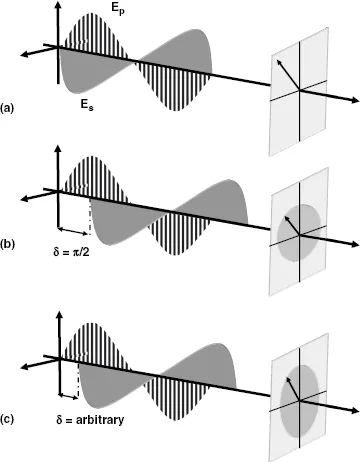
In the late 1800s, Paul Drude [2] used the phase shift induced between the perpendicular components of polarized light to measure film thickness down to a few nanometers. This was the first study on film thickness measurement with a method that was later called ellipsometry. When the perpendicular components of polarized light are out of phase, the light is said to be elliptically polarized, for which this technique came to be called ellipsometry. Ellipsometry measures reflectance at nonnormal incidence (typically around 75° from normal) and is rather sensitive to very thin layers. The two different polarization measurements provide twice as much information for analysis. Variable-angle ellipsometry can be used to take reflectance measurements at many different incidence angles, thereby increasing the amount of information available for analysis. In 1977, Azzam and Bashara [3] authored the book Ellipsometry and Polarized Light, which has been the key source to be cited in most technical writing on the subject. Later on, several handbooks were published [4–6] that cover the theory of ellipsometry, instrumentation, applications, and emerging areas, in which experts in the field contributed to various aspects of ellipsometry. Fundamental principles and applications of spectroscopic ellipsometry are to be found in the recently published work of Fujiwara [7].
This book starts with Chapter 2 with an introduction to the basics of the propagation of light and other electromagnetic radiation in space and matter. Beyond the general properties of electromagnetic waves, we consider mainly the deviations from the straightforward propagation by reflection, refraction, and diffraction since they are important for understanding the optical layer thickness determination and the functioning of the optical measuring devices. Interference of electromagnetic waves is a key effect not only for the diffraction of light but also for the optical layer thickness determination as it causes characteristic deviations in the reflectance spectrum of a thin film. From this characteristic interference pattern, all the film parameters are finally deduced.
Optical thickness determination is not only a question of electrodynamics but also a question of solid-state physics. The reason is that propagation in matter also means interaction of the electromagnetic wave with the matter. This interaction can be described with the complex dielectric function, while when discussing wave propagation in and through media the complex refractive index is appropriate. Both are connected via Maxwell's relation. In Chapter 2, we discuss physical models for the dielectric function and present empiric formulas for the refractive index.
The main topics of this book, the determination of the thickness of a layer in a layer stack from measurement of the spectral reflectance or transmittance, is treated in Chapters 3, 4, 5. The first step is taken in Chapter 3 with the modeling of the spectral reflectance R and transmittance T of a layer stack. Giving the thicknesses and complex refractive indices of all layers and substrates of the layer stack as input parameters, two common models – the propagating wave model and the r-t-ϕ model – can be used to calculate R and T of the stack (see Figure 1.1). The models are introduced in Chapter 3 and extensions on surface roughness and incoherent substrates are discussed. Absorption of light in the layer restricts the measurability of the thickness to a material-dependent maximum thickness.
In Chapter 4, we introduce the reflectometric and ellipsometric measurement and further optical methods, and discuss the optical components needed for the measurements. In all setups for optical thickness determination, the sample gets illuminated. Hence, light sources and their spectral distribution play a key role in the layer thickness determination, as well as the second key component, spectrometers. With the spectrometer, the reflected light modulated by the thickness interference gets spectrally resolved and analyzed.
Reflectometric and ellipsometric measurements do not measure the physical properties themselves but the optical response of the system caused by the physical properties. Hence, one needs to solve an inverse problem in order to find the value of actual physical properties of interest, such as thicknesses of the layers and optical properties of the materials. This inverse problem is solved numerically by finding the best fit between measured and calculated data, and physical properties are inferred from the model that gives the best fit (see Figure 1.2). To get reliable results, it is important to check the validity of the used model and to understand the sensitivity of the measured data to parameters of interest. In Chapter 5, we present and discuss numerical methods for determination of layer thickness and determination of optical constants of the layer material.
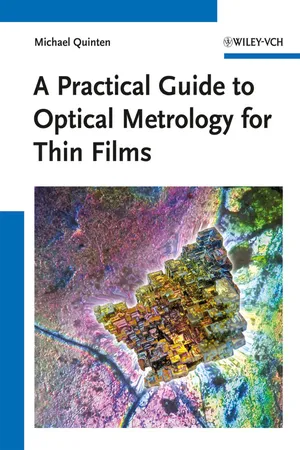
Chapter 6 is devoted to the apparent color of thin films. As the photographs on the cover of this book demonstrate, the interference in thin films leads to various colors depending on the thickness and refractive index of the film. However, not all colors are available from one single layer. Instead, multilayer systems are needed to cover a certain color gamut.
Finally, in Chapter 7 we present several technical applications where film thickness measurement is important. They are accompanied by corresponding measuring results. The applications can be classified into the following:
- Applications with a single unsupported layer, for example, glass, sapphire, or semiconductor wafers, and transparent polymer films.
- Applications with one layer on a substrate, for example, protective layers (hard coats), broadband antireflection coatings, photoresists, and transparent conductive layers (TCF and TCO).
- Applications with two layers on a substrate. Examples of two layers on a substrate are photoresists on silica on a wafer, bonded wafers, and SOI wafers (SOI, silicon on insulator).
- Multilayer applications, for example, high reflective (HR) and antireflective (AR) coatings, beam splitter coatings, dielectric mirrors, optical filters, thin-film solar cells, and OLEDs (organic light emitting diodes).
We want to point out that all calculations of reflectance and transmittance spectra, the evaluation of thickness parameters and color, and the determination of optical constants were carried out with self-made software packages, MQLayer, MQNandK, and MQColor [8].
![]()
Chapter 2
Propagation of Light and Other Electromagnetic Waves
This chapter introduces the basics of the propagation of light and other electromagnetic radiation in space and matter. Beyond the general properties of electromagnetic waves, we consider mainly the deviations from the straightforward propagation by reflection, refraction, and diffraction since they are important for understanding the optical layer thickness determination and the functioning of the optical measuring devices. Last but not least, propagation in matter also means interaction of the electromagnetic wave with the matter for what we also discuss the dielectric function and the refractive index in this chapter.
2.1 Properties of Electromagnetic Waves
When discussing the properties of electromagnetic waves, it seems appropriate to give first a definition of a wave. A wave generally is a process that is ...