eBook - ePub
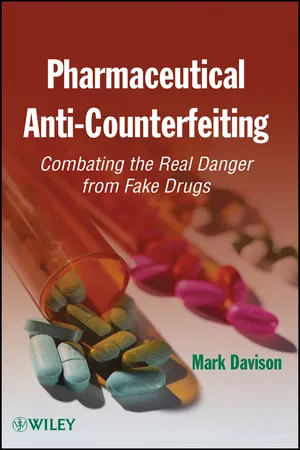
Pharmaceutical Anti-Counterfeiting
Combating the Real Danger from Fake Drugs
- English
- ePUB (mobile friendly)
- Available on iOS & Android
eBook - ePub
About this book
This book overviews and integrates the business and technical issues that pharmaceutical companies need to know in order to combat the major global problem of counterfeit medicines. In addition to discussion of the problems, the author Davison addresses analytical techniques scientists use to detect counterfeits and presents some possible solutions to the threat of counterfeit medical products. Coverage moves from basic overview of the problem, costs / risks to consumers (toxic products, mistrust of drug companies) and business (revenue loss, public trust), government oversight and regulation, authentication strategies (packaging, analytical techniques), product tracking and supply chain, and case studies from around the globe.
Information
Part 1
GENERAL THEMES
Chapter 1
Introduction
The problem of counterfeit drugs is not a new one, but it is a growing issue and one that cannot be ignored. Of course, this book does not review all of the possible situations or contain all the answers necessary to solve the problem. Nevertheless, I hope that it provides some guidance on the principles of anti-counterfeiting and gives some food for thought on strategy and technology choices. Counterfeit medicines cannot be tolerated–we all have an urgent obligation to do something about it. It is not just a few technical specialists or even the whole pharmaceutical industry that needs to take action: counterfeit medicines are everybody's problem. We may not be able to stop fake drugs entirely, but we have to keep that as our aim. One life lost because of a counterfeit medicine is a death too many.
Why Write This Book?
Counterfeiting is a growing, worldwide criminal trend that affects us all.1 It is now present in almost all industry sectors, not just consumer goods, and fake products are getting ever harder to avoid. We can choose not to buy obviously counterfeit “designer” items sold at bargain prices by street traders. By buying only from authorized outlets, we consider ourselves safe from being ripped off. But in many cases, fakes are not so easy to spot, however vigilant we are. The same profit motive that has led to rip-offs in the consumer goods industry has caused an alarming rise in counterfeit medicines. These are very difficult for the average consumer to spot and they are starting to turn up in local pharmacies around the world. They are already endemic in developing countries and evidence suggests that they kill hundreds of thousands of people every year.2
Almost everyone on the planet will take pharmaceutical drugs at some point during their lifetime. Some people must take dozens of pills every day just to stay alive. Every time we take a painkiller for a headache or get our children immunized, we are placing our safety or that of our loved ones in the hands of the drug supply chain. We rightly anticipate that our sore head will benefit from analgesic drugs and our children's future health will benefit from vaccinations. We do not expect our immediate or future well-being to be harmed by toxic effects or by ineffective medicines that expose us to preventable danger.
Twenty years ago that may have been a relatively safe assumption, but today, the activities of organized criminals have turned counterfeit medicines and medical products into a global parallel industry, with the potential to undermine progress in healthcare if its growth is not checked.
The reasons why drug counterfeiting occurs are many, varied and complex. These subjects are well covered elsewhere and I have included references for those interested in these issues. I have spent the last few years working as part of a small industry that is trying to use technology first to control and eventually to prevent the spread of counterfeit products. My work has taken me around the world and into several different industries. Although I will give an overview of the counterfeiting problem, this book is deliberately and specifically about anti-counterfeiting. Whether we like it or not, counterfeit drugs have gained a foothold. This book is a primer for those who want to know more about the problem and how to deal with it.
Doesn'T This Book Just Help the Criminals?
The paradox of writing about anti-counterfeiting is that it runs the risk of educating the very people we are trying to thwart. I therefore took several key decisions when planning this book.
Firstly, this book is not a technical manual or a directory of security suppliers and their capabilities. None of the technical information or real-world examples given is based on privileged information and this book does not discuss specific details of the proprietary technologies used by any brand owner or vendor. All of the technical information given is available elsewhere in the public domain and I neither endorse nor criticize any of the technologies discussed. I explain the general principles of various techniques, but in general, the book focuses on policy and strategy issues—which in any case are often far more critical to success than the technology employed. There are also some technical subject areas which I have deliberately covered in less detail to avoid giving help to counterfeiters. In particular, these areas relate to specific covert and forensic technologies, which are confidential and not publicly disclosed. Pharmaceutical product protection, like all security functions, should follow the need-to-know principle. In the interests of transparency, I should again point out that I was previously employed by a leading security vendor, but of course none of the confidential aspects of my work there are mentioned in this book. There are many excellent technology providers and sources of independent advice, and I encourage the reader to contact me privately or to seek other expert guidance when assessing technology choices. The “Further Resources” section contains contact details for various trade associations.
Secondly, with only one or two well-studied exceptions, I have chosen not to use illustrations and case studies which involve specific brands. The pragmatic reason is that drug companies are often reluctant to give permission for photographs of their products to be used, but the main argument is that it is unfair to single out individual corporations. All manufacturers and all price levels of products are now vulnerable to counterfeiting. Vigilant and transparent companies often have a higher apparent incidence of counterfeits only because they look harder and report fully. Therefore, in most cases, I have used illustrations of generic types of counterfeiting to show the methods used, with links to public domain information about real examples where appropriate.
Who is the Book Aimed At?
Pharmaceutical company executives, in all disciplines, need to be conversant with the issue of counterfeit drugs and with the technical and policy approaches required to combat them. Other pharmaceutical employees, from R&D scientists to sales representatives to manufacturing supervisors, should also have a working knowledge of the issues discussed in this book. Only by involving all levels and functions in constant vigilance can we begin to get on top of the counterfeiting and diversion problem. More specifically, most drug companies and other organizations involved in the production, distribution, or monitoring of drug supplies now have individuals with responsibility for anti-counterfeiting and supply chain security. I hope this book will provide them with some fresh insights.
Pharmacists and doctors are key arbiters of drug quality and provide the final professional link in the chain of custody from drug manufacturer to patient. Many of the drug tracking and anti-counterfeiting systems currently being piloted are heavily reliant on pharmacists' participation. This volume is an ideal primer on these issues for trainee and qualified pharmacists and doctors.
Many governments and non-government institutions have created agencies and appointed individuals to monitor and combat fake drugs. Resources are usually limited and these organizations are lobbied hard by technology vendors, pharmaceutical companies, and trade associations representing often conflicting views from various supply chain stakeholders. This book provides a neutral view of the issues to help civil servants to take informed judgements.
Although technical issues are discussed, I have also tried to ensure that the book remains accessible to the interested layman. We are all customers of the medical system and the more the general public is informed about counterfeit drugs, then the more vigilant society will become.
Chapter 2
Origins and Context of Counterfeiting in Healthcare
Background and Nature of the Threat
The use of unproven medical claims to make a living is probably as old as mankind, from shamanism1 to snake oil sellers.2 Just read the advertisement section of any newspaper and you can find companies selling herbal remedies, magnetic healing devices, and a myriad of other panaceas. Beneath a big headline, the supporting text is carefully and ambiguously worded (“May help …,” “Thought to improve …”). The claims are not supported by any clinical evidence, let alone a randomized, double-blind, placebo-controlled trial.3 There is usually a disclaimer, printed in a tiny font, but what the consumer responds to is the deliberately emotive headline, which promises to solve their real or perceived medical problem. The gullible will continue to be duped in this way, but generally these items are discretionary purchases and the products cause mild financial loss but not medical harm. Most people do not buy their day-to-day medication from small advertisements in the newspaper.
Within the last 10 years or so, there has been a dramatic increase in another form of medical deception—counterfeiting of drugs and medical devices. This is a much more menacing threat than the peddling of quack remedies described above. The consumer thinks they are getting a genuine, tested, safe, and efficacious product from a well-known manufacturer. They expect that product to have a positive impact on their life. But medicine is a complex area. Doctors and patients know that most diseases have more than one contributing factor and that most medications are not miracle cures. Therefore, if the patient does not get the desired benefit, they often simply stop treatment or their doctor switches them to an alternative product, without considering the possibility of counterfeiting. In the worst case, the patient may not live to find out that their drugs are fake. People die of pre-existing medical conditions every day. We do not routinely analyze the contents of their bathroom medicine cabinets to check for counterfeit medication.
It is now clear that fake drugs and medical devices place an increasing disease burden on society. Counterfeit drugs have come to dominate some markets so that they represent the majority of available medicines, with disastrous results. For example, the spread of fake antimalarial drugs is a tragedy4 that has already cost thousands of lives.
The volume and variety of fake pharmaceutical products is astonishing. All types of drugs and medical products are affected. When labor and raw material costs are low, even cheap branded items can provide a profit opportunity for criminals. Disposable products such as sutures, dressings, and hypodermic needles are copied using poor quality materials. Even worse, used and contaminated items are salvaged from disposal sites and repackaged as new products, complete with fake “sterile” status.
However, counterfeiting is not just an issue for tropical areas or developing countries. The rise of the Internet and the advent of so-called “lifestyle drugs” have driven the expansion of the counterfeit drug industry worldwide. Lifestyle drugs are aimed at indications where treatment is largely a matter of patient choice and not a medical requirement. They are often expensive and in many cases, they treat conditions (e.g., erectile dysfunction, obesity) that patients consider embarrassing. The high profile, high price, high demand nature of these products provides an obvious economic incentive to criminals.
Within the pharmaceutical industry as a whole, the major pharmaceutical companies especially have come under heavy criticism from some quarters for their perceived high prices. Many discussions of the counterfeit pharmaceutical problem, particularly those concentrating on intellectual property (IP) rights, tend to focus on the price of legitimate drugs in order to highlight the apparent financial incentive to counterfeiters. The reality is that price is not a strong predictor of counterfeiting. Even cheap generic antibiotics are copied, and in many developing countries it is the widespread presence of counterfeit versions of these critical drugs which is the main problem. To understand why pharmaceutical and medical device companies charge the prices that they do, we need to examine the economics of the pharmaceutical industry.
R&D Costs, Patent Life, and the Profit Imperative
Discovering and developing an innovative drug or medical device is difficult. It requires a multidisciplinary team of highly qualified people, expensive research facilities, complex animal studies, and challenging clinical trials. It takes lots of time and money and often some luck. The preclinical development time “from suggestion to ingestion” can be several years. There follows a hugely expensive clinical development process that takes even longer. One widely quoted estimate puts the total cost of developing a new chemical entity, including the cost of all the failed drug candidates and the cost of capital, at over 800 million dollars.5 That does not include the huge marketing and sales budgets necessary to ensure the commercial success of a product that makes it to the market.
Almost all innovative pharmaceutical products are discovered and developed by for-profit organizations, whether privately or publicly held, and the shareholders of these corporations naturally expect returns on their investments. But the patent life of a new product is finite—typically 20 years—and the long development process eats heavily into this time. Many newly launched drugs have only 5–10 years of market exclusivity remaining, before their patent protection expires and legitimate generic competition moves in. In this short time, the sales of the new drug are expected to recoup the development costs and eventually to make a net profit.
All these factors mean that drug prices are often relatively high. In the developed world, consumers and third-party payors (e.g., governments or health insurers) are generally prepared to pay these high prices. Why? In part, it is because “innovator” drug companies employ advertising campaigns and sales representatives to detail the benefits of their products directly to physicians and consumers and thereby build brand awareness. Moreover, in developed countries, the strict regulatory process ensures that manufacturers' claims have to be substantiated. The simple fact is that patented, branded drugs generally work. They are manufactured to a high standard, they are mostly effective in treating or alleviating disease, and they often save lives.
However, the same rigorous process that means that approved drugs have to be safe and effective also means that most experimental drugs fail to make it through the development phase. The survival of a pharmaceutical company is therefore dependent on its approved drugs carrying the full cost burden of the corporation (including the failures) and on new drugs coming onto the market regularly.
To add to the pressure, the overall productivity of the industry is falling. This is happening for various reasons, such as inefficient R&D structures, increasing regulatory hurdles, and sometimes just bad luck (such as rare but serious adverse events that only show up late on the development process or even after product launch).
The prices charged by major drug companies for their patented products can therefore be explained (although I neither justify nor criticize them here). What is the opportunity for counterfeiters?
A Low Cost, High Profit Business
A combination of factors creates a huge opportunity for criminals to exploit. These include high market prices, high customer demand, global brand awareness, consumer trust painstakingly created and supported by drug company R&D. Criminals producing fake drugs and medical devices have none of the commercial burdens discussed above in relation to drug companies. They have an advantage at all stages of the product life cycle.
Research and Development
Counterfeiters have almost zero R&D costs. Even if they wish to include an active ingredient or functional component in their product, they can simply copy the genuine art...
Table of contents
- Cover
- Title Page
- Copyright
- Dedication Page
- Preface
- Acknowledgments
- Part 1: General Themes
- Part 2: Authentication
- Part 3: Product Tracking
- Part 4: Conclusions and the Future
- Part 5: Further Resources
Trusted by 375,005 students
Access to over 1.5 million titles for a fair monthly price.
Study more efficiently using our study tools.
Frequently asked questions
Yes, you can cancel anytime from the Subscription tab in your account settings on the Perlego website. Your subscription will stay active until the end of your current billing period. Learn how to cancel your subscription
No, books cannot be downloaded as external files, such as PDFs, for use outside of Perlego. However, you can download books within the Perlego app for offline reading on mobile or tablet. Learn how to download books offline
Perlego offers two plans: Essential and Complete
- Essential is ideal for learners and professionals who enjoy exploring a wide range of subjects. Access the Essential Library with 800,000+ trusted titles and best-sellers across business, personal growth, and the humanities. Includes unlimited reading time and Standard Read Aloud voice.
- Complete: Perfect for advanced learners and researchers needing full, unrestricted access. Unlock 1.5M+ books across hundreds of subjects, including academic and specialized titles. The Complete Plan also includes advanced features like Premium Read Aloud and Research Assistant.
We are an online textbook subscription service, where you can get access to an entire online library for less than the price of a single book per month. With over 1.5 million books across 990+ topics, we’ve got you covered! Learn about our mission
Look out for the read-aloud symbol on your next book to see if you can listen to it. The read-aloud tool reads text aloud for you, highlighting the text as it is being read. You can pause it, speed it up and slow it down. Learn more about Read Aloud
Yes! You can use the Perlego app on both iOS and Android devices to read anytime, anywhere — even offline. Perfect for commutes or when you’re on the go.
Please note we cannot support devices running on iOS 13 and Android 7 or earlier. Learn more about using the app
Please note we cannot support devices running on iOS 13 and Android 7 or earlier. Learn more about using the app
Yes, you can access Pharmaceutical Anti-Counterfeiting by Mark Davison in PDF and/or ePUB format, as well as other popular books in Medicine & Pharmacology. We have over 1.5 million books available in our catalogue for you to explore.