eBook - ePub
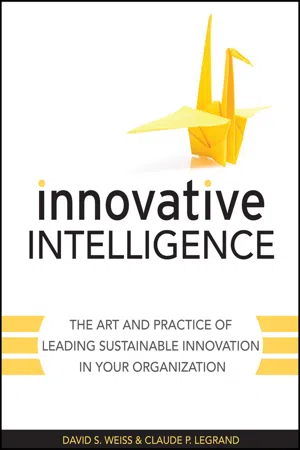
Innovative Intelligence
The Art and Practice of Leading Sustainable Innovation in Your Organization
- English
- ePUB (mobile friendly)
- Available on iOS & Android
eBook - ePub
Innovative Intelligence
The Art and Practice of Leading Sustainable Innovation in Your Organization
About this book
Innovation is a key source of competitive advantage, but it remains frustratingly elusive for many organizations. This book shows you how to close the innovation gap by making individuals and organizations systematically and sustainably innovative. You will learn how to embrace a culture of innovation and make it permeate every level of the organization. You will find a clear road map and practical tools to redefine your workplace's culture, identify and tap into the existing innovative intelligence, and develop leaders who can close the innovation gap for greater business success.
PART ONE
CLOSING THE INNOVATION GAP
CHAPTER ONE
THE INNOVATION GAP
“The problem is much more complex and challenging than we thought,” the CEO declared to his executive team. “Initially, we thought our challenge was to sustain our leading position in the new competitive environment. We thought we were an innovative pharmaceutical company—but really we’re only an innovative R&D company. And now our R&D pipeline has almost ground to a halt. Healthcare regulators are not approving our new products. Generic drug companies are contesting our patents through intense litigation. Doctors don’t have the time to see us. We’re facing unprecedented political pressure to reduce the costs of our drugs. It’s obvious that we must become innovative throughout our company and not just in R&D. But how do we do that quickly?”
“We’ve trained our best leaders to focus on short-term problems and ‘making’ the numbers. We haven’t trained them to think innovatively. Our few innovative leaders have left to join healthcare start-ups that appreciate their innovative thinking. So we don’t have the skilled innovative leaders who can help lead us out of this mess.”
The CEO raised his voice and challenged his executive team, “I’m not the only leader here. Together, we must radically change our culture and champion innovative leadership throughout our business to compete in our industry. Are you with me?” The executives saw the panic in the CEO’s eyes and nodded in agreement—but they didn’t believe they would make any meaningful changes—not because they didn’t want to, but because they just didn’t know how to do what the CEO wanted. And they didn’t believe the CEO knew either.
It is stories like this one that motivated us to write this book. Many organizations are caught in the turbulent world of the knowledge economy. They may have good intentions to become more innovative—but not many of their leaders know how to do it. They recognize that innovation is a key source of competitive advantage. However, despite extensive efforts to change, many organizations are having difficulty achieving the levels of innovation they require. This dynamic is an innovation gap.
Innovation Gap = The difference between the stated importance of innovation and the actual results in an organization
Our purpose in Innovative Intelligence is twofold:
• To provide business leaders and senior HR executives with an accelerated strategy to close the innovation gap.
• To supply a series of practical and implementable frameworks and tactics for developing leaders who can drive innovation in their organizations.
THE INNOVATION CHALLENGE
Let’s begin with the challenge of innovation.
Frequently it is only after the crisis has occurred—after the competition has captured market share, after the market has dried up, after organizations have slashed costs—that organizations react. Then they say they need to “innovate”—as best they can under the pressure of the crisis. Too often, they overreact and confuse systemic innovation with unbridled creativity. This kind of creativity merely produces high-risk ideas with no pragmatic means of applying them and no built-in process to sustain them.
Organizations face three major challenges as they attempt to respond to the innovation gap:
1. Lack of a common understanding of what innovation is, how it happens, and what prevents it. Despite many attempts at defining innovation, a lack of consensus on a common definition still exists. Too often, leaders define innovation only in terms of technology or scientific research, yet organizations require innovation in almost all areas.
2. Lack of innovative leaders.Most leaders have never learned how to be innovative and how to lead an organization so that it becomes more innovative. They may understand that they have a key role in innovation, but they do not know how to systematically generate new and better solutions. They also do not know how to reinforce the right innovative skills for their direct reports and teams.
3. Lack of enabling organizational practices and cultures to reinforce innovation. Many organizations inadvertently discourage innovation through their organizational practices (e.g. planning, budgeting, rewards). In addition, many organizations have cultures that drive short-term results and risk avoidance. Without changing some organizational practices and building a culture of innovation, leaders will not close the innovation gap.
Today, innovation is often extolled; however, on closer investigation, far more talk than action occurs. In this context, the old adage “talk is cheap” actually becomes “talk is expensive,” because organizations pay a hefty price if they do not practice what they preach. Failure to innovate can be terminal.
WHAT IS INNOVATION?
Let’s first define innovation. Then, we’ll explain the innovation gap dynamic and substantiate it with our evidence.
Most use the concept of “innovation” as either an outcome or a process. This book is not about innovation as an outcome, although a great deal of research describes the innovation gap that is associated with the lack of innovative outcomes in organizations.
Instead, our approach focuses on the process of innovation and how innovation happens. Here are some key aspects of the innovation process:
• The innovation process applies to everything an organization does or could do, as well as how it does it. For example, innovation applies to how the organization develops and implements strategies, creates new products and services, manufactures products and services, and ensures that internal functions support the business.
• It is an essential enabler of business strategies and goals—but it is not, in and of itself, the strategy or the goal.
• It is simply about innovating. It is a process that enables the organization to deliver on its strategies and its goals, in the same way that manufacturing, marketing, or accounting enables the organization to achieve its goals—no more and no less.
We use the word innovation in a very different way than the way we use the word creativity. Here are some comparisons of creativity and innovation:
• Creativity is about having new ideas, relevant or not, useful or not, implementable or not, while the output of innovation achieves defined value for an organization.
• Creativity is a stand-alone output, not a sustainable business outcome. On the other hand, innovation is directed toward achieving a sustainable outcome that can improve what people do or how they do it.
Our definition of innovation in a business context is as follows:
Innovation = Applied creativity that achieves business value
The confusion between innovation and creativity has been costly to many organizations. Once, a CEO of a successful bank indicated he did not want more innovation (because it would be too disruptive). What he was actually referring to was not innovation but creativity without boundaries, direction, or a rigorous process for application.
It is difficult to blame executives for their anxiety with unbridled creativity. Many executives are focused on risk mitigation and ensuring that the formula for success for their organization can be repeated continuously. Uncontrolled creativity could put an organization at risk, and although some executives say they want new ideas and innovation, they do not always support it when it occurs.
Even the expression “unleashing creativity” reflects this anxiety. To “unleash” implies that creativity was formerly restrained on a leash because it was dangerous. As a result, many executives do not focus on developing the innovation skills of their leaders because they are concerned that it will introduce uncontrollable risk.
Of course, managing risk is important—but concern with risk should not stop the innovation process. In fact, not taking risks and not changing is often the biggest risk of all, even if it is not immediately obvious. We need both innovation and risk mitigation at the same time.
We need both innovation and risk mitigation at the same time.
It is similar to the perceived oxymoron that higher quality can occur with lower cost. But it is true—better quality can be less expensive. The same is true for innovation: greater innovation can occur within acceptable levels of risk. Risk management should always be built into the innovative process.
Executives are correct in assuming that unbridled creativity could be disastrous—but focused innovation within acceptable risk levels can yield outstanding benefits for the business. To reduce associated risk, innovation needs to operate within clear boundaries and to be focused on achieving specific business outcomes.
The issue is that leaders often do not know how to foster innovation or how to manage risks on an ongoing basis. Risk is, just like innovation, an area that is spoken about frequently but with very little understanding or action. Risk is usually carefully evaluated for large projects or investments, but the discussion of risk for smaller projects is usually minimal. In most cases it is just glossed over, only to be discovered if something goes wrong later.
INNOVATIVE THINKING MAKES INNOVATION HAPPEN
Although there are many ways to understand innovation, most experts agree that innovation happens when people use innovative thinking.
Our definition of innovative thinking is as follows:
Innovative thinking is the process of solving problems by discovering, combining, and arranging insights, ideas, and methods in new ways.
The process of innovating is done by individuals or small teams that engage in innovative thinking. Computers, systems, cultures, or organizations do not innovate—only people do. However, the role of organizations and systems is critical; they are key enablers or potential blockers of innovative thinking by individuals and teams.
The Challenge to Innovate in the Knowledge Economy
The shift from the industrial economy to the knowledge economy has changed the nature of work more in the last 20 years than it changed in the last century. In the industrial economy, an organization could ask a few elite leaders to be innovative and focus everyone else on simply doing the work. When a problem happened, it was escalated to the elite “thinkers,” who solved the problem and communicated the “right” decision throughout the organization.
In the knowledge economy, there is a need for all employees to use their intellectual potential because the nature of work is constantly changing and presenting complex challenges at every level of organizations. In this new economy, better solutions can only come from new ways of thinking—innovative thinking—not from conventional linear analytical thinking alone.
We need innovative thinking in our schools and businesses, in our health care and justice systems, and throughout our public institutions, in everything from politics to parenting. Even in manufacturing, the traditional hub of the industrial economy, all employees need to contribute to innovative thinking.
Unfortunately, in the context of today’s collapsed time and increasing work complexity, many complain that there is little time for innovating, and too few people are able to dedicate time to thinking, let alone innovative thinking.
Almost no organization has a culture that allocates thinking time for employees as Google reputedly does3—and “lack of time” is the most common obstacle cited by workers when asked why they are not more innovative. Employees who designate office time to think about problems ...
Table of contents
- Title Page
- Copyright Page
- Dedication
- Acknowledgments
- Preface
- PART ONE - CLOSING THE INNOVATION GAP
- PART TWO - INNOVATIVE THINKING
- PART THREE - MAKING INNOVATION HAPPEN
- Index
- About the Authors
Trusted by 375,005 students
Access to over 1.5 million titles for a fair monthly price.
Study more efficiently using our study tools.
Frequently asked questions
Yes, you can cancel anytime from the Subscription tab in your account settings on the Perlego website. Your subscription will stay active until the end of your current billing period. Learn how to cancel your subscription
No, books cannot be downloaded as external files, such as PDFs, for use outside of Perlego. However, you can download books within the Perlego app for offline reading on mobile or tablet. Learn how to download books offline
We are an online textbook subscription service, where you can get access to an entire online library for less than the price of a single book per month. With over 1.5 million books across 990+ topics, we’ve got you covered! Learn about our mission
Look out for the read-aloud symbol on your next book to see if you can listen to it. The read-aloud tool reads text aloud for you, highlighting the text as it is being read. You can pause it, speed it up and slow it down. Learn more about Read Aloud
Yes! You can use the Perlego app on both iOS and Android devices to read anytime, anywhere — even offline. Perfect for commutes or when you’re on the go.
Please note we cannot support devices running on iOS 13 and Android 7 or earlier. Learn more about using the app
Please note we cannot support devices running on iOS 13 and Android 7 or earlier. Learn more about using the app
Yes, you can access Innovative Intelligence by David S. Weiss,Claude Legrand in PDF and/or ePUB format, as well as other popular books in Business & Management. We have over 1.5 million books available in our catalogue for you to explore.