- English
- ePUB (mobile friendly)
- Available on iOS & Android
eBook - ePub
About this book
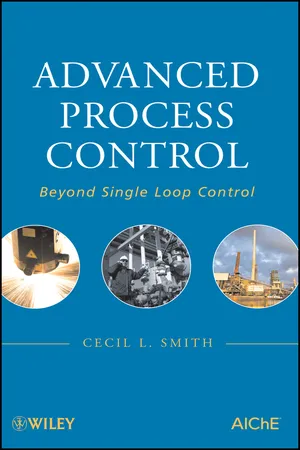
This book fills the gap between basic control configurations (Practical Process Control) and model predictive control (MPC). For those loops whose performance has a direct impact on plant economics or product quality, going beyond simple feedback or cascade can improve control performance, or specifically, reduce the variance about the target. However, the effort required to implement such control technology must be offset by increased economic returns from production operations. The economic aspects of the application of the various advanced control technologies are stressed throughout the book.
Information
1
Introduction
The vast majority of the control requirements in the process industries can be satisfied with a simple feedback control configuration that consists of three components:
- A measurement device for the controlled variable or process variable (PV)
- A proportional-integral-derivative (PID) controller
- A final control element, usually a control valve
The performance of any control configuration can be quantified by the variance in the control error, which is the difference between the set point (SP) and the PV. Control configurations more sophisticated than simple feedback offer the promise to reduce (or narrow) this variance. However, proceeding in this direction requires an incentive, the following two being the most common:
- The simple feedback configuration performs so poorly that it affects process operations negatively. Narrowing the variance in the control error translates directly into more consistent process operations.
- A significant economic incentive exists to operate the process more efficiently. Usually, this entails improving the control performance so that the process can be operated closer to a limiting condition. This is summarized as “narrow the variance, shift the target.”
In this book we examine several control methodologies that can be applied to enhance the performance of the controls. The user has two options:
- Replace the PID controller, usually with some version of model predictive control. Few regulatory control systems provide model predictive control as a standard feature, but the technology is readily available and easily purchased.
- Retain the PID controller, but incorporate additional logic to enhance the control performance. Most digital systems implement the PID controller as a function block. Numerous additional function blocks are supplied as part of the basic offering, making this approach relatively easy to pursue.
The choice is often dictated by economics. Significant benefits are required to justify model predictive control, so such controllers are often used in conjunction with optimization efforts. Otherwise, the capabilities of the controls must be enhanced by using other function blocks in conjunction with the PID controller.
1.1 Implementing Control Logic
As used in control systems, a block may encompass the following:
Input or measurement block. This block accepts a signal of some type from a field measurement device and converts the input to a numerical value of the measured variable in engineering units (°C, psi, lb/min, etc.).
Output or valve block. This block provides a signal of some type to a final control element. Most final control elements in process facilities are control valves, hence the term valve block.
Control block. Each block is described by an equation or algorithm that relates the output(s) of the block to its input(s). Some control systems provide a large number of very simple control blocks; others provide a smaller number of more complex control blocks, each with numerous options. Either approach is possible.
The processing of inputs and outputs can be implemented by other means, but for the control functions, the use of blocks is almost universal.
Input or Measurement Block
Although technically incorrect, the term analog is commonly used within digital systems. Prior generations of process controls were based on either electronic or pneumatic technology, and the term analog was appropriate. To ease the transition to digital controls, the initial versions of microprocessor-based process controls were designed specifically to closely emulate their analog predecessors. Hence, it should not be surprising that the term analog would be applied to corresponding signals within digital systems, and it is also used herein.
The correct term is digital. A digital signal is a finite arithmetic approximation to an analog signal. All digital values have a finite resolution: specifically, a change of 1 in the least significant number used in the representation. Here are two examples:
Decimal. A four-digit decimal representation with the format xxx.x has a resolution of 0.1. There are 10,000 possible values (0.0 through 999.9), so the resolution is often stated as 1 part in 10,000.
Binary. A 16-bit binary integer value (short integer) has a resolution of 1 bit. The number of possible values is 64,536 ( = 216), either 0 through 64,535 for unsigned integers or –32,768 through 32,767 for signed integers. The resolution is 1 part in 64,536 or less, depending on the range of values that can occur.
In processing inputs from room-temperature devices (RTDs) and thermocouples, a common approach is for the input card to convert the input to engineering units in either °C or °F (this is specified via an option on the input card). The result is a short integer value (16 bits) but with the format understood to be xxxx.x. That is, 1074 is understood to be either 107.4°C or 107.4°F. Considering the accuracy of RTDs and thermocouples, a resolution of 0.1°C or 0.1°F is reasonable. But for narrow spans on displays and trends, the finite resolution will be evident. Some address this issue by smoothing or filtering the input value, but this adds undesirable lag to a control loop.
In all examples presented herein that involve temperature measurements, a resolution of either 0.1°C or 0.1°F is imposed. The objective is to illustrate the impact of finite resolution on the performance of various control configurations.
Output or Valve Block
Some control valves fail closed; others fail open. For an output of 0%, a fail-closed control valve is fully closed; for an output of 0%, a fail-open control valve is fully open. If ...
Table of contents
- Cover
- Title Page
- Copyright
- Preface
- Chapter 1: Introduction
- Chapter 2: Cascade Control
- Chapter 3: Split-Range Control
- Chapter 4: Override Control
- Chapter 5: Valve Position Control
- Chapter 6: Ratio and Feedforward Control
- Chapter 7: Loop Interaction
- Chapter 8: Multivariable Control
- Index
Trusted by 375,005 students
Access to over 1.5 million titles for a fair monthly price.
Study more efficiently using our study tools.
Frequently asked questions
Yes, you can cancel anytime from the Subscription tab in your account settings on the Perlego website. Your subscription will stay active until the end of your current billing period. Learn how to cancel your subscription
No, books cannot be downloaded as external files, such as PDFs, for use outside of Perlego. However, you can download books within the Perlego app for offline reading on mobile or tablet. Learn how to download books offline
Perlego offers two plans: Essential and Complete
- Essential is ideal for learners and professionals who enjoy exploring a wide range of subjects. Access the Essential Library with 800,000+ trusted titles and best-sellers across business, personal growth, and the humanities. Includes unlimited reading time and Standard Read Aloud voice.
- Complete: Perfect for advanced learners and researchers needing full, unrestricted access. Unlock 1.5M+ books across hundreds of subjects, including academic and specialized titles. The Complete Plan also includes advanced features like Premium Read Aloud and Research Assistant.
We are an online textbook subscription service, where you can get access to an entire online library for less than the price of a single book per month. With over 1.5 million books across 990+ topics, we’ve got you covered! Learn about our mission
Look out for the read-aloud symbol on your next book to see if you can listen to it. The read-aloud tool reads text aloud for you, highlighting the text as it is being read. You can pause it, speed it up and slow it down. Learn more about Read Aloud
Yes! You can use the Perlego app on both iOS and Android devices to read anytime, anywhere — even offline. Perfect for commutes or when you’re on the go.
Please note we cannot support devices running on iOS 13 and Android 7 or earlier. Learn more about using the app
Please note we cannot support devices running on iOS 13 and Android 7 or earlier. Learn more about using the app
Yes, you can access Advanced Process Control by Cecil L. Smith in PDF and/or ePUB format, as well as other popular books in Technology & Engineering & Chemical & Biochemical Engineering. We have over 1.5 million books available in our catalogue for you to explore.