- Features extensive revisions and updates, and incorporates recent cross-national research on gender
- Expands and develops frameworks introduced in first edition
- Treats gender as a multilevel system operating at the individual, interactional, and institutional levels
- Stresses conceptual and theoretical issues in the sociology of gender
Offers an accessible yet intellectually sophisticated approach to current gender theory and research - Includes pedagogical features designed to encourage critical thinking and debate
- English
- ePUB (mobile friendly)
- Available on iOS & Android
eBook - ePub
About this book
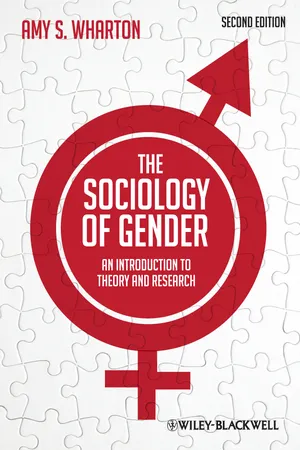
Featuring extensive revisions and updates, the Second Edition of The Sociology of Gender: An Introduction to Theory and Research presents an introductory overview of gender theory and research, and continues to offer a unique and compelling approach to one of the most important topics in the field of sociology.
Information
Chapter 1
Introduction to the Sociology of Gender
Chapter Objectives
- Provide an overview of the book’s general aims.
- Explain how sociologists approach the study of social life and gender, in particular.
- Define gender and other key terms, and understand the debates over their use.
- Identify the three frameworks sociologists use to examine this concept.
- Provide examples of the ways that gender shapes individuals, social interaction, and institutions.
- Explain the importance of considering gender from a cross-national and comparative perspective.
Last summer at a family gathering, my mother asked what I would be working on during my sabbatical. “Gender,” I responded. “You mean gender bias?” she asked helpfully. “No, gender,” I said. There ensued an awkward silence, then my sixteen-year-old nephew quipped, “There are men and there are women. What more is there to say? Short book.”
From “Confounding Gender” by Mary Hawkesworth
Introduction
I identify with the narrator in this story. Like her, I have often found myself having to explain my interest in the topic of gender. Many people share – at least implicitly, anyway – the teenage nephew’s belief that gender is something unproblematic, self-evident, and uncontested. Is there anything more to say?
My belief that there is, indeed, more to say on the topic of gender is the motivation for this book. In it, I hope to achieve two goals: First, I aim to convince readers that understanding gender requires us to go beyond the obvious and to reconsider issues we may think are self-evident and already well understood. Challenging the taken-for-granted is one essential component of the sociological perspective. In fact, sociologists argue that what people view as unproblematic and accept as “the way things are” may be most in need of close, systematic scrutiny. A second goal of the book is to demonstrate the ways that gender matters in social life. Though complex and ever-changing, the social world is ordered and, at some level, knowable. As a principle of social relations and organization, gender is one of the forces that contribute to this patterning of social life. By understanding gender, we understand more about the social world.
Meeting these goals is more challenging than ever before. Virtually all of the social sciences have produced a staggering amount of empirical research on gender. Further, gender research has proliferated across the globe, and the ability of scholars to communicate with and learn from one another across geographical and disciplinary boundaries has expanded exponentially. This multiplicity of views and perspectives does not have to result in chaos and confusion, however. The field’s conceptual and theoretical diversity can be a source of enrichment rather than fragmentation. In order to receive the benefits of this diversity, however, students of gender must be skilled at communicating across perspectives, identifying points of overlap, convergence, and opposition. Demonstrating how this can be accomplished while, at the same time, doing justice to the range and variety of the ever-expanding theory and research on gender presents challenges I hope to meet in the following pages.
Sociological Vantage Points
There are many ways to gather information and produce knowledge, including knowledge about gender. This book, however, is premised on my belief that sociology (and the social sciences) offers the most useful vantage points from which this topic can be understood. Sociology does not provide the only access to the social world, of course. Fiction, music, and art, for example, all may provide people with meaningful insights about their lives. As a scientific discipline, sociology values systematic, theoretically informed analyses of the empirical world. While personal narratives and experiences are undeniably important, relying exclusively on these sources of information may lead to the “fundamental attribution error” – the tendency to explain behavior by invoking personal dispositions while ignoring the roles of social structure and context (Aries 1996; Ross 1977). Only by moving away from the purely subjective can we understand the broader social forces that shape our lives. Sociologists employ a wide variety of quantitative and qualitative methods to gather the information that informs their empirical claims. They use these methods as means to insure that data are gathered and analyzed systematically, with the aim of explaining and extending knowledge.
Though embracing the assumptions and methods of science as it has traditionally been conceived, sociologists have – out of necessity – also broadened these traditions. We recognize that the social world we study is complex and that this demands multiple forms of knowledge-gathering, some of which may be unique to the social (as opposed to the other) sciences. Models of science that work well for those studying the natural or physical world are not always applicable or desirable for studying the social world. As numerous social scientists have pointed out, humans – unlike other species – have tremendous capacities for reflection, creativity, and agency. People are neither programmable machines nor are they prisoners of their instincts. As a result, sociologists must contend with the fact that all people know something of the circumstances in which they act and thereby possess a degree of “sociological competence” (Lemert 1997, p. x). As sociologists, we are at our best when we can communicate with and learn from those we study. The sociological enterprise is further strengthened by its practitioners’ capacities to critically reflect on the circumstances through which their knowledge is produced. The ability to engage in self-reflection and critique one’s assumptions, methods, and conceptual orientations contributes vitally to the growth of sociological knowledge.
There are several, more specific characteristics of sociological knowledge –including knowledge about gender. Most important, this knowledge emanates from diverse theoretical perspectives and methodologies. Because they focus attention on different aspects of the social world and ask different kinds of questions, the interplay of diverse perspectives and methods helps facilitate the production of knowledge. I believe that the most useful sociological knowledge is produced collectively, through dialogue and debate, rather than in self-contained isolation. Sociological knowledge is not complete, seamless, or monolithic, however. Rather, like all knowledge grounded in the practices of science, this knowledge is incomplete, contingent, and often inconsistent.
These disciplinary characteristics have shaped what we know about gender and how we have come to know it. What follows thus draws on these characteristics. In my view, the tools of social science and sociology, in particular – while not flawless or complete – have been and continue to be the most useful in providing people with the means to challenge the taken-for-granted, understand their own lives and the world around them, and create possibilities for change.
A Brief History of the Sociological Study of Gender
Beginnings
I took my first course on gender as an undergraduate at the University of Oregon in 1975. As I recall, the course had only been in existence for a few years prior. “Gender” appeared nowhere in the course title: It was called “the sociology of women.” My experience of being introduced to the study of gender through the sociology of women was fairly typical for sociology students of my generation. The study of gender in sociology grew out of the second wave of the women’s movement. One expression of this movement in colleges and universities was its critique of academic disciplines, like sociology, for ignoring women. Women were rarely the subjects of research and activities heavily dominated by women (e.g., housework) received little attention. Critics thus claimed that sociology reflected a “male bias,” generating knowledge most applicable to men’s lives rather than to the lives of women and to society defined more broadly. The challenge for sociology at that time was best captured in the question posed by the late sociologist, Jessie Bernard (1973a, p. 781): “Can [sociology] become a science of society rather than a science of male society?”
While the term “gender” gradually began to enter the sociological literature, gender scholars for many years devoted considerably more attention to women – and topics related to femininity – than to men and topics related to masculinity. In addition, much more was written about differences between women and men than was written about variations among women and among men. Perhaps more fundamental was the persistent, often implicit, assumption that sociology as a discipline could accommodate new knowledge about gender without having to rethink some of its own key assumptions about the social world. Each of these tendencies has been challenged in recent years.
Recent Conceptual Developments
The sociology of women has given way to a sociology of gender. On one level, this change is reflected in a growing literature on men and masculinity (Connell 1995; Schrock and Schwalbe 2009). Although men have long been of interest to sociologists, this recent literature focuses on men as gendered rather than generic beings. This development, in turn, has been accompanied by the recognition that gender itself is relational: Understanding what women are or can be thus requires attention to what men are or can be.
Another important development involves the growing recognition of variations among men and among women, resulting in increased attention to masculinities and femininities. The acknowledgment of multiple rather than singular expressions of gender has been accompanied by a recognition that some forms of masculinity or femininity are more socially valued than others. In this view, relations between particular kinds of masculinity (or particular kinds of femininity) are understood as relations of domination and subordination. In addition, this formulation recognizes that “masculinities [and femininities] come into existence at particular times and places and are always subject to change” (Connell 1995, p. 185).
A related development in the sociology of gender is the field’s increased concern with the relations between gender and other bases of distinction and stratification, such as age, race or ethnicity, sexual orientation, social class, or nation. This literature challenges the notion that women (or men) represent a homogeneous category, whose members can be automatically assumed to share common interests and experiences. For example, as studies of care work have shown, a global division of women’s labor underlies this industry: Poor women from less affluent countries migrate to the richer West to care for the children and clean the houses of women who are more well-to-do (Ehrenreich and Hochschild 2002). Contained within the global gap between rich and poor is a gap among women and women’s work activities. Though gender, race and ethnicity, and social class are analytically separate, as aspects of lived experience, they are highly intertwined.
Another aspect of gender scholarship is its attempt to transform sociological knowledge. It is insufficient to simply add knowledge about gender to existing sociological literatures. Instead, we should rethink taken-for-granted sociological concepts and ideas, with the aim of refashioning these literatures. Purportedly gender-neutral practices and institutions, such as law, work, and formal organization, have received new scrutiny from scholars interested in gender. These scholars’ efforts have helped move the sociology of gender from the margins to the center of sociological thought. In turn, they have contributed to the growing recognition that gender scholarship has something to offer the sociological mainstream.
A related theme in gender scholarship is the belief that cross-national, comparative research is essential. Gender has long been of interest to researchers around the world, but the vast majority of studies focus on a single society. There are some good reasons for this. Comparative data are not always easy to come by, and cross-national research can be time-consuming and expensive. However, some of these logistical barriers to cross-national research have been overcome. New technologies have vastly expanded access to information and increased the possibilities for scholarly communication among those in different places on the globe.
This has enabled researchers to learn more about the role of societal-level influences on gender and how aspects of gender uncovered in one societal context may or may not be generalizable to other settings. For example, while studies conducted in Western societies show that acts of physical aggression towards a partner are committed by both men and women, this pattern is not found in all nations (Archer 2006). Cross-national research thus is important in helping us avoid the dangers of over-generalization, which occurs when one assumes that conclusions based on one group of women or men can be automatically extended to all women or all men. As we saw earlier, a similar kind of critique was what led sociologists to examine women in their own right in the first place. The internationalization of gender scholarship has also helped facilitate new research agendas. A particular focus has been the ways that gender shapes and is shaped by macro-societal trends, processes, and institutions, such as globalization, migration, and state policies (O’Connor, Orloff, and Shaver 1999).
Nevertheless, it is important not to throw the baby out with the bathwater. Cross-national research on gender has taught us much about the ways that gender operates differently across societies and revealed the implications of those differences for women’s and men’s lives. Ironically, however, looking across boundaries in this way has also reinforced scholars’ view that gender’s role in social organization is fundamental: “In virtually every culture, gender difference is a pivotal way in which humans identify themselves as persons, organize social relations, and symbolize meaningful natural and social events and processes” (Harding 1986, p. 18).
In considering the history of gender scholarship, one final point to keep in mind is the relationship between how social scientists think about gender and events in the larger society. Gender scholarship emerged during the women’s movement, a time when middle-class women in the West were responding to growing educational and economic opportunities. Trends in gender scholarship in the current era are similarly linked to the social forces that are shaping the twenty-first century, such as globalization, neoliberalism, and the explosive growth of new modes and technologies of communication.
Defining Gender
Following Ridgeway and Smith-Lovin (1999, p. 192), I view gender as a “system of social practices”; this system creates and maintains gender distinctions and it “organizes relations of inequality on the basis of [these distinctions].” In this view, gender involves the creation of both differences and inequalities. But which social practices are most important in creating gender distinctions and inequalities, and how do these practices operate? The book’s primary aim is to examine alternative answers to these questions. In the process, students will be introduced to the range and diversity of sociological understandings of gender.
Three features of this definition are important to keep in mind. First, gender is as much a process as a fixed state. This implies that gender is being continually produced and reproduced. Stated differently, we could say that gender is enacted or “done,” not merely expressed. Understanding the mechanisms through which this occurs thus is an important objective. Second, gender is not simply a characteristic of individuals but occurs at all levels of the social structure. This is contained in the idea of gender as a “system” of practices that are far-reaching, interlocked, and exist independently of individuals. Gender is a multilevel phenomenon (Risman 1998). This insight enables us to explore how social processes, such as interaction, and social institutions, such as work, embody and reproduce gender. Third, this definition of gender refers to its importance in organizing relations of inequality. Whether gender differentiation must necessarily lead to gender inequality is a subject of debate that we will take up in the next chapter. For now, however, the important point is that, as a principle of social organization, gender is one critical dimension upon which social resources are distributed.
Gender is sometimes used interchangeably with the term “sex.” In fact, there is no firm consensus on the appropriate use of these two terms among gender scholars. Some reject the term “sex” altogether and refer only to “gender.” Others use them synonymously, while still others employ both concepts and recognize a clear distinction between them. These differences in usage are not merely semantic, but reflect more fundamental differences in perspective and theoretical orientation. Understanding the sociological meaning of sex and its relationship to gender thus is our next order of business in this chapter.
Sex and Sex Category
In conversation people often refer to men or women as the “opposite sex.” The term “opposite sex” implies that men and women belong to completely separate categories. Are women and men truly opposites? In fact, human males and females share many characteristics, especially biological characteristics. For example, both normally have 23 pairs of chromosomes and they are warm-blooded: In other respects, however, male and female bodies differ. These distinguishing characteristics, which include chromosomal differences, external and internal sexual structures, hormonal production, and other physiological differences, and secondary sex characteristics, signify sex.
The claim that sex marks a distinction between two physically and genetically discrete categories of people is called sexual dimorphism. Many view sexual dimorphism in humans as a biological fact; they believe that sexual differentiation creates two “structurally distinguishable” categories of humans (Breedlove 1994, p. 390). Others are more skeptical, arguing that social rather than biological forces produce two sexes in humans. This disagreement, which I will return to below, is an important area of debate among gender scholars.
In addition to the concept of sex, sociologist...
Table of contents
- Cover
- Title page
- Copyright page
- Chapter 1 Introduction to the Sociology of Gender
- Part I: Conceptual Approaches
- Part II: Gender in Context
- Part III: Epilogue
- References
- Index
Trusted by 375,005 students
Access to over 1.5 million titles for a fair monthly price.
Study more efficiently using our study tools.
Frequently asked questions
Yes, you can cancel anytime from the Subscription tab in your account settings on the Perlego website. Your subscription will stay active until the end of your current billing period. Learn how to cancel your subscription
No, books cannot be downloaded as external files, such as PDFs, for use outside of Perlego. However, you can download books within the Perlego app for offline reading on mobile or tablet. Learn how to download books offline
Perlego offers two plans: Essential and Complete
- Essential is ideal for learners and professionals who enjoy exploring a wide range of subjects. Access the Essential Library with 800,000+ trusted titles and best-sellers across business, personal growth, and the humanities. Includes unlimited reading time and Standard Read Aloud voice.
- Complete: Perfect for advanced learners and researchers needing full, unrestricted access. Unlock 1.5M+ books across hundreds of subjects, including academic and specialized titles. The Complete Plan also includes advanced features like Premium Read Aloud and Research Assistant.
We are an online textbook subscription service, where you can get access to an entire online library for less than the price of a single book per month. With over 1.5 million books across 990+ topics, we’ve got you covered! Learn about our mission
Look out for the read-aloud symbol on your next book to see if you can listen to it. The read-aloud tool reads text aloud for you, highlighting the text as it is being read. You can pause it, speed it up and slow it down. Learn more about Read Aloud
Yes! You can use the Perlego app on both iOS and Android devices to read anytime, anywhere — even offline. Perfect for commutes or when you’re on the go.
Please note we cannot support devices running on iOS 13 and Android 7 or earlier. Learn more about using the app
Please note we cannot support devices running on iOS 13 and Android 7 or earlier. Learn more about using the app
Yes, you can access The Sociology of Gender by Amy S. Wharton in PDF and/or ePUB format, as well as other popular books in Social Sciences & Gender Studies. We have over 1.5 million books available in our catalogue for you to explore.