General Surgery
  1. English
  2. ePUB (mobile friendly)
  3. Available on iOS & Android
eBook - ePub

About this book

The 12th edition of General Surgery Lecture Notes introduces the student to the principles of common surgical operations and systematically covers all clinical problems where surgical intervention is indicated.

Now in full colour throughout and fully-supported by a website of self-assessment questions and answers, this popular and classic text will appeal to all medical students and junior doctors who want a concise introduction to the fundamental aspects of general surgery and will provide the core knowledge needed for Finals and the MRCS examination.

Key features include:

  • Offers a comprehensive overview of surgical techniques
  • Contains a wide range of colour illustrations
  • Fully supported by hundreds of self-assessment questions and answers at www.testgeneralsurgery.com

Whether you need to develop or refresh your knowledge of surgery, General Surgery Lecture Notes presents 'need to know' information for all those carrying out general surgical procedures.

Frequently asked questions

Yes, you can cancel anytime from the Subscription tab in your account settings on the Perlego website. Your subscription will stay active until the end of your current billing period. Learn how to cancel your subscription.
No, books cannot be downloaded as external files, such as PDFs, for use outside of Perlego. However, you can download books within the Perlego app for offline reading on mobile or tablet. Learn more here.
Perlego offers two plans: Essential and Complete
  • Essential is ideal for learners and professionals who enjoy exploring a wide range of subjects. Access the Essential Library with 800,000+ trusted titles and best-sellers across business, personal growth, and the humanities. Includes unlimited reading time and Standard Read Aloud voice.
  • Complete: Perfect for advanced learners and researchers needing full, unrestricted access. Unlock 1.4M+ books across hundreds of subjects, including academic and specialized titles. The Complete Plan also includes advanced features like Premium Read Aloud and Research Assistant.
Both plans are available with monthly, semester, or annual billing cycles.
We are an online textbook subscription service, where you can get access to an entire online library for less than the price of a single book per month. With over 1 million books across 1000+ topics, we’ve got you covered! Learn more here.
Look out for the read-aloud symbol on your next book to see if you can listen to it. The read-aloud tool reads text aloud for you, highlighting the text as it is being read. You can pause it, speed it up and slow it down. Learn more here.
Yes! You can use the Perlego app on both iOS or Android devices to read anytime, anywhere — even offline. Perfect for commutes or when you’re on the go.
Please note we cannot support devices running on iOS 13 and Android 7 or earlier. Learn more about using the app.
Yes, you can access General Surgery by Harold Ellis,Sir Roy Calne,Sir Christopher Watson,Christopher Watson in PDF and/or ePUB format, as well as other popular books in Medicine & Surgery & Surgical Medicine. We have over one million books available in our catalogue for you to explore.

Information

1
Surgical strategy
Learning objectives
right
To understand the principles of taking a clear history, performing an appropriate examination, presenting the findings and formulating a management plan for surgical diagnosis.
right
To understand the common nomenclature used in surgery.
Students on the surgical team, in dealing with their patients, should recognize the following steps in their patients’ management.
1 History taking. Listen carefully to the patient’s story.
2 Examination of the patient.
3 Writing notes.
4 Constructing a differential diagnosis. Ask the question ‘What diagnosis would best explain this clinical picture?’
5 Special investigations. Which laboratory and imaging tests are required to confirm or refute the clinical diagnosis?
6 Management. Decide on the management of the patient. Remember that this will include reassurance, relief of pain and, as far as possible, allaying the patient’s anxiety.
History and examination
The importance of developing clinical skills cannot be overemphasized. Excessive reliance on special investigations and extensive modern imaging (some of which may be quite painful and carry with them their own risks and complications) is to turn your back on the skills necessary to become a good clinician. Remember that the patient will be apprehensive and often will be in pain and discomfort. Attending to these is the first task of a good doctor.
The history
The history should be an accurate reflection of what the patient said, not your interpretation of it. Ask open questions such as ‘When were you last well?’ and ‘What happened next?’, rather than closed questions such as ‘Do you have chest pain?’. If you have a positive finding, do not leave the subject until you know everything there is to know about it. For example, ‘When did it start?’; ‘What makes it better and what makes it worse?’; ‘Where did it start and where did it go?’; ‘Did it come and go or was it constant?’. If the symptom is one characterized by bleeding, ask about what sort of blood, when, how much, were there clots, was it mixed in with food/ faeces, was it associated with pain? Remember that most patients come to see a surgeon because of pain or bleeding (Table 1.1). You need to be able to find out as much as you can about these presentations.
Keep in mind that the patient has no knowledge of anatomy. He might say ‘my stomach hurts’, but this may be due to lower chest or periumbilical pain – ask him to point to the site of the pain. Bear in mind that he may be pointing to a site of referred pain, and similarly do not accept ‘back pain’ without clarifying where in the back – the sacrum, or lumbar, thoracic or cervical spine, or possibly loin or subscapular regions. When referring to the shoulder tip, clarify whether the patient means the acromion; when referring to the shoulder blade, clarify whether this is the angle of the scapula. Such sites of pain may suggest referred pain from the diaphragm and gallbladder, respectively.
Table 1.1 Example of important facts to determine in patients with pain and rectal bleeding
Pain Rectal bleeding
Exact site Estimation of amount (often inaccurate)
Radiation Timing of bleeding
Length of history Colour – bright red, dark red, black
Periodicity Accompanying symptoms – pain, vomiting (haematemesis)
Nature – constant/colicky Associated shock – faintness, etc.
Severity Blood mixed in stool, lying on surface, on paper, in toilet pan
Relieving and aggravating factors
Accompanying features (e.g. jaundice, vomiting, haematuria)
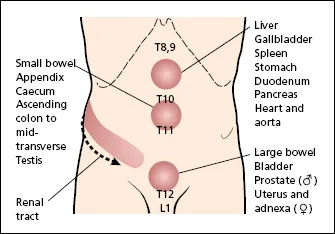
Figure 1.1 Location of referred pain for the abdominal organs.
c01f001
It is often useful to consider the viscera in terms of their embryology. Thus, epigastric pain is generally from foregut structures such as stomach, duodenum, liver, gallbladder, spleen and pancreas; periumbilical pain is midgut pain from small bowel and ascending colon, and includes the appendix; suprapubic pain is hindgut pain, originating in the colon, rectum and other structures of the cloaca such as the bladder, uterus and fallopian tubes (Figure 1.1). Testicular pain may also be periumbilical, reflecting the intra-abdominal origin of these organs before their descent into the scrotum – nev...

Table of contents

  1. Cover
  2. Series page
  3. Title page
  4. Copyright
  5. Introduction
  6. Acknowledgements
  7. Abbreviations
  8. 1: Surgical strategy
  9. 2: Fluid and electrolyte management
  10. 3: Preoperative assessment
  11. 4: Postoperative complications
  12. 5: Acute infections
  13. 6: Shock
  14. 7: Tumours
  15. 8: Burns
  16. 9: The skin and its adnexae
  17. 10: The chest and lungs
  18. 11: The heart and thoracic aorta
  19. 12: Arterial disease
  20. 13: Venous disorders of the lower limb
  21. 14: The brain and meninges
  22. 15: Head injury
  23. 16: The spine
  24. 17: Peripheral nerve injuries
  25. 18: The oral cavity
  26. 19: The salivary glands
  27. 20: The oesophagus
  28. 21: The stomach and duodenum
  29. 22: Mechanical intestinal obstruction
  30. 23: The small intestine
  31. 24: Acute appendicitis
  32. 25: The colon
  33. 26: The rectum and anal canal
  34. 27: Peritonitis
  35. 28: Paralytic ileus
  36. 29: Hernia
  37. 30: The liver
  38. 31: The gallbladder and bile ducts
  39. 32: The pancreas
  40. 33: The spleen
  41. 34: The lymph nodes and lymphatics
  42. 35: The breast
  43. 36: The neck
  44. 37: The thyroid
  45. 38: The parathyroids
  46. 39: The thymus
  47. 40: The suprarenal glands
  48. 41: The kidney and ureter
  49. 42: The bladder
  50. 43: The prostate
  51. 44: The male urethra
  52. 45: The penis
  53. 46: The testis and scrotum
  54. 47: Transplantation surgery
  55. Index