Bonus web content includes a PowerPoint presentation on CSR and short video clips." to: "Bonus web content includes a PowerPoint presentation on CSR implementation.
eBook - ePub
Now We Get It!
Boosting Comprehension with Collaborative Strategic Reading
- English
- ePUB (mobile friendly)
- Available on iOS & Android
eBook - ePub
Now We Get It!
Boosting Comprehension with Collaborative Strategic Reading
About this book
Information
CHAPTER 1
How CSR Works
Of probably all of the things I have done, with pre-AP or the differentiation or the other things the district has thrown at me in seven years, this is probably the only one I will keep and I’m hard to convince. I’m hard to convince and this one has.
—MIDDLE SCHOOL LANGUAGE ARTS TEACHER
I think CSR is wonderful. It’s an excellent program. It’s practical; it focuses kids; it has all the elements in reading that they need and it’s lifelong.
—MIDDLE SCHOOL READING INTERVENTION TEACHER
CSR is an excellent technique for teaching students reading comprehension and building vocabulary and also working together cooperatively. I think it is wonderful. We have been using it with the science text and it’s turned out beautifully.
—FIFTH-GRADE TEACHER
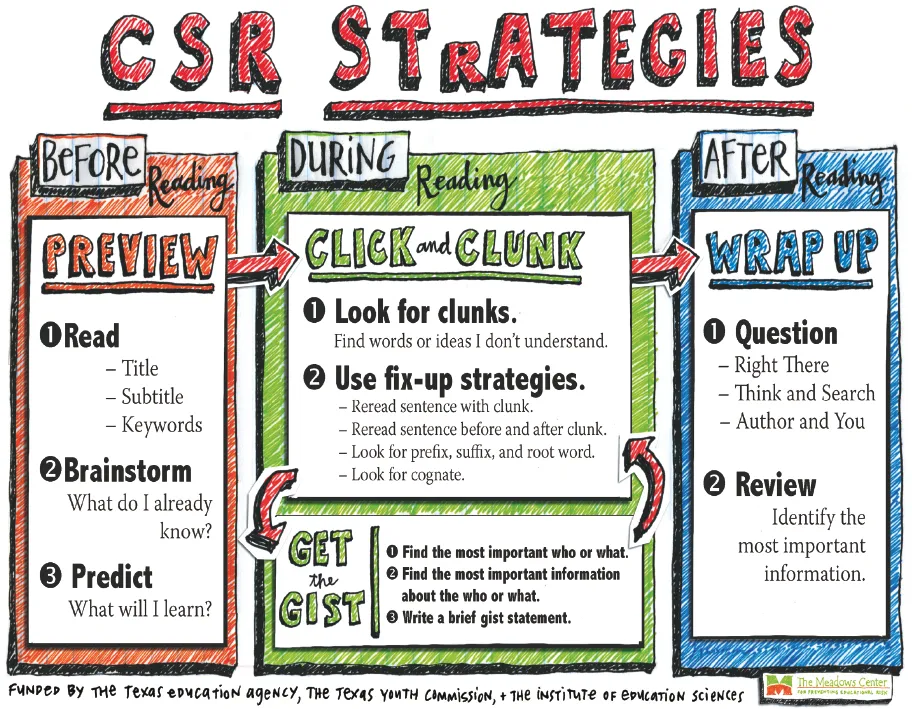
In this chapter, we describe CSR. We discuss each of the strategies and provide examples of students working together in small groups. CSR strategies occur before, during, and after reading (see Figure 1.1).
FIGURE 1.1. CSR Comprehension Strategies
Reprinted with permission from the Meadows Center for Preventing Educational Risk (2009). CSR strategies. Austin, TX: Janette Klingner and Sharon Vaughn.
Before Reading: Preview
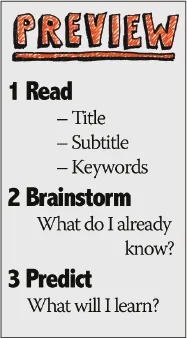
Students preview the entire passage before they read each section. The goals of previewing are (1) for students to learn as much about the passage as they can in a brief period of time (two to three minutes), (2) to activate their background knowledge about the topic, and (3) to make predictions about what they will learn. Previewing serves to motivate students’ interest in the topic and to engage them in active reading from the onset. Preview also provides opportunities to help students develop background knowledge about the reading, and build vocabulary and concepts to enhance their understanding of the passage.
When students preview before reading, they should look at the following:
- The passage’s title
- Any headings
- Words that are bolded or underlined
- Any pictures, tables, graphs, and other key information
This will help them do two things:
- Brainstorm what they already know about the topic
- Predict what they will learn about the topic
The teacher leads the preview portion of CSR. In previous versions of CSR,1 students conducted a student-guided preview while working together in their small groups. Over the years, we have found that students do not always have sufficient background knowledge about a topic or sufficiently understand how the topic of the day’s reading connects with other lessons. This is especially true when students begin a new unit of study. Therefore, we now ask teachers to facilitate the Preview. That way, the teacher can preteach a few key vocabulary words; provide a short video clip, pictures, chart, or diagram to help build background knowledge about the topic of the passage; and give students feedback on their brainstorms and predictions, helping them to make connections. While leading the Preview, the teacher asks students to write their brainstorm statements and predictions in their learning logs and to share with one another (either with a partner or in small groups) (see Figure 1.2).
FIGURE 1.2. The Preview Process
In the following example, students from an eighth-grade language arts class are sharing their predictions while reading “The Odyssey”:
Gabrielle: Do you guys have what you think might happen today?
Nate: I have mine.
Cassidy: Yes, me too, I have it.
James: Mmm, I don’t know …
Gabrielle: Well, I thought that we might learn about his journey from Achilles, because I looked ahead and I got to see the picture.
Cassidy: Mine is sort of like yours. I said that I think he [Ulysses] is going to be learning about, um, the land of the dead, because that is obviously the title, and that can help, so that’s what I think it’s about.
In the next example, seventh-graders are sharing their predictions about an article that describes the melting of the polar ice cap. The teacher has already conducted a whole-class Preview and has asked students to share their predictions. David is an English language learner (ELL) with learning disabilities who reads at about a second-grade level.
Cinthia: Okay, I think that I might learn what is happening in the North Pole and the effects of the ice melting and what it can do and what can happen.
David: Good job, Cinthia.
Cinthia: Thank you.
Laura: I might learn about the topic, how to help the environment and how to keep the ice, keep it safe. David?
David: I think I’m gonna learn how to find out what the climate is and how it is changing.
Katy: Okay, I put that I think that we will learn about how to prevent this and what we can do about it.
Although David might not be able to read every word in the passage, he was able to glean enough about the passage from previewing it and from hearing his peers’ predictions to come up with his own prediction.
During Reading: Click and Clunk
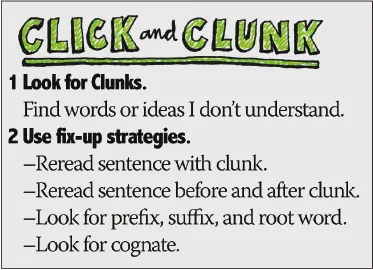
Students Click and Clunk while reading each section of the passage. One section of a passage typically consists of one to three paragraphs. Sometimes sections of text in a textbook are set off by subheadings that make it easy to separate them. At other times, the teacher decides where to separate the passage. Three sections of text for one day’s reading works well. Students learn to think about what they are reading and to determine if there is a word or concept that they do not understand. They learn to refer to this as a clunk. Students are then asked to underline or write down their clunks.
The goal of teaching students about Click and Clunk is to get them to monitor their understanding while they read and to determine whether they have “meaning” breakdowns. In other words, Click and Clunk helps students develop the metacognitive awareness that is so important for successful reading.
Many students with reading difficulties fail to adequately monitor their understanding while they are reading. Click and Clunk is designed to serve as a trigger for monitoring their understanding. Clicks refer to portions of the text that make sense to the reader: click, click, click—comprehension clicks into place as the reader proceeds smoothly through the text. When students come to a word, concept, or idea that does not make sense, they are taught to think of that as a clunk, a bump in the road where comprehension breaks down. Initially, the teacher asks, “Is everything clicking? Who has clunks about the section we just read?” Students know that they will be asked this question and are alert to identify clunks during reading. Over time, students take on the responsibility for identifying their own clunks. See Figure 1.3 for a summary of Click and Clunk.
FIGURE 1.3. The Click and Clunk Process
Learning to identify clunks is important. But wh...
Table of contents
- Cover
- Jossey-Bass Teacher
- More Praise for Collaborative Strategic Reading and
- Title page
- Copyright page
- ABOUT THE AUTHORS
- Dedication
- ACKNOWLEDGMENTS
- INTRODUCTION: COLLABORATIVE STRATEGIC READING IN A NUTSHELL
- Part I: Getting to Know Collaborative Strategic Reading
- Part II: Teaching CSR in the Classroom
- Part III: Providing CSR Professional Development and Ongoing Support
- Part IV: Appendixes
- Index
Trusted by 375,005 students
Access to over 1.5 million titles for a fair monthly price.
Study more efficiently using our study tools.
Frequently asked questions
Yes, you can cancel anytime from the Subscription tab in your account settings on the Perlego website. Your subscription will stay active until the end of your current billing period. Learn how to cancel your subscription
No, books cannot be downloaded as external files, such as PDFs, for use outside of Perlego. However, you can download books within the Perlego app for offline reading on mobile or tablet. Learn how to download books offline
Perlego offers two plans: Essential and Complete
- Essential is ideal for learners and professionals who enjoy exploring a wide range of subjects. Access the Essential Library with 800,000+ trusted titles and best-sellers across business, personal growth, and the humanities. Includes unlimited reading time and Standard Read Aloud voice.
- Complete: Perfect for advanced learners and researchers needing full, unrestricted access. Unlock 1.5M+ books across hundreds of subjects, including academic and specialized titles. The Complete Plan also includes advanced features like Premium Read Aloud and Research Assistant.
We are an online textbook subscription service, where you can get access to an entire online library for less than the price of a single book per month. With over 1.5 million books across 990+ topics, we’ve got you covered! Learn about our mission
Look out for the read-aloud symbol on your next book to see if you can listen to it. The read-aloud tool reads text aloud for you, highlighting the text as it is being read. You can pause it, speed it up and slow it down. Learn more about Read Aloud
Yes! You can use the Perlego app on both iOS and Android devices to read anytime, anywhere — even offline. Perfect for commutes or when you’re on the go.
Please note we cannot support devices running on iOS 13 and Android 7 or earlier. Learn more about using the app
Please note we cannot support devices running on iOS 13 and Android 7 or earlier. Learn more about using the app
Yes, you can access Now We Get It! by Janette K. Klingner,Sharon Vaughn,Alison Boardman,Elizabeth Swanson in PDF and/or ePUB format, as well as other popular books in Education & Education Teaching Methods. We have over 1.5 million books available in our catalogue for you to explore.