![]()
Chapter 1
What Employees Really Want
Here's a scenario that almost any manager, at any level, can relate to. You have a project due and it's requiring a big push from everyone involved. Millions in revenue are at stake. Your career, and your team's success, depend on the project being completed on time and in perfect condition. No problem, you think. You've done this before, but now one of your key team members—a direct report—is threatening to quit. The team member feels undervalued, underappreciated, and underpaid for what's being asked. If you lose this employee at this time, your project is doomed. What next?
Finding a replacement who can do the job on such short notice is out of the question. You need to fix this. You have to fix this. The project's success depends on it, and your own career depends on it.
But how do you fix it?
This turnover drama is no small matter, and it's one that is played out every day, in every industry, in every country around the world. In nearly every organization—be it small businesses, non-profit organizations, or multinational companies—human capital costs can exceed 40 percent of corporate expenses.1 Employees represent a massive investment, one that leaders know needs to be protected. It's not simply about avoiding the cost, distraction, and hassle of finding new employees—although those are valid issues. Making sure employees are fulfilled at work isn't just about simple human decency either, although that's also a great argument.
The fact is that managers and organizations that give their employees what they want outperform those that don't. As we'll see in Chapter 4, the evidence for providing employees with what they want is incredibly compelling. Figuring out exactly what it is that employees want can be more challenging, but that is exactly what we've spent the last twenty-five years getting to the bottom of. In the process we have amassed a research database unlike any other, and it all started with this simple question:
Beyond that original and fundamental question we've since added over one hundred additional items that probe topics like leadership effectiveness, employee engagement, diversity practices, turnover and retention, the impact of layoffs, union vulnerability, and job satisfaction. We have answers from all corners of the world, from all job types, from men and women, and from employees who span the working generations. Since we started our research, we've heard from over two hundred thousand employees. In our most recent survey alone, we heard from more than thirty-five thousand employees who work in some of the world's most powerful economies, including Canada, China, Brazil, France, Germany, India, Italy, Japan, Russia, Spain, the United Kingdom, and the United States. The survey's geographic reach actually expands even further, but these countries alone account for an incredible 71 percent of the world's gross domestic product (GDP).2
It's not just geographic diversity that we're after. We surveyed employees who work in every major industry, from food to finance, from heavy manufacturing to health care, from retail to pharmaceuticals, and from energy to electronics. We heard from senior U.S. executives in the restaurant business and from construction laborers in Italy. We surveyed retail managers in India and banking managers from the United Kingdom. Our database lets us compare how retail sales associates in, say, Japan match up against those in Canada—or against the rest of the world. How do government workers in Australia feel compared to their counterparts in China? We have that, too.
Not only has this mountain of data been subjected to ongoing and rigorous scientific analysis, but after two and a half decades of compounded knowledge it has allowed us to reveal the basic truths about employee needs and desires.
All I'm askin'
Is for a little respect….”
Business books don't generally begin by singing along with the Queen of Soul, Aretha Franklin, but frankly we couldn't have come up with a better entrée—or a more perfectly suited acronym. Your employees are definitely singing this tune, and we don't mean at karaoke night. If you've hired the right people, then you know they have what you need. But what do they need? The answer can be broken down into seven fundamental desires that include:
Recognition: A pat on the back from managers and the organization at-large
Exciting work: A job that's interesting, challenging, and fun
Security of employment: Job security, you may not want to talk about this, but employees do
Pay: Fair compensation for a day's work
Education and career growth: Opportunities to develop skills and a career
Conditions at work: A workplace that is comfortable physically and socially, and well-equipped
Truth: Frank, honest, and transparent leaders
RESPECT means a job that offers employees something they enjoy doing and a chance to shine. Employees are looking for stability and security now (financially and otherwise), and a clear path for their occupational futures. They want the truth—to know what is going on so they can make the best decisions for themselves and their families. Build this organization—one that offers employees the whole package—and employees will work harder, stay longer, and help the organization outperform its competitors.
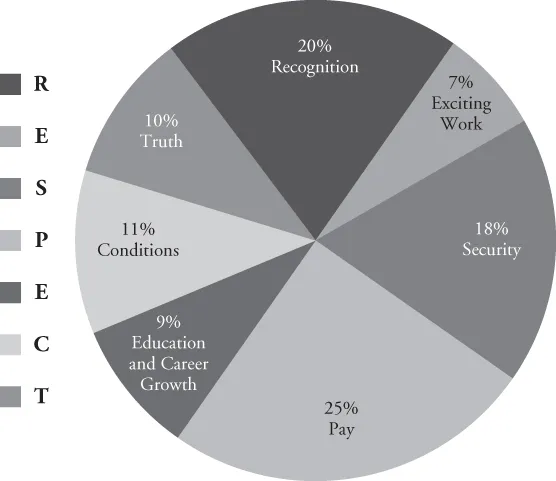
It's important to realize at the outset that it's not all about the money. Before we started this project, we assumed that the vast majority of employees would primarily want one thing: more pay. The small remainder, we suspected, would be sprinkled across the other categories, but the results, shown in Figure 1.1, indicate that this is definitely not so. It's true that pay comes out on top, with 25 percent of employees saying it is the most important thing to them. Yet, recognition comes in a close second—with 20 percent citing that as their foremost want—and security is right behind, with 18 percent saying it's their most important work need.
This is, frankly, nothing short of incredible news. Think about it. That means 75 percent of what employees want is not directly tied to a fatter paycheck. It means that executives, managers, and organizations have powerful solutions other than salary and benefits to motivate, engage, and retain employees.
In Chapters 3 through 9 we're going to explore each area of RESPECT individually. We'll show you ways to diagnose your organization's current state of RESPECT, offer you some guiding principles for improving RESPECT, and, finally, give you some concrete actions with proven examples that you can use to increase RESPECT. For now, let's take a quick look at the seven RESPECT principles. For managers who are highly in tune with their workforce, many of these will immediately resonate. What's different today is that we now have the research and the tools to accurately measure, explain, and understand these employee needs and to create a better, more productive workplace.
Recognition
It is so simple really: just tell employees they've done a good job. When we pore through the responses in this category, employees typically say they want things like: “to be appreciated for the work I do,”
Finding Self-RESPECT: The Case of the Battered Trainee
On a recent road trip I stopped in at a fast food restaurant. It was about 2:00 p.m. and there was only one other patron there, and he was reading the newspaper while his French fries got cold and clammy. As I approached the counter, a ponytailed skinny girl of sixteen or so glanced up and offered me a tired, “pity-me” sort of smile.
Her badge announced that her name was Amy, and tacked on underneath, “trainee.” Poor Amy; in an effort to elicit compassion from the customer, the organization had branded Amy as slow and dimwitted. I wondered how long she'd have to wait to qualify for her credentials.
Typically, when I see that badge, depending on how hurried I am, I either (a) pretend I forgot something and step back fifteen feet so I can covertly change cashiers or (b) revert back to my coaching days and offer unsolicited feedback: “You're doing a great job!” However, on this particular day, my choice was forced—there were no other cashiers, and I was the only person ordering. C'est la vie.
I purposefully approached the counter and ordered a Number 3. She pressed a button. It beeped. Apparently, this was not the response she had hoped for. She tried again—beep. And again. She muttered an apology and I said, “It's ok.” She glared at the cash register for quite some time, although I was sure that the stink-eye and a hard stare wouldn't convince it to do her bidding. As Amy held her finger poised above the button, I held my breath for the sake of her dignity, but no—beep. Defeated, she called Glenda over.
Now, there was no “trainee” apology on Glenda's nametag. With an air of superiority, Glenda emerged from the bowels of the grill area. Glasses blurred with grease, Glenda reminded me of a soldier who has seen a lot of action at the front lines. She was the top dog on this shift.
Glenda clomped over, her gait possibly powered by kinetic energy generated by her fantastic eye rolls. As Glenda instructed Amy on how to right the wrong, it was clear that my trainee had made an error so egregious that the world might just spin right off its axis. Glenda also drove the point home that Amy may be the most stupid employee who ever graced the front counter with her presence. Amy looked so small that she might have crawled into the cash drawer had space allowed. I considered kidnapping her and taking her with me.
At the very least, Amy was most certainly not getting what she needed from her organization. Relationships don't tend to work if one person perceives they are more important than the other. It's a reciprocal engagement, and one that needs to be in balance. Employees give their employer their time, energy, knowledge, and skills. The employer owes them something in return.
Enter RESPECT. Could Amy's hourly wage be motivating enough for her to put up with Glenda's abuse? Unlikely. Plenty of other places pay minimum wage. If Amy likes her job at all, she must have a value in one of the other elements of RESPECT that provide a strong reason to stay despite the verbal floggings doled out by her half-wit supervisor.
Finally, a note to organizations who brand their newcomers as “trainees”—train them as fast as possible! Nothing like starting out at a new job by being embarrassed all day.
—Brenda Kowske
“true recognition, not a good job postal card,” and “recognition for the job I've done, and a valid interest in my concerns.”
There are a million ways to be busy and overwhelmed at work, so much so that it can be tough to look back and give someone a pat on the back. We are so quick to move to the next challenge that taking a moment to recognize what went right and who was responsible gets lost in the shuffle. Yet, our data clearly indicate that making recognition happen is important to employees. Managers should make the time for recognition and thoroughly integrate it into the normal routine.
Exciting Work
Exciting work means being driven by the result—a result in which both the employee and the organization are heavily committed. Leaders understandably hope that employees make a personal commitment to an organization's financial goals, but employees often get excited by more altruistic goals. I want “a job I can believe in and know that ...