In fluid mechanics, velocity measurement is fundamental in order to improve the behavior knowledge of the flow. Velocity maps help us to understand the mean flow structure and its fluctuations, in order to further validate codes. Laser velocimetry is an optical technique for velocity measurements; it is based on light scattering by tiny particles assumed to follow the flow, which allows the local fluid flow velocity and its fluctuations to be determined. It is a widely used non-intrusive technique to measure velocities in fluid flows, either locally or in a map. This book presents the various techniques of laser velocimetry, as well as their specific qualities: local measurements or in plane maps, mean or instantaneous values, 3D measurements. Flow seeding with particles is described with currently used products, as well as the appropriate aerosol generators. Post-processing of data allows us to extract synthetic information from measurements and to perform comparisons with results issued from CFD codes. The principles and characteristics of the different available techniques, all based on the scattering of light by tiny particles embedded in the flow, are described in detail; showing how they deliver different information, either locally or in a map, mean values and turbulence characteristics.
Trusted by 375,005 students
Access to over 1.5 million titles for a fair monthly price.
Measurements provide useful information for the interpretation of physical phenomena and for code validation. Fluid mechanics is based on nonlinear Navier– Stokes equations, which are very difficult to solve directly; simplifying assumptions or numerical approximations are used in order to make calculation times reasonable. Sometimes empirical relations are established when theory is not available; in particular, turbulent regime analysis leads to the building of new theories that must be verified. All these processes require validation by experiments and accurate measurements.
The most famous names in physics are associated with knowledge evolution in fluid mechanics, from Newton to Euler, Navier and Stokes, and also Bernoulli, Lagrange, Leibniz and Cauchy.
Theoretical approaches consist of mathematical resolution of partial differential equations. When an analytical solution is not possible, numerical approaches are used, but must be verified by well–documented experiments. In fluid mechanics, more than elsewhere, the three approaches (theory, simulation, and experimentation) often cannot be separated.
Theoretical treatment is exact and universal, but requires good physical knowledge of the phenomena. Boundary conditions are often made ideal and solutions are not available for complex flow configurations.
Numerical simulation provides complete flow information, with conditions that can be easily modified. Nevertheless, the process is often very expensive to put into operation, is limited by the computer power, and as turbulence models are not universal, a certain ability is required for correct employment.
Experimental investigations make parametric studies possible, in order to recognize which parameters are influent; sometimes it is the only way to obtain information. Yet they may appear rather complicated and expensive to implement; not all the variables can be measured and the intrusive character of the measuring method must be minimized.
1.1. Navier–Stokes equations
General equations in fluid mechanics are based on mass and energy conservation, as well as on movement quantity equations. These equations, called Navier–Stokes equations, make use of spatial and temporal partial derivatives of velocity and temperature, at first and second order. Even if exact solutions exist for simple laminar flows, for real flows, which are turbulent and 3D, calculations become much too complex to be solved by current computers within acceptable timescales. Therefore, numerical solutions are not exact and generate errors that must be evaluated by experiments and appropriate measurements.
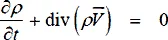
The continuity equation (mass conservation) is expressed by:
[1.1]
where ρ is the volume mass and
the velocity vector, with (u, v, w) coordinates in the frame (x, y, z) or (u1, u2, u3) in the frame (x1, x2, x3).
For an incompressible flow (ρ = constant), it becomes:
[1.2]
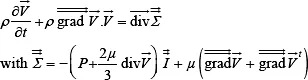
The movement quantity equation expresses the fact that the system movement quantity derivative is equal to the sum of the forces acting on the system. Using some assumptions, mainly that of Newtonian flow, this vector equation is written:
[1.3]
is the constraint tensor, which makes pressure P and dynamic viscosity µ appear.
represents the unity tensor.
In incompressible conditions, movement quantity equation along x is reduced to:
[1.4]
where v = µ/ρ is the kinematic v...
Table of contents
Cover
Title Page
Copyright
Preface
Introduction
Chapter 1: Measurement Needs in Fluid Mechanics
Chapter 2: Classification of Laser Velocimetry Techniques
Chapter 3: Laser Doppler Velocimetry
Chapter 4: Optical Barrier Velocimetry
Chapter 5: Doppler Global Velocimetry
Chapter 6: Particle Image Velocimetry
Chapter 7: Seeding in Laser Velocimetry
Chapter 8: Post-Processing of LDV Data
Chapter 9: Comparison of Different Techniques
Conclusion
Nomenclature
List of Authors
Index
Frequently asked questions
Yes, you can cancel anytime from the Subscription tab in your account settings on the Perlego website. Your subscription will stay active until the end of your current billing period. Learn how to cancel your subscription
No, books cannot be downloaded as external files, such as PDFs, for use outside of Perlego. However, you can download books within the Perlego app for offline reading on mobile or tablet. Learn how to download books offline
Perlego offers two plans: Essential and Complete
Essential is ideal for learners and professionals who enjoy exploring a wide range of subjects. Access the Essential Library with 800,000+ trusted titles and best-sellers across business, personal growth, and the humanities. Includes unlimited reading time and Standard Read Aloud voice.
Complete: Perfect for advanced learners and researchers needing full, unrestricted access. Unlock 1.5M+ books across hundreds of subjects, including academic and specialized titles. The Complete Plan also includes advanced features like Premium Read Aloud and Research Assistant.
Both plans are available with monthly, semester, or annual billing cycles.
We are an online textbook subscription service, where you can get access to an entire online library for less than the price of a single book per month. With over 1.5 million books across 990+ topics, we’ve got you covered! Learn about our mission
Look out for the read-aloud symbol on your next book to see if you can listen to it. The read-aloud tool reads text aloud for you, highlighting the text as it is being read. You can pause it, speed it up and slow it down. Learn more about Read Aloud
Yes! You can use the Perlego app on both iOS and Android devices to read anytime, anywhere — even offline. Perfect for commutes or when you’re on the go. Please note we cannot support devices running on iOS 13 and Android 7 or earlier. Learn more about using the app
Yes, you can access Laser Velocimetry in Fluid Mechanics by Alain Boutier in PDF and/or ePUB format, as well as other popular books in Physical Sciences & Mechanics. We have over 1.5 million books available in our catalogue for you to explore.