![]()
Part 1
Overview and Perspectives
![]()
1
Introduction
Gade Pandu Rangaiah1 and Vinay Kariwala2
1Department of Chemical and Biomolecular Engineering, National University of Singapore, Singapore
2School of Chemical and Biomedical Engineering, Nanyang Technological University, Singapore
1.1 Background
Industrial chemical plants and processes usually involve many types of operations and numerous items of equipment operating at different temperatures and pressures. Consequently, these plants are complex and also often large in size. The safe and optimal operation of industrial chemical plants requires the maintenance of critical operating conditions such as temperature, pressure and composition at their respective optimal values as well as within safe limits. This challenging task has to be achieved in the presence of known disturbances such as throughput and product specification changes arising from variations in the market demand and requirements, as well as unknown and unmeasured disturbances in raw material composition, catalyst activity, equipment conditions and environment. Hence, a reliable and extensive monitoring and control system is essential for the safe and optimal operation of modern chemical plants.
The monitoring and control requirements from the chemical plants have led to the development of process control as an important area within the Chemical Engineering discipline. Accordingly, the majority of undergraduate programs in Chemical Engineering throughout the world have a compulsory course on process dynamics and control. Further, many of these programs include an optional course on advanced process control. Many textbooks on process dynamics and control are available, a number of them into their second or even third editions (e.g., Ogunnaike and Ray, 1994; Marlin, 2000; Bequette, 2003; Romagnoli and Palazoglu, 2005; Riggs and Karim, 2006; Svrcek et al., 2006; Seborg et al., 2010). Advanced and specialized courses in process control such as model predictive control, digital control, robust control and nonlinear control can be found in the graduate programs in Chemical Engineering.
Numerous equipment in industrial chemical plants are inter-connected and operate together in order to achieve the desired process objective such as optimal production of a valuable product of desired quantity and quality from the raw materials. In effect, there are complex interactions between the equipment in chemical plants; these are increasing with energy and material integration and safety and optimization requirements (with consequent reduction in intermediate storage). A plantwide perspective is therefore crucial for synthesis and design of control systems for chemical plants, and this in turn has led to the development of plantwide control (PWC) as a sub-area within the broad topic of process control. This can be seen from the inclusion of one or two chapters in the more recent textbooks related to process control (e.g., Marlin, 2000; Skogestad and Postlethwaite, 2005; Svrcek et al., 2006; Seborg et al., 2010; Seider et al., 2010). There is also one book dedicated to plantwide control by Luyben et al. (1998). Another book on plantwide dynamic simulators by Luyben (2002) is also relevant and useful for PWC applications.
1.2 Plantwide Control
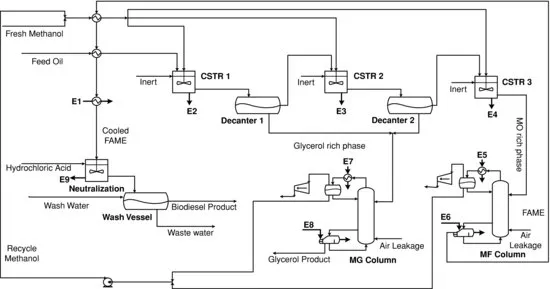
As an example of a typical chemical plant, consider the biodiesel production from vegetable oil by trans-esterification. The process flow diagram for this process is shown in Figure 1.1. This process has three continuous stirred tank reactors (CSTRs), two liquid-liquid phase separators, two distillation columns, a neutralization unit, a wash vessel and several heat exchangers. The process features a material recycle of un-reacted methanol and an energy recycle stream for energy conservation. The liquid-liquid phase separators can have very slow dynamics due to their large inventories. A suitable thermodynamic model is necessary for predicting phase behavior in the phase separators and distillation columns. Besides the product specifications, there are upper limits on the maximum temperature (i.e., in the reboiler) of the two columns in order to avoid decomposition of biodiesel and glycerol byproduct, which also necessitate vacuum operation. A plantwide control system needs to be synthesized and designed for the complex biodiesel process for its safe and optimal operation. It should consider and maintain product purities and operating constraints as well as smoothly change the throughput in response to the variations in the feed availability and/or product demand. In fact, a control system for this plant is synthesized and tested in Chapter 14 of this book.
Accordingly, PWC refers to the synthesis and design of a control system for the complete plant considering all aspects such as throughput changes and interaction between units affecting the safe and optimal operation of the entire plant. Interaction between units has been increasing with increasing energy and mass recycling due to process optimization and with reducing inventories due to safety concerns. The main focus in PWC is on the control system synthesis considering these interactions within the plant, and not on the design of a feedback controller (although it is one part of PWC). The key questions in the control system synthesis are: which variables should be controlled, which variables should be manipulated and how should these be paired? In other words, what kind of controllers are required and where should they be placed for safe, economic and sustainable operation of the plant? In a complete plant, there are numerous choices for both controlled and manipulated variables; PWC system synthesis is therefore a large combinatorial problem. It is also a complex problem since it should consider the dynamics of all equipment in the plant.
PWC typically deals with the synthesis and development of the regulatory layer of the control system and can include supervisory layer. The former consists of ubiquitous proportional-integral-derivative (PID) controllers which directly manipulate mass and energy flow to the equipment, for example, through control valves. For complete PWC design, parameters of these feedback controllers, ratio/cascade control loops and so on also need to be specified. Complexity of PWC is also evident from the numerous PID controllers in a typical plant. On the other hand, the supervisory layer has one or more model-based/predictive controllers providing set points for some of the PID controllers in the regulatory layer.
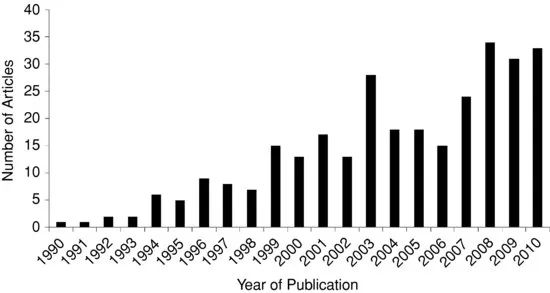
Interest, research and development in PWC can be traced back to Buckley (1964), who developed the first procedure for PWC. Most of the developments in PWC have occurred during the last two decades. Figure 1.2 shows the number of articles published in each year during the period 1990–2010. These data were obtained by searching by topic on Web of Science for the important keywords (plantwide control, plant-wide control and reactor separator recycle control) in the subject area of Chemical Engineering. The search has found many PWC papers known to us, but it has missed some related papers (e.g., on controlled and manipulated variables selection and pairing). Note that the data shown in Figure 1.2 include conference papers. In any case, Figure 1.2 gives a good indication of the research in the area of PWC. It is clear that PWC papers have been increasing since mid-1990s, with 30–35 papers published in each of the years 2008, 2009 and 2010.
1.3 Scope and Organization of the Book
PWC covers selection and pairing of controlled and manipulated variables, degrees of freedom, comprehensive methodologies, realistic applications and performance assessment of control systems designed. Obviously, it requires enabling techniques and tools for these such as steady-state/dynamic simulation and controller tuning. All these are covered in this book, with emphasis on recent research and development.
This book is broadly divided into five parts. Part I (Chapters 1 and 2) provide an overview and perspectives on research and development in PWC. Several tools and heuristics for carrying out subtasks of PWC design are presented in Part II (Chapters 3–8). Part III (Chapters 9–12) deals with systematic methodologies for design and evaluation of PWC systems. Various application studies are used to illustrate the wide applicability of these approaches in Part IV (Chapters 13–17). Some emerging topics within the scope of PWC are described in Part V (Chapters 18–20). Brief overviews of these chapters are presented next.
In Chapter 2, Downs provides an industrial perspective on the past and ongoing research activities in the area of PWC. It is emphasized that industrial acceptance requires design of control strategies, which are easy to understand and can be devised in a time-efficient fashion with limited information (e.g., steady-state model). These requirements often limit the application of analytical methods based on a detailed dynamic model in process industries. Furthermore, Downs highlights the need to develop tools for the important issue of identifying the most difficult disturbances to be handled by the PWC system.
Chapters 3–5 deal with the identification and pairing of controlled and manipulated variables; these decisions are collectively known as control structure design. In Chapter 3, Konda and Rangaiah point out that the traditional method of computing control degrees of freedom (CDOF) by subtracting the number of equations from number of variables is tedious and error-prone for large-scale processes. A simple method based on the concept of restraining number for identifying CDOF is discussed in detail and illustrated using several case studies ranging from simple units to industrial processes, including a carbon capture process.
In Chapter 4, Umar, Hu, Cao and Kariwala present the self-optimizing control (SOC) based method for systematic selection of controlled variables (CVs) from available measurements. The general formulation of SOC methodology and the local methods for quick pre-screening of CV alternatives are presented. Branch and bound methods, which allow the application of local methods to large-scale systems, are discussed. The detailed case study of the forced-circulation evaporator is used to illustrate the CV selection method.
In Chapter 5, Moaveni and Kariwala provide an overview of the key methods available for selection of pairings of controlled and manipulated variables. Pairing selection methods for linear time-invariant systems are classified as relative gain array (RGA) and variants, interaction methods, and controllability- and observability-based methods. Some recent methods for pairing selection for uncertain and nonlinear processes are also discussed. Several examples are presented in tutorial fashion to aid the reader’s understanding of the application of different methods.
In Chapter 6, Luyben presents some ‘common-sense’ heuristics which can aid the design of practical PWC systems for complex chemical processes. In particular, heuristics are presented for dealing with recycle streams and determining effective ways to feed the fresh reactant streams into the process. Some guidelines for tuning the PID controller for different loops (e.g., flow, pressure, level, temperature and composition) with a plantwide perspective are also provided. The toluene hydrodealkylation (HDA) process is used to illustrate the application of these heuristics.
In Chapter 7, Jagtap and Kaistha discuss the choice of the throughput manipulator (TPM). A heuristic for selecting the TPM for tight bottleneck/economically dominant constraint control and designing the PWC system around the selected TPM is suggested. The effect of the TPM choice on the economic performance of two realistic chemical processes is evaluated. It is shown that the suggested heuristic provides better economic performance than the conventional practice of using the fresh process feed as the TPM.
In Chapter 8, Downs and Caveness highlight that the PWC system is a mechanism to shift process disturbances and process variability from harmful locations to other locations that have less risk, harm or cost to the overall plant. Thus, viewing the process control system as a variability change agent can provide insights into PWC system development and analysis. Theoretical analysis and realistic examples are presented to signify the effect of choosing inventory location and size, TPM and strategies for managing recycle streams or the management of process variability.
In Chapter 9, Vasudevan and Rangaiah present a review of PWC design methodologies and applications. The available PWC methodologies are classified based on their approach and their brief overview is provided. The structure-based classification of PWC methodologies is also presented. The industrial processes considered in the reported PWC studies are listed together with their main features. Finally, PWC comparative studies performed to date are reviewed.
In Chapter 10, Vasudevan, Konda and Rangaiah present the integrated framework of simulation and heuristics (IFSH) as an effective and practical PWC system design method. The main emphasis of this methodology is the use of steady-state and dynamic simulations of the plant throughout the procedure to make the right decision from those suggested by heuristics. The IFSH procedure is illustrated on the modified HDA process featuring a membrane separator in the gas recycle loop. Analysis of the results indicates that the integrated framework builds synergies between the powers of both simulation and heuristics, to yield a stable and robust PWC structure.
Chapter 11 is on the PWC procedure of Skogestad. An important feature of this procedure is to start with the optimal economic operation of the plant and then attempt to design a control structure that implements optimal operation, while also considering the more basic requirements of robustness and stability. The procedure is split into a top-down part, based on plant economics, and a bottom-up part. The bottom-up parts aims to find a simple and robust ‘stabilizing’ or ‘regulatory’ control structure, which can be used under most economic conditions.
In Chapter 12, Vasudevan and Rangaiah present reliable quantitative criteria for comprehensively analyzing and comparing the performance of different PWC structures. These criteria include dynamic disturbance sensitivity, deviation from the production target, total variation in manipulated variables, process settling time and steady-state economic measure. These measures are applied to the PWC system developed for the modified HDA process in Chapter 10. The authors also provide some recommendations for comprehensive performance assessment of PWC systems.
In Chapter 13, Luyben considers control of an ammonia process containing multiple adiabatic reactors with ‘cold-shot’ cooling. It is demonstrated that a cooled ammonia reactor is much more economical because of low...