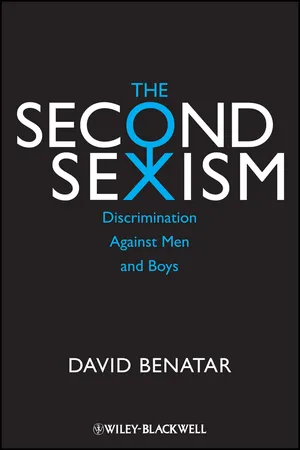
This book draws attention to the "second sexism," where it exists, how it works and what it looks like, and responds to those who would deny that it exists. Challenging conventional ways of thinking, it examines controversial issues such as sex-based affirmative action, gender roles, and charges of anti-feminism. The book offers an academically rigorous argument in an accessible style, including the careful use of empirical data, and includes examples and engages in a discussion of how sex discrimination against men and boys also undermines the cause for female equality.
- English
- ePUB (mobile friendly)
- Available on iOS & Android
eBook - ePub
About this book
Does sexism against men exist? What it looks like and why we need to take it seriously
Information
1
Introduction
Many men are far more oppressed than many women, and any feminist who was determined to support women in all situations would certainly encounter some where her support of women against men would increase the level of injustice in the world. … No feminist whose concern for women stems from concern for justice in general can ever legitimately allow her only interest to be the advantage of women.
Janet Radcliffe Richards, The Sceptical Feminist,
London: Penguin Books, 1994, p. 31.
London: Penguin Books, 1994, p. 31.
What Is the Second Sexism?
In those societies in which sex discrimination has been recognized to be wrong, the response to this form of discrimination has targeted those attitudes and practices that (primarily) disadvantage women and girls. At the most, there has been only scant attention to those manifestations of sex discrimination whose primary victims are men and boys. 1 What little recognition there has been of discrimination against males 2 has very rarely resulted in amelioration. For these reasons, we might refer to discrimination against males as the “second sexism,” to adapt Simone de Beauvoir’s famous phrase. 3 The second sexism is the neglected sexism, the sexism that is not taken seriously even by most of those who oppose (or at least claim that they oppose) sex discrimination. This is regrettable not only because of its implications for ongoing discrimination against males but also, as I shall argue later, because discrimination against females cannot fully be addressed without attending to all forms of sexism.
Disadvantage
So unrecognized is the second sexism that the mere mention of it will appear laughable to some. Such people cannot even think of any ways in which males are disadvantaged, and yet some of them are surprised, when provided with examples, that they never thought of these before. Male disadvantages include the absence of immunity, typically enjoyed by females, from conscription into military service. Men, unlike women, are not only conscripted but also sent into combat, where they risk injury, both physical and psychological, and death. Men are also disproportionately the victims of violence in most (but not all) non-combat contexts. For example, most victims of violent crime are male, and men are often (but again not always) specially targeted for mass killing. Males are more likely than females to be subject to corporal punishment. Indeed, sometimes such punishment of females is prohibited, while it is permitted, if not encouraged, for males. Although males are less often victims of sexual assault than are females, the sexual assault of males is typically taken less seriously and is thus even more significantly under-reported. Fathers are less likely than mothers to win custody of their children in the event of divorce. These and other examples will be presented in some, but by no means exhaustive detail, in Chapter 2.
However, demonstrating the existence of male disadvantage is, by itself, insufficient to show that males are the victims of sexism. Not all disadvantages somebody suffers on the basis of his or her sex amount to sexism. By way of illustration, consider the following. The disease called hereditary haemochromatosis is a genetic condition in which the body gradually absorbs too much iron, storing it in major organs. If the condition is not detected in time, serious organ damage and failure can result, often resulting in death. The treatment, if the condition is detected sufficiently early, is regular blood-letting. 4 Although both males and females can have this genetic condition, males are more likely to suffer from the resultant disease. This is because females, during their reproductive years, regularly lose blood, and thus iron, during menstruation. 5 It thus transpires that menstruation is an advantage for those females with haemochromatosis. But menstruation can also be a disadvantage. Because younger women do lose blood and iron, they are more prone than are men to iron deficiency anemia. Menstruation is thus an advantage for women with haemochromatosis, but a disadvantage for women who are susceptible to iron deficiency anemia. Similarly, the absence of menstruation is a health disadvantage for men with haemochromatosis, but an advantage for men who might otherwise be susceptible to iron deficiency.
The presence or absence of these disadvantages does not demonstrate that males with symptomatic haemochromatosis and females with iron deficiency anemia are the victims of sexism.
Discrimination
To understand the relationship between disadvantage (on the basis of sex) and sexism, there are a number of concepts we need to understand and distinguish. First, we need to distinguish disadvantage from discrimination. The man with haemochromatosis is disadvantaged by not menstruating, but he is not discriminated against. For there to be discrimination the disadvantage must be at least partly the product of agency, or, on some views, of social structures or practices. Thus an individual, an institution or a state might discriminate against people of one sex. Or it might be the case that particular social structures or practices have the effect of favoring one sex over the other. The disadvantage suffered by the man with haemochromatosis is not in itself the product of any of these. For example, nobody forbade or discouraged him from menstruating or removed the uterus he never had, or prevented him from acquiring one. 6
We cannot conclude, however, that whenever some disadvantage is experienced as a result of discrimination on the basis of sex that the person suffering the disadvantage is the victim of sexism. This is because discrimination is sometimes entirely appropriate, if not desirable. The word “discrimination” is so often used in its pejorative sense that it is sometimes forgotten that it also has an entirely non-pejorative sense. To discriminate is to recognize a difference or to differentiate. Some discrimination in this sense is both necessary and desirable. Teachers, for example, must discriminate – discern the difference – between good- and bad-quality work submitted by their students. If teachers awarded first-class passes for all work, or failed all work, irrespective of its quality, they would not be acting in an appropriately discriminating way.
Wrongful discrimination
This brings us to a second distinction, namely between discrimination and unfair or wrongful discrimination. Whereas discrimination per se can be morally acceptable, wrongful discrimination is, by definition, morally problematic.
There are obviously many possible grounds on which one might wrongly discriminate. These include sex, race, religion, ethnic group, national origin and sexual orientation. Of interest in this book is wrongful discrimination on the basis of a person’s sex. 7
However, sex is not always an inappropriate basis on which to discriminate between people. Thus once one has established that a disadvantage is the product of discrimination on the basis of somebody’s sex, one then needs to establish whether or not that discrimination is fair, just or justifiable. That is to say, one must determine whether or not a person’s sex provides an appropriate basis for the differential treatment. For example, one might say that middle-aged males are discriminated against if their medical insurance does not cover them, but does cover females of similar age, for routine mammography. However, one might argue that the discrimination is not unfair on account of a relevant difference between men and women. Women, given the nature of their breasts, are more likely to get breast cancer, and thus the cost of routine scanning may be warranted for them but not for men. (We can imagine exceptions, of course. If some subset of males were known to have an elevated risk of breast cancer, we might think it unfair if they, unlike other men, were not covered.)
As we might expect, there is disagreement about the correct account of when discrimination is wrong. My preferred answer is that discrimination is wrong when people are treated differently without there being a relevant difference between the people that justifies the differential treatment. (When I speak of the differential treatment being justified, I do not mean that some or other reason is offered for the differential treatment, but rather that there is good objective reason for the differential treatment.) If, for example, a teacher were to fail work that deserves to pass and does so on account of its having been written by a student of a particular sex, race, religion, ethnic group or sexual orientation, then that teacher has also acted unfairly and wrongly. Such features of the author of a piece of written work are irrelevant to assessing the quality of that work.
Although this is my preferred account of what makes discrimination wrong, it is not necessary to accept this particular account in order to reach the conclusions for which I shall argue later in this book. It is possible for people with different accounts of what makes discrimination wrong to agree that specific instances of discrimination are wrongful. Thus my arguments in subsequent chapters will not presuppose a specific account of when discrimination is wrongful. In this way I hope to bypass at least some disagreement about what makes some discrimination wrong.
To give a specific example, we do not need to have an account of what makes discrimination wrong in order to know that excluding women from university (because they are women) amounts to wrongful discrimination. Similarly, we do not need to have such an account in order to know that laws permitting the corporal punishment of boys but not of girls amounts to wrongful discrimination. This is not to say that each of these discriminatory practices has not had its defenders. Instead it is to say that the best way to determine whether a given form of discrimination is wrong is to examine that specific treatment and all the considerations relevant to it. That is what I shall do in Chapter 4.
For this same reason it is not necessary, for those who do accept my preferred account, to give a more detailed account of when precisely a person’s sex is irrelevant. This question too can be bypassed. Moreover, it is not clear, in any event, that any more precise account could be given. There are so many different ways of treating people and so many different conditions under which they may be treated. To expect that a precise account can be given to cover all these cases is to expect more than can be provided. 8 Consider, for example, the breast cancer screening example above. Determining whether that is a case of justifiable discrimination depends on the relative risks of breast cancer faced by men and women, on the costs of competing screening policies and on the rationing principles one uses to distribute scarce resources. This is just one of very many contexts in which we need to determine whether discrimination is fair.
Sexism
I shall refer to wrongful discrimination on the basis of sex as “sex discrimination,” “sexist discrimination” or “sexism.” 9 This seems like an entirely reasonable understanding of what sexism is. However, it is not uncontroversial and thus more needs to be said about this definition, its competitors and what is at stake between them.
The first thing to note is that there is no single, standard usage of the term “sexism.” It is used in many different ways, even by those who are united in opposing it. For example, Janet Radcliffe Richards defines it, albeit in passing, as counting “sex as relevant in contexts in which it is not.” 10 Mary Anne Warren says that sexism “is usually defined as wrongful discrimination on the basis of sex” 11 and that discrimination “based on sex may be wrong either because it is based on false and invidious beliefs about persons of one sex or the other, or because it unjustly harms those discriminated against.” 12
Others think that a definition of this kind is inadequate and that sexism involves at least one further element, which is variably described as the subordination of one sex to the other, the domination of one sex by another or the oppression of one sex. 13 Those who think that some such additional element is required for sexism to exist typically think that sexism must be a systemic phenomenon, because subordination, domination or oppression could not exist without systemic discrimination. They also think that such additional conditions for sexism preclude the possibility that males could be the victims of sexism. This is because they deny that males suffer from subordination or being dominated or oppressed. In addition they might deny that discrimination against males, even if it exists, is systemic in some other way.
There are innumerable versions and combinations of these views and I obviously cannot consider them all. However, I shall consider a few examples.
Richard Wasserstrom says that “racism and sexism should not be thought of as phenomena that consist simply in taking a person’s race into account … in an arbitrary way.” 14 It must also be the case that this occur
in the context of a specific set of institutional arrangements and a specific ideology which together create and maintain a specific system of institutions, role assignments, beliefs and attitudes. That system is one, and has been one, in which political, economic, and social power and advantage is concentrated in the hands of those who are white and male. 15
According to this understanding of sexism, it must be systemic and the system must favor those who enjoy overall power. 16 Mar...
Table of contents
- Cover
- Title page
- Copyright page
- Dedication page
- Preface
- 1 Introduction
- 2 Male Disadvantage
- 3 Explaining Male Disadvantage and Thinking about Sex Differences
- 4 From Disadvantage to Wrongful Discrimination
- 5 Responding to Objections
- 6 Affirmative Action
- 7 Conclusion
- Bibliography
- Index
Trusted by 375,005 students
Access to over 1.5 million titles for a fair monthly price.
Study more efficiently using our study tools.
Frequently asked questions
Yes, you can cancel anytime from the Subscription tab in your account settings on the Perlego website. Your subscription will stay active until the end of your current billing period. Learn how to cancel your subscription
No, books cannot be downloaded as external files, such as PDFs, for use outside of Perlego. However, you can download books within the Perlego app for offline reading on mobile or tablet. Learn how to download books offline
Perlego offers two plans: Essential and Complete
- Essential is ideal for learners and professionals who enjoy exploring a wide range of subjects. Access the Essential Library with 800,000+ trusted titles and best-sellers across business, personal growth, and the humanities. Includes unlimited reading time and Standard Read Aloud voice.
- Complete: Perfect for advanced learners and researchers needing full, unrestricted access. Unlock 1.5M+ books across hundreds of subjects, including academic and specialized titles. The Complete Plan also includes advanced features like Premium Read Aloud and Research Assistant.
We are an online textbook subscription service, where you can get access to an entire online library for less than the price of a single book per month. With over 1.5 million books across 990+ topics, we’ve got you covered! Learn about our mission
Look out for the read-aloud symbol on your next book to see if you can listen to it. The read-aloud tool reads text aloud for you, highlighting the text as it is being read. You can pause it, speed it up and slow it down. Learn more about Read Aloud
Yes! You can use the Perlego app on both iOS and Android devices to read anytime, anywhere — even offline. Perfect for commutes or when you’re on the go.
Please note we cannot support devices running on iOS 13 and Android 7 or earlier. Learn more about using the app
Please note we cannot support devices running on iOS 13 and Android 7 or earlier. Learn more about using the app
Yes, you can access The Second Sexism by David Benatar in PDF and/or ePUB format, as well as other popular books in Philosophy & Philosophy History & Theory. We have over 1.5 million books available in our catalogue for you to explore.