![]()
Chapter 1
Option Basics
To understand and implement option strategies effectively, you need to understand not only how stocks and the equity markets work, but what options are, how they function, and what affects their value. The strategy discussions in this book assume you are already familiar with stocks and options, so to refresh you on the basics, we have constructed Chapters 1 and 2 as a review of listed equity options. If you are already familiar with options, you can begin reading about call writing in Chapter 3.
What Are Options?
An option is a contract representing the right, for a specified term, to buy or sell a specified security at a specified price. Like stock, they are also standardized so they can trade on formal securities exchanges and are regulated by the Securities and Exchange Commission (SEC).
There are two types of options: puts and calls.
1. Call option: A contract representing the right for a specified term to buy a specified security at a specified price.
2. Put option: A contract representing the right for a specified time to sell a specified security at a specified price.
The specified price is known as the strike, or exercise, price; the specified term is determined by the option's expiration date; and the specified security is referred to as the underlying security. There are exchange-listed options on a number of securities and even non-securities (such as indexes), but this book is devoted entirely to those on stocks and exchange-traded funds (ETFs).We may refer to both of these in aggregate as equity options. A standard equity option represents 100 shares of the underlying stock or ETF. Thus a call option on Disney with a strike price of $35 that expires in two months gives the buyer the right, anytime during the next two months, to buy 100 shares of Disney at $35 each.
- Strike price: The price at which the underlying security of an option can be purchased or sold by the contract buyer.
- Expiration: The date when the terms of an option contract terminate.
- Underlying security: The security that an option gives its buyer the right to buy or sell.
An option contract is not issued until a buyer and seller come together in the marketplace. When an exchange initiates trading on a particular option, no contract exists until the first transaction takes place. The option is issued when party A agrees to buy one or more contracts from party B, and additional contracts are issued as other buyers and sellers make deals.
Standardization
Although options contracts are legally binding, you need not call your attorney to draw one up when you want either to buy or to sell. Option contracts are originated and standardized by an independent entity called the Options Clearing Corporation (OCC). To comply with SEC regulations, the OCC files a prospectus for all options on behalf of all the buyers and sellers. It also sets, guarantees, and enforces all contract terms and keeps the master versions of all contracts. You see only a trade confirmation, as you most often do with stocks. (If you are curious, you can see the OCC prospectus on the Internet at www.optionsclearing.com under Publications.)
- OCC: The Options Clearing Corp., an independent entity that acts as the issuer and guarantor for all listed option contracts.
By standardizing contracts, the OCC enables options to be traded in the secondary market (on an exchange), just like a listed stock or bond. In other words, they are interchangeable, or fungible. When you buy 100 shares of Disney common stock for your account, you know that those shares are exactly the same as any other Disney common shares. Similarly, the OCC guarantees that when you buy a particular Disney call option, your contract has the same terms—that is, it is for the same type of option, on the same underlying stock, with the same strike price and expiration—as all others referred to with the same designation. All options having identical terms are said to be part of the same series and are interchangeable.
- Class: All the options of the same type that have the same underlying security. For example, all the call options that exist for Microsoft stock are part of the same option class.
- Series: All the options in the same class that also have the same strike price and expiration date. For example, all IBM calls in January with a strike price of 150 are part of the same option series.
Listed options are those that are formally traded on a recognized exchange. Non-listed, or over-the-counter (OTC), options also exist, but they are not standardized and are used infrequently. For the most part OTC options are only used by institutions. All the options reported through quote services are listed, and options may be listed on more than one exchange. This does not affect the option's interchangeability. Option exchanges generally trade during the same hours as the underlying stocks plus a few extra minutes at the end of the day (4:02 P.M. Eastern time), except on the Friday before expiration, when they stop trading right at 4 P.M.
The OCC plays another important role: as intermediary between option buyers and sellers. When you buy or sell an option, you are actually dealing directly with the OCC (through your broker), rather than with a particular individual. That means you do not need to worry about the integrity of the transaction or about the other party's ability to pay. Their broker worries about that.
Option Listings
The option exchanges determine what options they will list—in other words, which underlying stocks they will allow options to trade on. Thus IBM, for instance, has no say as to whether options are listed on its shares. Currently, options are available on approximately 2,600 stocks and ETFs, with new listings added every month. The reason that figure is so small compared with the total universe of listed stocks is that only certain stocks meet the exchanges’ requirements. Because of the close relationship between options and their underlying securities, primary among the exchanges’ criteria are that the underlying stocks be listed and actively traded on a national market. Other requirements concern the number of shares outstanding, the stock's price history, its daily trading volume, the company's assets, and so on. As an example, new options listings are not approved for stocks trading below $7.50.
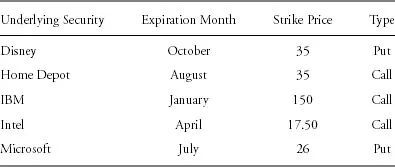
Since 100 shares is the standard contract size for a single option, you only need to identify any option by the four items that make it unique: underlying stock; expiration month; strike price; and type. Table 1.1, for example, shows that IBM Jan 150 call designates a call option on IBM shares, expiring in January, with a strike price of 150.
TABLE 1.1 Option Examples
Strike Price
Options on a particular stock are always available for at least several different strike prices above and below the current price of the stock. The number of strikes, which can sometimes rise to 50 or more on a single underlying, depend on the stock's price and volatility (how much the share price has moved historically). A volatile stock such as Research in Motion (RIMM), for example, currently has more than 50 strike prices for the January 2011 expiration month. The option exchanges offer strikes in increments of $2.50, $5, or $10, depending on the price of the underlying stock. Thus, if XYZ is selling for around $50 a share when options trading on the stock begins, the exchange would typically allow trading (for both puts and calls) on a range of strike prices including, say, $40, $45, $50, $55, and $60. On the other hand, if the share price is $16, you would probably see strike prices of $15, $17.50, and $20. As stocks move, new strike prices are added, although the exchanges generally do not add new strikes during the last few weeks before an expiration.
Depending on the price of the underlying stock at the time, options at various strike prices are said to be in the money or out of the money. These terms are important to the covered writer (option seller) and will be referred to frequently in the text.
- In the money (ITM): Describes a call option whose strike price is below the current price of the underlying stock or a put with a strike above the current price. Example: When ABC stock is trading at $43, call options with strike prices of $40, $35, and $30 are all in the money.
- Out of the money (OTM): Describes a call option whose strike price is above the current price of the underlying stock or a put with a strike below the current price. Example: When ABC stock is trading at $43, call options with strike prices of $45, $50, and $55 are all out of the money.
- At the money (ATM): Describes an option that has a strike price equal to (or close to) the current price of the underlying stock. Example: A GHI call option with a strike of $30 is at the money when the stock is trading at or very close to $30.
Expiration
The most distinctive characteristic of options is their limited life, determined by the expiration date. On that date, they cease to exist, and any value they may have contained up to that point becomes moot. In contrast...