Physical Properties of Concrete and Concrete Constituents
eBook - ePub

Physical Properties of Concrete and Concrete Constituents

  1. English
  2. ePUB (mobile friendly)
  3. Available on iOS & Android
eBook - ePub

Physical Properties of Concrete and Concrete Constituents

About this book

Understanding the rheological properties of fresh concrete, the hydration phenomenon of cement responsible for structuration, the relationship between the characteristics of the porous solid obtained and its mechanical performances or resistance to the aggressive penetration requires a complex knowledge of the physicochemistry of reactive porous materials. The development of simple formulation rules therefore requires the assimilation of this knowledge and a good command of the properties of these materials.

The purpose of this book is to provide the mix designer with useful knowledge on granular materials and porous materials, which will enable the innovative design of concrete. Topics covered include the characterization of granular materials, the concepts of porosity and specific surface area, and the transport properties (diffusion and permeation) of concrete. Some of these topics are already covered in other general books dedicated to granular or porous materials. The objective here is to bring them together in one book by adapting them for use by concrete specialists.

Applications in the form of exercises are offered at the end of each chapter to enable readers to assimilate the theoretical knowledge and to apply such knowledge to concrete problems encountered in civil engineering.

Frequently asked questions

Yes, you can cancel anytime from the Subscription tab in your account settings on the Perlego website. Your subscription will stay active until the end of your current billing period. Learn how to cancel your subscription.
At the moment all of our mobile-responsive ePub books are available to download via the app. Most of our PDFs are also available to download and we're working on making the final remaining ones downloadable now. Learn more here.
Perlego offers two plans: Essential and Complete
  • Essential is ideal for learners and professionals who enjoy exploring a wide range of subjects. Access the Essential Library with 800,000+ trusted titles and best-sellers across business, personal growth, and the humanities. Includes unlimited reading time and Standard Read Aloud voice.
  • Complete: Perfect for advanced learners and researchers needing full, unrestricted access. Unlock 1.4M+ books across hundreds of subjects, including academic and specialized titles. The Complete Plan also includes advanced features like Premium Read Aloud and Research Assistant.
Both plans are available with monthly, semester, or annual billing cycles.
We are an online textbook subscription service, where you can get access to an entire online library for less than the price of a single book per month. With over 1 million books across 1000+ topics, we’ve got you covered! Learn more here.
Look out for the read-aloud symbol on your next book to see if you can listen to it. The read-aloud tool reads text aloud for you, highlighting the text as it is being read. You can pause it, speed it up and slow it down. Learn more here.
Yes! You can use the Perlego app on both iOS or Android devices to read anytime, anywhere — even offline. Perfect for commutes or when you’re on the go.
Please note we cannot support devices running on iOS 13 and Android 7 or earlier. Learn more about using the app.
Yes, you can access Physical Properties of Concrete and Concrete Constituents by Jean-Pierre Ollivier,Jean-Michel Toorenti,Myriam Carcasses in PDF and/or ePUB format, as well as other popular books in Technology & Engineering & Construction & Architectural Engineering. We have over one million books available in our catalogue for you to explore.

Chapter 1

Description of Granular
Materials, Definitions

1.1. Introduction

We call a set of grains “aggregate”. We also refer to this as granular material. Several civil engineering materials are granular materials: soil, road-building materials or concrete before the setting the binder, etc.
Let us consider a grain, as shown in Figure 1.1. This grain consists of a solid phase, voids or open pores and voids or closed pores. The former communicates with the outside, and the latter are included in the solid phase.
Figure 1.1. Definition of a grain
ch1-fig1.1.gif
By definition, the grain volume is the sum of the volume of a grain in its solid phase and the volume of the closed pores.
Let us now consider a set of grains. vg is the grain volume of this set.
Different volumes are defined:
Va is the apparent volume of granular material. This is, for example, the volume of the container that holds all of the material or the volume of the stack of material if it is in bulk (which is the bulk volume).
vs is the volume of the total solid phase.
v is the void volume: the total volume of the intergranular voids and open voids of grains. The geometric definition of the open void volume of a grain is not simple, as it necessitates the prior definition of the envelope of the grain. In practice, we speak of the void volume accessible to water. In the case of a granular material, the definition of void volume is simpler: it is the difference between the apparent volume and the grain volume.
Va=vg+v
The void volume is wholly or partially full of air or water.

1.2. Density

1.2.1. At the grain scale

We distinguish:
– The solid density:
images
where ms is the solid mass. This mass is ordinarily measured after drying, where the water contained in the open pores evaporates. We also refer to it as dry mass.
– The density of grains:
images
. This density is less than or equal to ρs according to the presence or absence of closed pores in the grains.
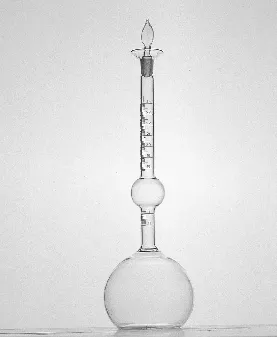
For example, in the case of cements these two densities are identical. Their measurement is taken using a volumeter (or hydrometer), known as the Chatelier, in accordance with standard EN 196–6.
Figure 1.2. The Chatelier volumeter or hydrometer (CONTROLAB)
To characterize cement, it is placed in a glass container raised in a graduated cylinder (the volumeter), which contains oil (cement being reactive with water, it is advisable to choose an inert liquid). The change in volume is measured by the displacement of the oil in the graduated cylinder and the mass of the cement is obtained by weighing the volumeter twice: before and after adding the cement.
ch1-fig1.2.webp
In the case of concrete aggregates, the NF EN 1097–6 standard defines four densities1. The latter definitions complicate the landscape slightly, but they are subject to requirements. They are subject to standard methods of measurement (NF EN 1097–6), which can be found in the exercises presented at the end of this chapter.

1.2.2. At the granular material scale

The density of granular material, also known as the bulk density, ρ, is defined as the apparent mass per unit volume of aggregate:
images
where ms is the mass of grains (it is also the mass of solid) and me is the mass of water contained in the voids.
When the material is dry (me = 0), the density is called the “dry density” and is written as ρd.
The density of a granular material depends on:
– the density of grains,
– the arrangement of the grains in space; and
– the quantity of water present in the voids.
Before being more specific about it (see section 1.8), we must define the variables characterizing the arrangement of the grains and the presence of water in the voids.

1.3. Porosity of granular material

This is the ratio between the void volume and the apparent volume:
images

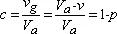
1.4. Compactness

This is the ratio between the volume of grains and the apparent volume:
images

1.5. Void ratio

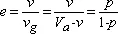
This is the ratio between the void volume and the volume of grains:
images
Porosity, compactness and the void ratio are the three quantities that characterize the relative volume fractions of voids and grains of a granular material. Relationships exist between them and knowledge of one enables us to calculate the other two. For example, the measurement of the porosity of an aggregate is taken by weighing the quantity of the dry material, ms, filling a container of a known volume, Va. Knowing the density of the grains, ρg, the porosity is calculat...
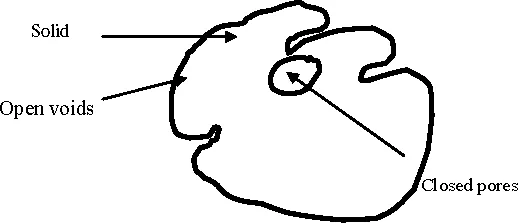
Table of contents

  1. Cover
  2. Title Page
  3. Copyright
  4. Introduction
  5. Chapter 1. Description of Granular Materials, Definitions
  6. Chapter 2. Granulometry
  7. Chapter 3. Specific Surface Area of Materials
  8. Chapter 4. Voids in Granular Materials and the Arrangement of Grains
  9. Chapter 5. Voids in Concrete
  10. Chapter 6. The Fundamentals of Diffusion
  11. Chapter 7. Permeability
  12. Index