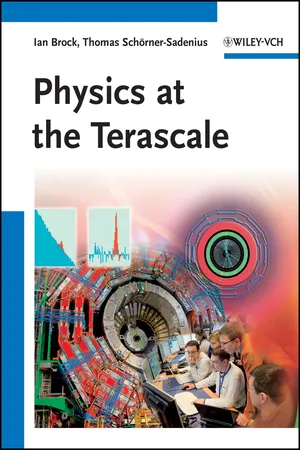
Written by authors working at the forefront of research, this accessible treatment presents the current status of the field of collider-based particle physics at the highest energies available, as well as recent results and experimental techniques. It is clearly divided into three sections; The first covers the physics -- discussing the various aspects of the Standard Model as well as its extensions, explaining important experimental results and highlighting the expectations from the Large Hadron Collider (LHC). The second is dedicated to the involved technologies and detector concepts, and the third covers the important - but often neglected - topics of the organisation and financing of high-energy physics research. A useful resource for students and researchers from high-energy physics.
In this chapter we introduce the basic features of the field of particle physics at the Terascale and give a short historical perspective. Given that we are experimentalists, we concentrate more on the landmark experimental measurements and leave the discussion of theoretical developments to the later chapters on the Standard Model (SM), supersymmetry (SUSY), physics beyond the Standard Model and so on. We also briefly cover a few topics that are otherwise not addressed in the rest of the book, such as the connection between particle physics and astrophysics, neutrinos and spin physics.
Throughout the book we use the usual particle physics units, that is,
= c = 1, and use energy units for momenta and masses, for example mμ = 0.105 GeV and pT > 10 GeV.
1.1 From the 1970s into the Twenty-first Century
It is difficult to know where to start when writing an introduction to both a book and the field of particle physics. We decided that the 1970s would be the appropriate time, as this was when the Standard Model of particle physics started to establish itself as the theory of fundamental particles and their interactions; it was also the decade when one of us (ICB) entered the field.
The 1970s saw a whole slew of fundamental discoveries and theoretical developments, to name just a few:
the discovery of weak neutral currents;
the discovery of the J/ψ meson and further excited charmonium states;
the discovery of the τ lepton;
the discovery of the b quark;
the discovery of the gluon at the end of the decade.
Within theory notable developments include:
the proof that local gauge theories are renormalisable;
the development of Quantum Chromodynamics (QCD), the theory of the strong interaction;
the recognition that CP violation could be explained within the framework of the Standard Model, if there are at least three generations of quarks and leptons. In other words the Cabibbo–Kobayashi–Maskawa (CKM) matrix contains a non-trivial phase for three or more generations.
Although the pace of discoveries slowed in the last three decades, both the experimental measurements and the theoretical developments have been essential in establishing the Standard Model as the theory of fundamental particles and interactions as well as exposing weaknesses in the models and indicating directions for future accelerators, detectors and theory.
1.1.1 Weak Neutral Currents
The combination of a theory of the weak interactions which relied on the local gauge principle and the Higgs mechanism led to the formulation of the Standard Model by Glashow, Weinberg and Salam in the mid-1960s. Together with the proof of the renormalisability of such theories by ’t Hooft and Veltman in 1971, the prediction of the existence of a neutral partner for the W± bosons (responsible for charged-current interactions) became a hot topic for the experimentalists.
Groups in the USA and at CERN looked for bubble chamber events in which a group of hadrons appear from nowhere! These were supposed to be due to reactions such as νp → νX. A major difficulty in extracting a signal from such events was that neutron-induced interactions look very similar. Very detailed studies of neutron production in the detector surroundings were necessary before it was possible to convince both the collaborations and the community at large that such neutral-current events actually exist. First evidence was announced in 1973 by the Gargamelle collaboration and by June 1974 three different collaborations all showed clear evidence for weak neutral currents.
This discovery marked the beginning of a huge experimental and theoretical activity in the field of electroweak unification at CERN and around the world. By comparing the charged-current and neutral-current cross sections it was possible to determine the weak mixing angle, θW. This yielded a prediction for the mass of the W boson, which in turn led to the idea of building a proton–antiproton collider in order to be able to discover the W and Z bosons well before the start of the e+e− collider, LEP.
1.1.2 November Revolution
The discovery of the J/ψ meson in 1974 and the ψ′ shortly thereafter have rightly been named the “November Revolution”. Quite remarkably the J/ψ meson was observed in two very different experiments at the same time: e+e− collisions at a centre-of-mass energy of 3.1 GeV using the S...
Table of contents
Cover
Half Title page
Related Titles
Title page
Copyright page
Dedication
Foreword
Preface
List of Authors
The Authors
List of Abbreviations
Part One: The Physics
Part Two: The Technology
Part Three: The Organisation
Index
Trusted by 375,005 students
Access to over 1.5 million titles for a fair monthly price.
Study more efficiently using our study tools.
Frequently asked questions
Yes, you can cancel anytime from the Subscription tab in your account settings on the Perlego website. Your subscription will stay active until the end of your current billing period. Learn how to cancel your subscription
No, books cannot be downloaded as external files, such as PDFs, for use outside of Perlego. However, you can download books within the Perlego app for offline reading on mobile or tablet. Learn how to download books offline
Perlego offers two plans: Essential and Complete
Essential is ideal for learners and professionals who enjoy exploring a wide range of subjects. Access the Essential Library with 800,000+ trusted titles and best-sellers across business, personal growth, and the humanities. Includes unlimited reading time and Standard Read Aloud voice.
Complete: Perfect for advanced learners and researchers needing full, unrestricted access. Unlock 1.5M+ books across hundreds of subjects, including academic and specialized titles. The Complete Plan also includes advanced features like Premium Read Aloud and Research Assistant.
Both plans are available with monthly, semester, or annual billing cycles.
We are an online textbook subscription service, where you can get access to an entire online library for less than the price of a single book per month. With over 1.5 million books across 990+ topics, we’ve got you covered! Learn about our mission
Look out for the read-aloud symbol on your next book to see if you can listen to it. The read-aloud tool reads text aloud for you, highlighting the text as it is being read. You can pause it, speed it up and slow it down. Learn more about Read Aloud
Yes! You can use the Perlego app on both iOS and Android devices to read anytime, anywhere — even offline. Perfect for commutes or when you’re on the go. Please note we cannot support devices running on iOS 13 and Android 7 or earlier. Learn more about using the app
Yes, you can access Physics at the Terascale by Ian Brock,Thomas Schörner-Sadenius in PDF and/or ePUB format, as well as other popular books in Physical Sciences & Nuclear Physics. We have over 1.5 million books available in our catalogue for you to explore.