Only a lucky few of us are natural born leaders. It takes time and effort to develop a range of leadership styles which work for you and those around you as well as discovering how to become comfortable leading others. Leadership can be a lonely occupation; Leadership For Dummies is your ideal companion. John Marrin explores the fine line between managing and leading and the book is full of tips for making the most of your leadership experiences and how to cope with the dilemmas and discomfort all leaders at some point experience.
- English
- ePUB (mobile friendly)
- Available on iOS & Android
eBook - ePub
Leadership For Dummies
About this book
Do you find yourself being asked to lead others but have no idea where to start? Do you lead a team spread across different offices or even continents? In this no-nonsense guide to leadership you will find answers to crucial questions like: what is leadership? And what style of leadership should I be using? You'll discover how to lead your friends whilst remaining their friend; how to lead change in a way that people accept and understand; when and where to draw the line; and how to reflect on your experiences to become a better and more effective leader.
Information
Part I
Introducing Leadership

In this part . . .
The chapters in this part help you to acquire an understanding of leadership and start to lay the foundations for you becoming the great leader you aspire to be. I introduce you to common language used in practising leadership and in management literature, and guide you to see the key differences between leading and managing. You can use these chapters to work on clarifying your expectations of yourself and others as leaders.
Chapter 1
Taking the Lead
In This Chapter

Leadership is common sense; but unfortunately not always common practice. With the right information gleaned from my experience of working closely with thousands of managers, and some practice and thought on your part, leading can become as natural as riding a bike (even if you do experience a few wobbles along the way)!
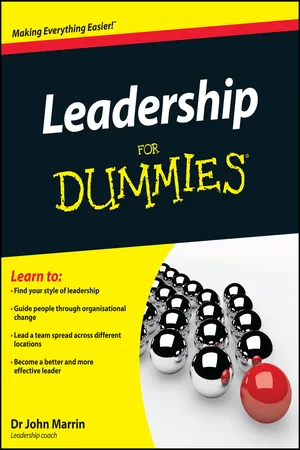
If you couple your common sense to this book’s numerous tips, prompts, guidelines, memory joggers and even (dare I say it) pearls of wisdom, you can become the great leader you aspire to be. You can literally get your ducks in a row – just like on the front cover – reflected by your staff wanting to follow you without you having to look behind to check whether they’re still there. Carry out the exercises and implement the advice throughout the book, and you can turn effective leadership into your personal common practice.
In this chapter, I describe the importance of leaders, how and why you should step up to become a leader and how to lead different teams and implement workplace change successfully.
Appreciating Why the Work of Leaders Isn’t Easy
Why is effective leadership not more often put into practice? Well, too many managers don’t demonstrate great leadership because they don’t think enough about the situation that they and their people are in: they rush in and get things wrong or fail to act when people are looking for leadership. You’ve probably all too often experienced situations in which you get too much, too little or the wrong type of leadership.

In defence of leaders, although leadership is common sense, leading people isn’t easy. People are complex and have different needs, motives, abilities and expectations. Human flexibility and adaptability are great strengths, but people can also be unpredictable and changeable: their moods may alter, reflecting whether they’re happy, sad, enthusiastic, angry or depressed. People’s emotional states affect their approach to work and their performance at work.
Part of your role as a leader is to get the best from people who work for and with you; you have to consider all these issues in deciding how best to lead individuals and teams.
Leaders also have to champion and look after the needs of their organisation whether it’s a business, charity, public sector service or whatever. You have to enthuse about and promote the purpose and objectives of your organisation, department and/or team (depending on your position), the products or services you and your team provide, reconcile differences in priorities between your team and other teams, and so on.
Bearing these challenges in mind, leadership is difficult!
You may not know how to handle the leadership dilemmas that these and many other challenges throw up for you, and that’s probably why you bought this book! In this chapter, you find out more about the challenges and opportunities of being a leader – and discover insights into how to address the problems. I also provide directions to other relevant chapters that allow you to explore leadership in depth.
Looking for Leadership . . . and Leaders
Life in general, and especially in the workplace, seems to be becoming more uncertain and complex for most people. The old adage of ‘a job for life’ no longer applies to most people as private and public-sector organisations change, downsize and merge.
In such uncertain times people look for leadership and leaders, but don’t always find what they need. This section helps you to discover more about the typical situations being experienced by thousands if not millions of workers every day, and why people are looking for leadership and leaders.
Cooking the stew rather than being in one!
Many people become anxious or agitated when they experience workplace complexity and uncertainty: they are, as we say, ‘in a bit of a stew’. People can be mixed up, het up, cut up, or shut up when they’re in ...
Table of contents
- Cover
- Table of Contents
- Title Page
- Introduction
- Part I: Introducing Leadership
- Part II: Leading Yourself
- Part III: Leading Others
- Part IV: Leading People Through Change
- Part V: Leading Different Types of Team
- Part VI: The Part of Tens
- Cheat Sheet
Trusted by 375,005 students
Access to over 1.5 million titles for a fair monthly price.
Study more efficiently using our study tools.
Frequently asked questions
Yes, you can cancel anytime from the Subscription tab in your account settings on the Perlego website. Your subscription will stay active until the end of your current billing period. Learn how to cancel your subscription
No, books cannot be downloaded as external files, such as PDFs, for use outside of Perlego. However, you can download books within the Perlego app for offline reading on mobile or tablet. Learn how to download books offline
Perlego offers two plans: Essential and Complete
- Essential is ideal for learners and professionals who enjoy exploring a wide range of subjects. Access the Essential Library with 800,000+ trusted titles and best-sellers across business, personal growth, and the humanities. Includes unlimited reading time and Standard Read Aloud voice.
- Complete: Perfect for advanced learners and researchers needing full, unrestricted access. Unlock 1.5M+ books across hundreds of subjects, including academic and specialized titles. The Complete Plan also includes advanced features like Premium Read Aloud and Research Assistant.
We are an online textbook subscription service, where you can get access to an entire online library for less than the price of a single book per month. With over 1.5 million books across 990+ topics, we’ve got you covered! Learn about our mission
Look out for the read-aloud symbol on your next book to see if you can listen to it. The read-aloud tool reads text aloud for you, highlighting the text as it is being read. You can pause it, speed it up and slow it down. Learn more about Read Aloud
Yes! You can use the Perlego app on both iOS and Android devices to read anytime, anywhere — even offline. Perfect for commutes or when you’re on the go.
Please note we cannot support devices running on iOS 13 and Android 7 or earlier. Learn more about using the app
Please note we cannot support devices running on iOS 13 and Android 7 or earlier. Learn more about using the app
Yes, you can access Leadership For Dummies by John Marrin in PDF and/or ePUB format, as well as other popular books in Business & Leadership. We have over 1.5 million books available in our catalogue for you to explore.