This is a unique question-and-answer book for surgical residents and trainees, concentrating on the growing subspecialty of surgery in critical care and emergency surgery. This book covers all surgical aspects of critical care and acute or emergency surgery, making it an ideal learning and review text for surgical trainees and those professionals specializing in these fields.
Marcin A. Jankowski, DO and Frederick Giberson, MD, FACS
1. All of the following are mechanisms by which vasodilators improve cardiac function in acute congestive heart failure except:
A. Increase stroke volume
B. Decrease ventricular filling pressure
C. Increase ventricular preload
D. Decrease end-diastolic volume
E. Decrease afterload
Most patients with acute heart failure present with increased left-ventricular filling pressure, high systemic vascular resistance, high or normal blood pressure and low cardiac output. These physiologic changes increase myocardial oxygen demand and decrease the pressure gradient for myocardial perfusion resulting in ischemia. Therapy with vasodilators in the acute setting can often improve hemodynamics and symptoms.
Nitroglycerine is a powerful venodilator with mild vasodilitory effects. It relieves pulmonary congestion through direct venodilation, reducing left and right ventricular filling pressures, systemic vascular resistance, wall stress, and myocardial oxygen consumption. Cardiac output usually increases due to decreased LV wall stress, decreased afterload, and improvement in myocardial ischemia. The development of tolerance within 16 to 24 hours of starting the infusion is a potential drawback of nitroglycerine.
Nitroprusside is an equal arteriolar and venous tone reducer, lowering both systemic and vascular resistance and left and right filling pressures. Its effects on reducing afterload increase stroke volume in heart failure. Potential complications of nitroprusside include cyanide toxicity and the risk of “coronary steal syndrome.”
In patients with acute heart failure, therapeutic reduction of left-ventricular filling pressure with any of the above agents correlates with improved outcome.
Increased ventricular preload would increase the filling pressure, causing further increases in wall stress and myocardial oxygen consumption, leading to ischemia.
Answer: C
Hollenberg, MS (2007) Vasodilators in acute heart failure. Heart Failure Review12, 143–7.
Marino P (2007) The ICU Book, 3rd edn, Lippincott Williams & Wilkins, Philadelphia, PA, Chapter 14.
Nohria A, Lewis E, Stevenson, LW (2002) Medical management of advanced heart failure. Journal of the American Medical Association287 (5), 628–40.
2. Which is the most important factor in determining the rate of peripheral blood flow?
A. Laminar flow
B. Length
C. Viscosity
D. Radius
E. Pressure gradient
The forces that determine peripheral blood flow are derived from observations on ideal hydraulic circuits that are rigid and the flow is steady and laminar. This is quite different from the human circulatory system which is compressible and flow is pulsatile and turbulent. The Hagen-Poiseuille equation states that flow is determined by the fourth power of the inner radius of the tube (Q =
), where P is pressure, μ is viscosity, L is length, and r is radius. This means that a twofold increase in the radius will result in a sixteenfold increase in flow. As the equation states, the remaining components of resistance, such as pressure difference along the length of the tube and fluid viscosity, are inversely related and exert a much smaller influence on flow. Although this equation may not accurately describe the flow state in our circulatory system, it has useful applications in describing flow through catheters, flow characteristics of different resuscitative fluids and the hemodynamic effects of anemia and blood transfusions on flow. With turbulent flow (Fanning equation), the impact of the radius is raised to the fifth power (r5) as opposed to the fourth power in the Poiseuille equation.
It is important to realize that flow through compressible tubes (blood vessels) is greatly influenced by external pressure surrounding the tubes. Therefore, if a tube is compressed by an external force, the flow will be independent of the pressure gradient along the tube.
Answer: D
Brown SP, Miller WC, Eason JM (2006) Exercise Physiology; Basis of Human Movement in Health and Disease, Lippincott Williams & Wilkins, Philadelphia.
Marino P (2007) The ICU Book, 3rd edn, Lippincott Williams & Wilkins, Philadelphia, PA, Chapter 1.
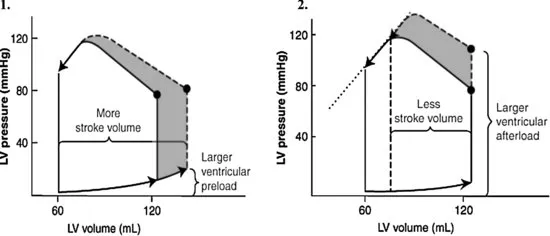
3. Choose the correct physiologic process represented by each of the cardiac pressure-volume loops below.
One of the most important factors in determining stroke volume is the extent of cardiac filling during diastole or the end-diastolic volume. This concept is known as the Frank–Starling law of the heart. This law states that, with all other factors equal, the stroke volume will increase as the end-diastolic volume increases. In Figure 1, the ventricular preload or end-diastolic volume (LV volume) is increased, which ultimately increases stroke volume defined by the area under the curve. Notice the LV pressure is not affected. Increased afterload, at constant preload, will have a negative impact on stroke volume. In Figure 2, the ventricular afterload (LV pressure) is increased, which results in a decreased stroke volume, again defined by the area under the curve.
Answer: A
Mohrman D, Heller L (2010) Cardiovascular Physiology, 7 edn, McGraw-Hill, New York, Chapter 3.
Shiels HA, White E (2008) The Frank–Starling mechanism in vertebrate cardiac myocytes. Journal of Experimental Biology211 (13), 2005–13.
4. An 18-year-old patient is admitted to the ICU following a prolonged exploratory laparotomy and lysis of adhesions for a small bowel obstruction. The patient has had minimal urine output throughout the case and is currently hypotensive. Identify the most effective way of promoting end-organ perfusion in this patient.
A. Increase arterial pressure (total peripheral resistance) with vasoactive agents
B. Decrease sympathetic drive with heavy sedation
C. Increase end-diastolic volume with controlled volume resuscitation
D. Increase contractility with a positive inotropic agent
E. Increase end-systolic volume
This patient is presumed to be in hypovolemic shock as a result of a prolonged operative procedure with inadequate perioperative fluid resuscitation. The insensible losses of an open abdomen for several hours in addition to significant fluid shifts due to the small bowel obstruction can significantly lower intravascular volume. The low urine output is another clue that this patient would b...
Table of contents
Cover
Title Page
Copyright
Contributors
Preface
PART ONE: Surgical Critical Care
PART TWO: Emergency Surgery
Plates
Index
Trusted by 375,005 students
Access to over 1.5 million titles for a fair monthly price.
Study more efficiently using our study tools.
Frequently asked questions
Yes, you can cancel anytime from the Subscription tab in your account settings on the Perlego website. Your subscription will stay active until the end of your current billing period. Learn how to cancel your subscription
No, books cannot be downloaded as external files, such as PDFs, for use outside of Perlego. However, you can download books within the Perlego app for offline reading on mobile or tablet. Learn how to download books offline
Perlego offers two plans: Essential and Complete
Essential is ideal for learners and professionals who enjoy exploring a wide range of subjects. Access the Essential Library with 800,000+ trusted titles and best-sellers across business, personal growth, and the humanities. Includes unlimited reading time and Standard Read Aloud voice.
Complete: Perfect for advanced learners and researchers needing full, unrestricted access. Unlock 1.5M+ books across hundreds of subjects, including academic and specialized titles. The Complete Plan also includes advanced features like Premium Read Aloud and Research Assistant.
Both plans are available with monthly, semester, or annual billing cycles.
We are an online textbook subscription service, where you can get access to an entire online library for less than the price of a single book per month. With over 1.5 million books across 990+ topics, we’ve got you covered! Learn about our mission
Look out for the read-aloud symbol on your next book to see if you can listen to it. The read-aloud tool reads text aloud for you, highlighting the text as it is being read. You can pause it, speed it up and slow it down. Learn more about Read Aloud
Yes! You can use the Perlego app on both iOS and Android devices to read anytime, anywhere — even offline. Perfect for commutes or when you’re on the go. Please note we cannot support devices running on iOS 13 and Android 7 or earlier. Learn more about using the app
Yes, you can access Surgical Critical Care and Emergency Surgery by Forrest "Dell" Moore, Peter M. Rhee, Samuel A. Tisherman, Gerard J. Fulda, Forrest "Dell" Moore,Peter Rhee,Samuel A. Tisherman,Gerard J. Fulda,Peter M. Rhee,Forrest O. Moore, Forrest "Dell" Moore, Peter Rhee, Samuel A. Tisherman, Gerard J. Fulda in PDF and/or ePUB format, as well as other popular books in Medicine & Nursing. We have over 1.5 million books available in our catalogue for you to explore.