- Grounded in social domain theory, the book draws on the author's research over the past 25 years
- Draws from the results of in-depth interviews with more than 700 families
- Explores adolescent-parent relationships among ethnic majority and minority youth in the United States, as well as research with adolescents in Hong Kong and China
- Discusses extensive research on disclosure and secrecy during adolescence, parenting, autonomy, and moral development
- Considers both popular sources such as movies and public surveys, as well as scholarly sources drawn from anthropology, history, sociology, social psychology, and developmental psychology
- Explores how different strands of development, including autonomy, rights and justice, and society and social convention, become integrated and coordinated in adolescence
eBook - ePub
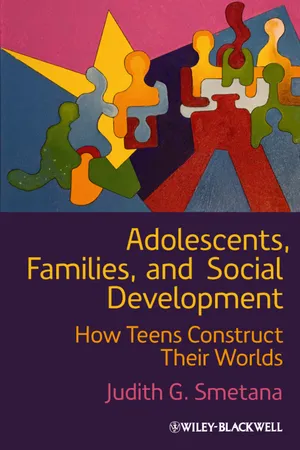
Adolescents, Families, and Social Development
How Teens Construct Their Worlds
- English
- ePUB (mobile friendly)
- Available on iOS & Android
eBook - ePub
About this book
This book provides an in-depth examination of adolescents' social development in the context of the family.
Information
1 Introduction
Perspectives on Adolescents and Their Families
There is a great deal of interest, ambivalence, and confusion about today’s adolescents and their role and place in contemporary society. Social commentators are perennially trying to understand “what makes adolescents tick,” as a 2008 cover story in Time Magazine illustrates (Wallis, 2008, September 26). This question has been answered in many ways, in part due to scientific advances in knowledge, but also as a reflection of the various preoccupations of different eras. At different times, explanations for teenagers’ behavior have focused on teenagers’ character (or lack thereof), the negative influences of their peers, and raging hormones. Currently, as showcased in the Time Magazine article, explanations are being sought in adolescent brain functioning. The claim is that adolescents misbehave because their brains are not yet mature. But why does adolescent behavior raise these questions? After all, we would not expect to see a cover story focusing on “what makes adults tick.” The question highlights a societal unease about the very nature of adolescence.
Popular Views of Adolescence
Some public opinion surveys reveal that prevailing attitudes towards teenagers are largely negative. Public Agenda, a national public interest research organization, conducted a multi-year national survey a decade ago to examine the American public’s attitudes regarding the nation’s youth. Duffet, Johnson, and Farkas (1999) reported that “[m]ost Americans are deeply disappointed with “kids these days.” More than seven in ten adults resort to words such as ‘rude,’ ‘irresponsible,’ and ‘wild’ to describe today’s teens, and more than half also describe young children disapprovingly” (p. 3). According to Public Agenda’s findings, both parents and the general public agree in these observations. Less than 15% of randomly sampled adults participating in this survey viewed positive characteristics as good descriptors for today’s youth. Moreover, a surprising 58% of the general public and 57% of the parents surveyed agreed with the statement that “today’s children will make America a worse place or will make little difference” (Duffet et al., 1999, p. 3).
Yet, despite these negative findings, the survey also found that most Americans acknowledged that it is much harder to be a parent now than before. Nearly 70% of the adults sampled viewed abuse of drugs or alcohol and too much sex and violence on TV as very serious problems facing today’s youth. In 1999, nearly half of the adults surveyed blamed the problems that teenagers face as due to irresponsible parents who fail to do their job. A smaller percentage – less than a third – blamed the fact that there are perilous circumstances for today’s youth on social and economic pressures on parents. This represented an increase from the previous survey, conducted 2 years prior, in the proportion of Americans willing to hold parents rather than broader social and economic circumstances responsible for the situation of American youth.
Some prominent commentators and moral educators also have promoted negative perceptions of adolescents. For instance, the former United States Secretary of Education William Bennett (1992, 2001) argues that there is a rising tide of juvenile delinquency, homosexuality, adolescent drug and alcohol use, and teenage pregnancy and child bearing that reflects a breakdown in the moral fabric of society. No matter that current statistics do not bear this out. (In fact, for the past decade, rates of teenage child bearing and juvenile delinquency have been on the decline.) In Bennett’s view, as well as in that of some other prominent moral educators (Lickona, 1991, 2004), adolescents are rejecting parents’ moral values and resisting adult authority. In their opinion this has led to widespread societal moral decay.
Another way to explore whether parents are failing in their parental roles is to examine the advice child-rearing experts offer. Parent advice books both reflect and shape the way adolescents and their growth and development are perceived. Americans are enamored with self-help books. Bookstores devote voluminous shelf space to books by child-rearing experts dispensing advice on parenting. The findings of psychological research studies and of large opinion surveys are echoed in child-rearing books. Books devoted to the special perils of raising a teenager typically are located apart from the volumes devoted to rearing infants and younger children. This physical separation is paralleled by marked differences in the tenor of the titles. Books geared towards parents of newborns and infants generally convey the joy and optimism that parents feel at bringing a new baby into the family. Of course, there are many books reflecting the difficulties of parenting infants and explaining how to cope with lack of sleep, cranky babies and the like, but the overall tone of the books imparts a view of parenting a young child as a happy and rewarding experience, of the role of parents as facilitating their children’s creativity and development, and of babies as enjoyable, adaptive, and responsive.
The advice books for parents of children in middle childhood are more sober and straightforward. The majority of titles reflect a greater emphasis on how to discipline children and on how to manage their behavior effectively, as well as on how to instill self-esteem, good moral character and values, and positive attitudes. The books suggest that parenting during middle childhood is serious business, requiring effective and appropriate disciplinary techniques and behavior management strategies.
But child-rearing books on adolescence reflect a cultural anxiety that is not apparent in the books providing advice about parenting younger children. Whereas some of these books focus on more positive themes, a majority of the advice books on parenting teenagers portray adolescents as characteristically willful, unresponsive, and disrespectful. At the same time parents are depicted as bewildered, stressed, and overwhelmed. Both the tone and the titles depart from those of books about earlier ages, even when the same expert writes about different developmental periods. Thus one expert, who offers “magic hints for effective discipline” during middle childhood, views adolescence as something parents need to survive, as the title suggests: Surviving your adolescents: How to manage and let go of your 13–18 year olds (Phelan, 1998). And many more examples abound. The titles are catchy: Teenagers! A bewildered parent’s guide (Caldwell, 1996); Get out of my life – but first would you drive me and Cheryl to the mall? A parent’s guide to the new teenager (Wolf, 2002), How to survive your teenager (Gluck & Rosenfeld, 2005), and “I’m not mad, I just hate you!” – A new understanding of mother daughter conflict (Cohen-Sandler & Silver, 2000). Indeed, adolescence today has been considered so problematic that even one’s pet’s adolescence is to be feared – consider the recent addition to the canon, Surviving your dog’s adolescence: A positive training program (Benjamin, 1993). But the sentiments these books convey about parenting an adolescent or engaging in a relationship with an adolescent are decidedly negative, even towards “normal,” run-of-the-mill teenagers and their everyday problems. Why is there such a drastic shift in attitude, from the unconditional love and bonding reflected in the advice books to parents of babies to the ambivalence and hostility about parenting and parent–adolescent relationships expressed in these titles?
Of course, titles sell books, and, to some extent, the anxiety expressed in these titles, no matter how cute they are, may be “pitched” to match the prevailing beliefs about parenting and adolescence. But I believe these titles reflect more than shrewd marketing. If these books did not appeal to parents’ concerns, the books would not sell. They would quickly disappear. And there is a market for such books, as their proliferation suggests. Beyond the clever titles, the contents of these books dwell on similar themes. They cover topics such as “how to bridge the gap,” “emotional blackmail,” “a different planet,” “conflict,” and “controlling your teenager.”
There is a smaller but parallel set of advice books by child-rearing experts, which are geared to the teenage audience. Again, the titles are instructive. They are meant to convey the impression that parents’ behavior is inscrutable and that parents are not listening to teenagers. Consider the following: Teenage survival manual: Why parents act that way and other mysteries of mind and matter (Coombs, 1998), and Why can’t we talk? What teens would share if parents would listen: A book for teens (Trujillo, 2000). Are these titles accurate reflections of adolescents’ views of their parents and of the adult world?
Adolescents’ Views of Adolescence
When American teenagers are asked to characterize the general nature of adolescent–parent relationships, their responses are similar to those of adults. For instance, 60% of the teens surveyed in the Public Agenda national opinion poll – as compared to 58% of the general public and 57% of parents – also agreed with the statement that “today’s children will make America a worse place or will make little difference.”
Surveying a sample of college youth, Grayson Holmbeck and John Hill (1988) found that, prior to taking a psychology course on the psychology of adolescence, most students strongly believed that adolescence is typically a time of storm and stress. More than half of them endorsed, as being often or more frequently true, views such as that adolescents have identity crises, that adolescents are rebellious, that adolescents frequently fight with their parents, that adolescents prefer to talk to peers rather than parents, and that adolescence is a stormy and stressful time. Indeed, this last item was endorsed as being often or more frequently true by nearly three quarters of the sample studied by Holmbeck and Hill (and more so by girls than by boys). They were asked about the typical frequency of fights with parents over trivial issues (such as how to dress, what kind of music to listen to, cleaning one’s room, spending money, and doing homework) and over nontrivial issues (such as attitudes, basic and religious values, educational and occupational plans, and respect for parents). Students reported that the typical teenager has about seven fights per month with parents over each nontrivial issue and over nine fights per month with parents over each trivial issue. Therefore the participants in this survey believed that the average teenager has over 40 fights per week across the different issues sampled! And these were students who were barely out of adolescence themselves.
Despite this situation, students typically did not believe that parents are disappointed in their adolescent offspring, or that children do not cooperate with their parents. They also rejected the notion that there is a generation gap between parents and children. These findings led the researchers to conclude that college students tend to view adolescence as a developmental period characterized by disruptions in relationships with parents rather than by a complete rejection of parents. Among the youth being queried, the perceptions were that college students viewed adolescence as a time typified by problems of identity, by a tendency to argue with parents, and by the rising influence of peers. This picture of adolescence as a relatively calm developmental period, characterized by generally positive relationships with parents, predominated over the view that adolescence typically involves oppositionalism and noncompliance. As we shall see in Chapter 2, this accords well with the conclusions drawn from recent psychological research to the effect that, when families are warm and close, moderate levels of conflict can have positive functions for adolescents’ development.
Other research shows that, if adolescents and parents expect to have more “storm and stress” during adolescence, then this is what they experience (Buchanan & Hughes, 2009). When African American and European American 11- and 12-year-olds expected to be more involved in risk-taking and rebellious behavior during adolescence, they reported more of these behaviors in the next year than if they had not had these expectations. Likewise, early adolescents who expected to become more alienated from parents reported greater alienation later on. One year later, they reported less close and more conflictual relationships with their parents. They also were more susceptible to peer influence. The same was true for mothers; their perceptions became reality. Children and mothers who expected behaviors to be consistent with the stereotypes of adolescence as a period of storm and stress were more likely to experience those behaviors as the child transitioned to adolescence. This could reflect the fact that a perceptual bias towards the view that storm and stress behaviors are the norm stands a good chance of becoming a self-fulfilling prophecy. Indeed, in her earlier research, Buchanan (2003; Whiteman & Buchanan, 2002) found that general expectations about storm and stress had an influence on adolescents’ behavior above and beyond the specific characteristics of the child. To some extent, adolescents behaved in ways that were consistent with their own and their mothers’ earlier expectations.
Recently, sociologist Reginald Bibby (2009) reported the results of a decades-long large-scale survey study of 15- to 19-year-old Canadian youth. Every 8 years for over 30 years, he surveyed different cohorts of teenagers on a range of topics that included values, sexuality, their troubles, and global issues. He also surveyed them about their attitudes towards their parents. He found that Canadian youth today reported stronger ties to their parents than any cohort in the past 30 years. The picture that emerged is that adolescence is a time of relative calm and respect for parents. Relatively fewer adolescents than in earlier cohorts (although still over 50%) thought that their parents misunderstood them. Reports of squabbling with parents, although still substantial, also decreased by comparison with findings from earlier cohorts. Bibby’s interpretation was that today’s parents are doing a better job of parenting. They have become better at balancing careers and families than earlier generations of parents were. They make more time for their children, and their teenagers are happier because of this.
But others have criticized Bibby’s “good news” interpretation of these findings. Lisa Belkin, a parenting blogger for the New York Times, quotes others, who suggest that today’s parents are pushovers (Belkin, 2009, May 14). Belkin believes that, instead of being more competent, parents are more indulgent than earlier generations of parents. They give in to every whim. Teenagers may be happier and enjoy their parents’ company more because parents are not doing their job. They are not parenting their children effectively and not holding them to reasonable standards. The emergence of “helicopter parents” is another manifestation of this phenomenon. It provides further support for this more negative interpretation of Bibby’s results. Helicopter parenting refers to parents who pay extremely close attention to the successes and failures of their children (typically, college students) and attempt to buffer them from negative experiences. Helicopter parents do not let their children grow up and handle difficult experiences on their own. Instead, these parents inappropriately continue to manage their children’s lives right through college.
Anthropological Surveys of Adolescence and Parent–Adolescent Relationships
Reports of conflict and disagreements in parent–adolescent relationships are not limited to Americans, nor are they limited to industrialized countries. Schlegel and Barry (1991) drew on the standard cross-cultural sample of 186 pre-industrial societies worldwide (Murdock & White, 1969; Murdock & Wilson, 1980) to draw conclusions about the variations in adolescent–parent relationships. The societies included in the sample were selected to be broadly representative, and the samples ranged widely in terms of their geographic location, type of subsistence technique and social organization, and level of modernization. Cultures that had a great deal of close contact with other cultures were excluded, so that the effects of cultural diffusion could be minimized. Schlegel and Barry coded these largely ethnographic accounts for different facets of adolescent–parent relationships, which included amount of contact (for instance the proportion of waking time spent together), intimacy, and adolescent–parent conflict. They also examined many other issues pertinent to an understanding of adolescence across cultures.
Several aspects of their findings are illuminating. First, with the exception of girls in one of the societies, all of the cultures in the standard ethnographic sample distinguished a social phase of life for both boys and girls that is distinct from childhood and adulthood. Schlegel (2009) notes that social adolescence has a biological basis, its onset being signaled by the physical signs of puberty. However, the expectations for young people’s behavior and the way they are treated during this period differ from the behavior and treatment of younger children and adults. This led her to conclude that a distinct social stage of adolescence, which is separate from both childhood and adulthood, is a constant across cultures for both boys and girls. Schlegel notes: “Its absence rather than its presence requires explanation” (p. 574). Many but not all of the cultures had a specific label for this developmental period. But, according to Schlegel, the absence of a specific term does not negate the social reality of adolescence.
Second, Schlegel and Barry concluded that, overall, the ethnographies indicated that adolescents’ relations with family members are generally harmonious – a conclusion that can be drawn about contemporary American families as well (Laursen & Collins, 2009; Smetana, Campione-Barr, & Metzger, 2006). Conflict between generations was found to be widespread, but generally mild in intensity. Again, these findings accord well with what is generally known about conflict in contemporary American families with adolescents. The amount of obedience, deference, or subordination in parent–child relationships in different societies was not associated with either intimacy or the extent of conflict with mothers or fathers.
Nuclear-family households, where husbands and wives live with their unmarried offspring, are the norm in Western societies. But they are not the preferred form in much of the pre-industrial world. Extended family arrangements, where several married couples live together (most typically, married parents and two or more of their adult, married sons and their wives, plus all unmarried children), are more common among tribal people. Households consisting of married parents and an adult child are more common in peasant societies. Schlegel and Barry (1991) had expected to find that there would be less conflict in larger households than in nuclear ones. This is because, in the former, there may be a need to suppress conflict in order to maintain harmony and the father’s authority. But this was not the case. Across the wide array of the societies they studied, the type of family structure was not associated with the amount of conflict they experienced.
Schlegel and Barry drew distinctions between antagonism and conflict. Conflict “can often be petty, the bickering or mild disobedience that indicates discordance but not necessarily fear or dislike” (1991, p. 61). In contrast, antagonism does imply fear and dislike and may arise because of different interests of adolescents and parents (for instance in the case of inheritance of property or succession). Specifically addressing the issue of parent–adolescent conflict, Schlegel and Barry wrote:
The impression one gets from reading many ethnographies is that conflict and antagonism between adolescents and parents in most traditional societies are not, in fact, serious problems. Adolescents do not struggle to individuate themselves from the family to the degree that Western young people do: their dependency on their families, or their spouses’, will continue after they reach adulthood, and much of their economic well-being is likely to come from their contribution to group effort rather than from independent action. Nevertheless, conflict and antagonism can arise, so predictably as to be part of the cultural pattern.
(Schlegel and Barry, 1991, p. 62)
This cultural pattern varied according to the social organization, including the means of production and control over property. This factor, in turn, determines the extent to which adolescents are required to become independent from their families. Schlegel and Barry’s analysis suggested that individuals who move out of their parents’ homes, who, in adulthood, are no longer economically dependent on their parents, and who have an extended period of adolescence before they are economically and socially independent experience more conflict with parents. But everyday and often petty disagreements appear to be an inescapable feature of adolescence across a wide variety of cultures. Disagreements and squabbling are not just a characteristic of adolescents and parents in modern North American families; they are found worldwide, and in very different types of families living in diverse circumstances. In this book, I describe adolescent–parent relationships, including conflict, in Western (primarily North American) families and in families from other, non-Western cultures.
Historical P...
Table of contents
- Cover
- Epigraph page
- Title page
- Copyright page
- Preface
- 1 Introduction
- 2 Studying Adolescent–Parent Relationships from the Lens of Developmental Psychology
- 3 Conflicts and Their Vicissitudes
- 4 Parents’ Voices:
- 5 Adolescents’ Voices
- 6 Autonomy, Conflict, Connectedness, and Culture
- 7 Adolescent Relationships and Development within and between Cultures
- 8 Adolescent–Parent Relationships in African American Families
- 9 Beliefs about Parental Authority
- 10 Parenting Styles and Practices
- 11 Disclosure and Secrecy in Adolescent–Parent Relationships
- 12 Coordinations and Change in Social Development
- 13 Life Beyond Adolescence
- References
- Index
Trusted by 375,005 students
Access to over 1.5 million titles for a fair monthly price.
Study more efficiently using our study tools.
Frequently asked questions
Yes, you can cancel anytime from the Subscription tab in your account settings on the Perlego website. Your subscription will stay active until the end of your current billing period. Learn how to cancel your subscription
No, books cannot be downloaded as external files, such as PDFs, for use outside of Perlego. However, you can download books within the Perlego app for offline reading on mobile or tablet. Learn how to download books offline
Perlego offers two plans: Essential and Complete
- Essential is ideal for learners and professionals who enjoy exploring a wide range of subjects. Access the Essential Library with 800,000+ trusted titles and best-sellers across business, personal growth, and the humanities. Includes unlimited reading time and Standard Read Aloud voice.
- Complete: Perfect for advanced learners and researchers needing full, unrestricted access. Unlock 1.5M+ books across hundreds of subjects, including academic and specialized titles. The Complete Plan also includes advanced features like Premium Read Aloud and Research Assistant.
We are an online textbook subscription service, where you can get access to an entire online library for less than the price of a single book per month. With over 1.5 million books across 990+ topics, we’ve got you covered! Learn about our mission
Look out for the read-aloud symbol on your next book to see if you can listen to it. The read-aloud tool reads text aloud for you, highlighting the text as it is being read. You can pause it, speed it up and slow it down. Learn more about Read Aloud
Yes! You can use the Perlego app on both iOS and Android devices to read anytime, anywhere — even offline. Perfect for commutes or when you’re on the go.
Please note we cannot support devices running on iOS 13 and Android 7 or earlier. Learn more about using the app
Please note we cannot support devices running on iOS 13 and Android 7 or earlier. Learn more about using the app
Yes, you can access Adolescents, Families, and Social Development by Judith G. Smetana in PDF and/or ePUB format, as well as other popular books in Psychology & Developmental Psychology. We have over 1.5 million books available in our catalogue for you to explore.