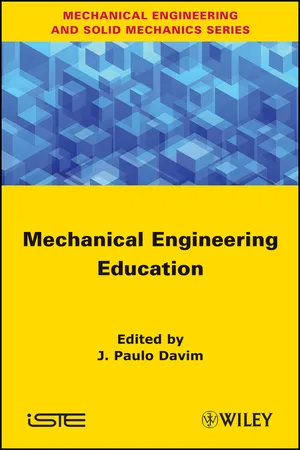
Mechanical Engineering is defined nowadays as a discipline "which involves the application of principles of physics, design, manufacturing and maintenance of mechanical systems". Recently, mechanical engineering has also focused on some cutting-edge subjects such as nanomechanics and nanotechnology, mechatronics and robotics, computational mechanics, biomechanics, alternative energies, as well as aspects related to sustainable mechanical engineering.
This book covers mechanical engineering higher education with a particular emphasis on quality assurance and the improvement of academic institutions, mechatronics education and the transfer of knowledge between university and industry.
- English
- ePUB (mobile friendly)
- Available on iOS & Android
eBook - ePub
Mechanical Engineering Education
About this book
Information
Chapter 1
Quality Assurance in Greek HEIs: Convergence or Divergence with European Models? 1
This chapter discusses the quality assurance schemes applied to Greek Higher Education Institutions (GHEIs), in accordance with the context and specifications induced by the European Higher Education Area (EHEA) and the European Standards and Guidelines (ESG). Section 1.3 summarizes the quality management models with an emphasis on those applied to higher education, while section 1.4 focuses on quality assurance schemes in the EHEA. Section 1.5 examines the case of Greek HEIs.
1.1. Introduction
A core component of higher education reform is the systematic quality assurance and improvement of the Higher Education Institutions (HEIs). The “Communiqué of the Conference of Ministers Responsible for Higher Education” in Berlin on 19 September 2003 establishes that the quality of higher education has “proven to be at the heart of the setting up of a European Higher Education Area”. Assuring quality in teaching and learning is no longer a matter only for the higher educational policy programs or broad international professional discussion. Quality development and assurance have for a long time played a central role in strategic higher educational planning and in the everyday work of HEIs [SPA 08].
In many countries and many cultures, the issue of quality management has been firmly on the agenda of HEIs for quite some time. Higher education for the masses and a growing climate of increased accountability are frequently cited as rationales for a greater emphasis on quality [ERI 95, BEC 06]. Other reasons include the greater expectations and diversity of students as consumers, their demand for increased flexibility in provision and increasing levels of competition within and across national borders. The role of HEIs in stimulating national economic growth and the value of international students to national economies, emphasize the need to ensure quality within Higher Education (HE). These forces demand that quality assurance processes are both rigorous and transparent, and that quality enhancement initiatives are firmly embedded in any quality management program.
This has led to the emergence of a debate on the applicability of quality management principles, methodologies and tools for the HE sector. A study of the literature on higher education indicates that a number of researchers support the non-applicability of those management theories, especially because they are derived from industry and have nothing to do with the higher education ethos [HAR 95; PRA 10]. Other authors have given a more balanced view on the subject, claiming that although HEIs are not companies, some of the basic principles and tools could be applied, as long as they were instruments at the service of institutions and their governance and management boards, subject to the academic mission, goals and strategies of the institution [WIL 93, DIL 95, SPA 08].
Although this is an old debate, no firm conclusions have been arrived at so far. It seems, nevertheless, that in Europe, due to the developments on quality assurance schemes following the Bologna Declaration, HEIs are now being “forced” to implement internal quality assurance systems based on the European standards and guidelines (ESG); see [ROS 12].
1.2. Definitions and fundamentals
In quality management, it is vital to study the meaning of quality in the situation under examination. In the area of higher education, the concept of what constitutes quality has not been thoroughly addressed, although some interesting studies exist; for an overview see [LAG 04, VEN 07]. Furthermore, there is the vast field of general research into quality management in services. The extent to which this research is applicable to the higher education sector also needs to be analyzed.
There are various well-known definitions of quality. Crosby (1979) defines quality as “conformance to requirement” while Juran and Gryna (1980) define quality as “fitness for use”. Deming's (1986) definition of quality as “a predictable degree of uniformity and dependability at low cost and suited to the market” is more concerned with quality in operation. Many organizations found that the old definition of quality — “the degree of conformance to a standard” — was too narrow, and have consequently started to use a new definition of quality in terms of “customer focus” [SPA 08].
As far as total quality management (TQM) is concerned, there are a number of researchers who have proposed frameworks and/or models for quality improvements; it is not the scope of the present chapter to present them critically. In general, it is agreed that TQM consists of two main notions — continuous improvement and the tools and techniques/methods used. In general, TQM encompasses many management and business philosophies while its focus shifts, based on a scenario where TQM is applied. Whether it is in industry or in higher education, TQM philosophy revolves around the customer [SPA 08].
Quality in higher education is even more difficult to define than in most other sectors. Frazer [FRA 94] argues that a first important step would be to agree internationally on terms such as levels, standards, effectiveness and efficiency. Such agreement on basic factors is also an objective for the so-called “Bologna process” of integration currently taking place in Europe. Discussing quality in higher education, Harvey and Green [HAR 93] proposed five discrete but interrelated ways to think about quality:
1) Quality as exceptional. Quality is regarded in terms of excellence, which means something special or exceptional. High standards are exceeded.
2) Quality as perfection or consistency. The focus is on processes and specifications that are aimed to be perfectly met. Excellence, in this case, means “zero defects”, i.e. perfection.
3) Quality as fitness for purpose. Quality has meaning only in relation to the purpose of the product. In traditional quality management, the “fitness for purpose” notion was related to the customers; an idea originated by Juran. In higher education, however, a number of researchers view quality as “meeting customer requirements” to be problematic due to the contentiousness of the notion of “customer” and the difficulty for students for example to specify what is required.
4) Quality as value for money. Quality is equated with the levels of specifications and is directly related to costs.
5) Quality as transformation. The process should ideally bring about a qualitative change, a fundamental change of form, such as the phase transition when water transforms into ice as the temperature is lowered. This view can be found in the thinking of major Western philosophers, as well as in Eastern philosophies. In education, the transformation can take the form of enhancement and empowerment.
Next, in order to set the complete stage, some additional definitions are needed. Quality assurance is defined in the ISO 9000:2005 standards as “part of quality management focused on providing confidence that quality requirements will be fulfilled” while quality management is defined as “coordinated activities to direct and control an organization with regard to quality” [ISO 05]. Note that quality assurance has been defined most broadly in [GRA 09] as “…systematic management and assessment procedures adopted by a higher education institution or system to monitor performance and to ensure achievement of quality outputs or improved quality”. On the other hand, [SCH 04a] defines a quality assurance scheme or quality assurance system as “accreditation and evaluation systems together” by defining accreditation as “institutionalized and systematically implemented evaluation schemes that end in a formal summary judgment that leads to formal approval processes regarding the respective institution, degree type and/or program”. Within this concept, accreditation is the element of quality assurance schemes that set the standards for granting the “right to exist” within the system. In turn, evaluation activities are defined as “institutionalized and systematically implemented activities regarding the measurement, analysis and/or development of quality for institutions, degree-types and/or programs”.
The terms assessment and evaluation are often used synonymously, denoting both means, i.e. techniques, procedures, instruments and methods for measurement and analysis used to monitor performance and, ends, “to ensure achievement of quality outputs or improved quality”. Accountability is another term that has been associated with such a definition and denotes a responsibility or answerability to external audiences [GRA 09].
The linking of accreditation, evaluation or assessment and accountability in higher education Quality Assurance (QA) schemes causes considerable tension because of their historical, philosophical, political and social background. Understanding this background can help us, first, to appreciate how the quality assurance movement arrived at where it is today and, second, how development in the future should be guided; see for example [GRA 09, ROS 12].
1.3. Quality management models in HE
1.3.1. Overview
While there has been considerable interest in issues concerning how quality could be defined [HAR 93, SPA 08], in the design and relevance of various national quality assurance schemes in higher education [SCH 04b] as well as in the outcomes and effects of such quality assurance processes throughout the world [STE 08], the analysis of models or approaches of quality assurance at the institutional level is rarely addressed. In [BRO 07] a summary of research on quality management at the institutional level has been presented. It points out that the introduction of quality management concepts in higher education are mainly an externally-driven process related to increased demands for accountability and efficiency in the sector. They also found that much attention has been given to quality management models developed for business and industry, and there is a concern that such models may add little to the improvement of teaching and learning, although they might have advantages for improving accountability.
The review indicates that a range of quality management models developed for industry have been adopted or proposed for adoption within HE institutions on a global basis. Internationally, the model most frequently drawn upon, see for example [MOT 97, CRU 03], is TQM defined as “a management approach of an organization, centered on quality, based on the participation of all its members and aiming at long run success through customer satisfaction and benefits to all members of the organization and to socie...
Table of contents
- Cover
- Title Page
- Copyright
- Preface
- Chapter 1. Quality Assurance in Greek HEIs: Convergence or Divergence with European Models?
- Chapter 2. Mechatronics Education
- Chapter 3. Mechatronics Educational System Using Multiple Mobile Robots with Behavior-Based Control Approach
- Chapter 4. Knowledge Transfer between University and Industry: Development of a Vision Measuring System
- List of Authors
- Index
Trusted by 375,005 students
Access to over 1.5 million titles for a fair monthly price.
Study more efficiently using our study tools.
Frequently asked questions
Yes, you can cancel anytime from the Subscription tab in your account settings on the Perlego website. Your subscription will stay active until the end of your current billing period. Learn how to cancel your subscription
No, books cannot be downloaded as external files, such as PDFs, for use outside of Perlego. However, you can download books within the Perlego app for offline reading on mobile or tablet. Learn how to download books offline
Perlego offers two plans: Essential and Complete
- Essential is ideal for learners and professionals who enjoy exploring a wide range of subjects. Access the Essential Library with 800,000+ trusted titles and best-sellers across business, personal growth, and the humanities. Includes unlimited reading time and Standard Read Aloud voice.
- Complete: Perfect for advanced learners and researchers needing full, unrestricted access. Unlock 1.5M+ books across hundreds of subjects, including academic and specialized titles. The Complete Plan also includes advanced features like Premium Read Aloud and Research Assistant.
We are an online textbook subscription service, where you can get access to an entire online library for less than the price of a single book per month. With over 1.5 million books across 990+ topics, we’ve got you covered! Learn about our mission
Look out for the read-aloud symbol on your next book to see if you can listen to it. The read-aloud tool reads text aloud for you, highlighting the text as it is being read. You can pause it, speed it up and slow it down. Learn more about Read Aloud
Yes! You can use the Perlego app on both iOS and Android devices to read anytime, anywhere — even offline. Perfect for commutes or when you’re on the go.
Please note we cannot support devices running on iOS 13 and Android 7 or earlier. Learn more about using the app
Please note we cannot support devices running on iOS 13 and Android 7 or earlier. Learn more about using the app
Yes, you can access Mechanical Engineering Education by J. Paulo Davim in PDF and/or ePUB format, as well as other popular books in Technology & Engineering & Technology & Engineering Research & Skills. We have over 1.5 million books available in our catalogue for you to explore.