- English
- ePUB (mobile friendly)
- Available on iOS & Android
eBook - ePub
About this book
This book presents recent advances in DSP to simplify, or increase the computational speed of, common signal processing operations. The topics describe clever DSP tricks of the trade not covered in conventional DSP textbooks. This material is practical, real-world, DSP tips and tricks as opposed to the traditional highly-specialized, math-intensive, research subjects directed at industry researchers and university professors. This book goes well beyond the standard DSP fundamentals textbook and presents new, but tried-and-true, clever implementations of digital filter design, spectrum analysis, signal generation, high-speed function approximation, and various other DSP functions.
Information
Efficient Digital Filters
Chapter 1
Lost Knowledge Refound: Sharpened FIR Filters
What would you do in the following situation? Let’s say you are diagnosing a DSP system problem in the field. You have your trusty laptop with your development system and an emulator. You figure out that there was a problem with the system specifications and a symmetric FIR filter in the software won’t do the job; it needs reduced passband ripple or, maybe, more stopband attenuation. You then realize you don’t have any filter design software on the laptop, and the customer is getting angry. The answer is easy: you can take the existing filter and sharpen it. Simply stated, filter sharpening is a technique for creating a new filter from an old one [1]–[3]. While the technique is almost 30 years old, it is not generally known by DSP engineers nor is it mentioned in most DSP textbooks.
1.1 IMPROVING A DIGITAL FILTER
Before we look at filter sharpening, let’s consider the first solution that comes to mind, filtering the data twice with the existing filter. If the original filter’s transfer function is H(z), then the new transfer function (of the H(z) filter cascaded with itself) is H(z)2. For example, let’s assume the original lowpass N-tap FIR filter, designed using the Parks-McClellan algorithm [4], has the following characteristics:
Number of coefficients: N = 17
Sample rate: Fs = 1
Passband width: fpass = 0.2
Passband deviation: δpass = 0.05 (0.42 dB peak ripple)
Stopband frequency: fstop = 0.3
Stopband deviation: δstop = 0.005 (−46 dB attenuation)
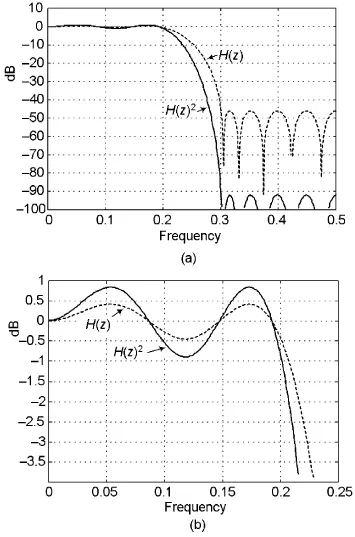
Figure 1–1(a) shows the performance of the H(z) and cascaded H(z)2 filters. Everything looks okay. The new filter has the same band edges, and the stopband attenuation is increased. But what about the passband? Let’s zoom in and take a look at Figure 1–1(b). The squared filter, H(z)2, has larger deviations in the passband than the original filter. In general, the squaring process will:
1. Approximately double the error (response ripple) in the passband.
2. Square the errors in the stopband (i.e., double the attenuation in dB in the stopband).
3. Leave the passband and stopband edges unchanged.
4. Approximately double the impulse response length of the original filter.
5. Maintain filter phase linearity.
Figure 1–1 H(z) and H(z)2 performance: (a) full frequency response; (b) passband response.
It is fairly easy to examine this operation to see the observed behavior if we view the relationship between H(z) and H(z)2 in a slightly unconventional way. We can think of filter squaring as a function F[H(z)] operating on the H(z) transfer function. We can then plot the output amplitude of this function, H(z)2, versus the amplitude of the input H(z) to visualize the amplitude change function.
The plot for F[H(z)] = H(z) is simple; the output is the input, so the result is the straight line as shown in Figure 1–2. The function F[H(z)] = H(z)2 is a quadratic curve. When the H(z) input amplitude is near zero, the H(z)2 output amplitude is closer to zero, which means the stopband attenuation is increased with H(z)2. When the H(z) input amplitude is near one, the H(z)2 output band is approximately twice as far away from one, which means the passband ripple is increased.
Figure 1–2 Various F[H(z)] functions operating on H(z).
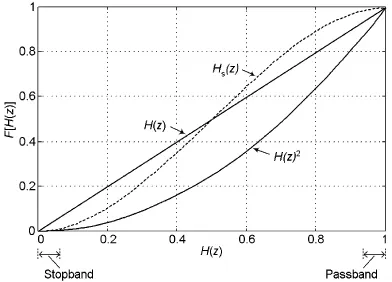
The squaring process improved the stopband, but degraded the passband. The improvement was a result of the amplitude change function being horizontal at zero. So to improve H(z) in both the passband and stopband, we want the F[H(z)] amplitude function to be horizontal at both H(z) = 0 and H(z) = 1 (in other words, have a first derivative of zero at these points). This results in the output amplitude changing slower than the input amplitude as we move away from zero and one, which lowers the ripple in these areas. The simplest function that meets this will be a cubic of the form

Its derivative (with respect to x) is

Specifying F(x) and F′(x) for the two values of x = 0 and x = 1 allows us to solve (1–1) and (1–2) for the cn coefficients as




Solving (1–5) and (1–6) simultaneously yields c2 = 3 and c3 = –2, giving us the function

Stating this function as the sharpened filter Hs(z) in terms of H(z), we have

The function Hs(z) is the dotted curve in Figure 1–2.
1.2 FIR FILTER SHARPENING
Hs(z) is called the “sharpened” version of H(z). If we have a function whose z-transform is H(z), then we can outline the filter sharpening procedure, with the aid of Figure 1–3, as the following:
1. Filter the input signal, x(n), once with H(z).
2. Double the filter output sequence to obtain w(n).
3. Subtract w(n) from 3x(n) to obtain u(n).
4. Filter u(n) twice by H(z) to obtain the output y(n).
Figure 1–3 Filter sharpening p...
Table of contents
- Cover
- IEEE Press
- Title page
- Copyright page
- Dedication
- Preface
- Contributors
- Part One: Efficient Digital Filters
- Part Two: Signal and Spectrum Analysis Tricks
- Part Three: Fast Function Approximation Algorithms
- Part Four: Signal Generation Techniques
- Part Five: Assorted High-Performance DSP Techniques
- Index
Trusted by 375,005 students
Access to over 1.5 million titles for a fair monthly price.
Study more efficiently using our study tools.
Frequently asked questions
Yes, you can cancel anytime from the Subscription tab in your account settings on the Perlego website. Your subscription will stay active until the end of your current billing period. Learn how to cancel your subscription
No, books cannot be downloaded as external files, such as PDFs, for use outside of Perlego. However, you can download books within the Perlego app for offline reading on mobile or tablet. Learn how to download books offline
We are an online textbook subscription service, where you can get access to an entire online library for less than the price of a single book per month. With over 1.5 million books across 990+ topics, we’ve got you covered! Learn about our mission
Look out for the read-aloud symbol on your next book to see if you can listen to it. The read-aloud tool reads text aloud for you, highlighting the text as it is being read. You can pause it, speed it up and slow it down. Learn more about Read Aloud
Yes! You can use the Perlego app on both iOS and Android devices to read anytime, anywhere — even offline. Perfect for commutes or when you’re on the go.
Please note we cannot support devices running on iOS 13 and Android 7 or earlier. Learn more about using the app
Please note we cannot support devices running on iOS 13 and Android 7 or earlier. Learn more about using the app
Yes, you can access Streamlining Digital Signal Processing by Richard G. Lyons in PDF and/or ePUB format, as well as other popular books in Technology & Engineering & Electrical Engineering & Telecommunications. We have over 1.5 million books available in our catalogue for you to explore.