From B.B. King to Billie Holiday, Blues music not only sounds good, but has an almost universal appeal in its reflection of the trials and tribulations of everyday life. Its ability to powerfully touch on a range of social and emotional issues is philosophically inspiring, and here, a diverse range of thinkers and musicians offer illuminating essays that make important connections between the human condition and the Blues that will appeal to music lovers and philosophers alike.
eBook - ePub
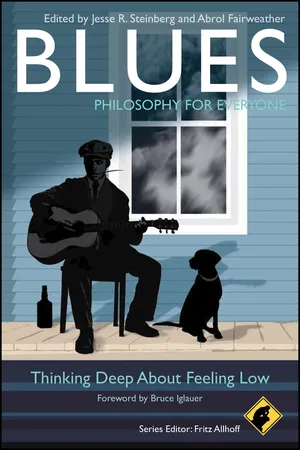
Blues - Philosophy for Everyone
Thinking Deep About Feeling Low
- English
- ePUB (mobile friendly)
- Available on iOS & Android
eBook - ePub
Blues - Philosophy for Everyone
Thinking Deep About Feeling Low
About this book
The philosophy of the blues
Information
PART 1
HOW BLUE IS BLUE? THE METAPHYSICS OF THE BLUES
CHAPTER 1
TALKIN’ TO MYSELF AGAIN
A Dialogue on the Evolution of the Blues
It is unlikely that [the blues] will survive through the imitations of the young white college copyists, the ‘urban blues singers’ whose relation to the blues is that of the ‘Trad’ jazz band to the music of New Orleans: sterile and derivative. The bleak prospect is that the blues probably has no real future; that folk music that it is, it served its purpose and flourished whilst it had meaning in the Negro community. At the end of the century it may well be seen as an important cultural phenomenon – and someone will commence a systematic study of it, too late.
(Paul Oliver)1
Me: Remember when blues historians were all worried about the blues surviving the rock era?
Myself: Absolutely. Paul Oliver actually said he didn’t think that the blues would survive through the 1960s. The way he saw it, the blues was essentially rooted in time and place – a variety of folk music indigenous to the post-reconstruction American South. In that unique context the music served an essential social function within its community of origin. Removed from that cultural context the blues is severed from its essence, resulting in music that is at best merely ‘sterile and derivative.’
Me: Shows how much they knew! Check it out – we’re now ten years into the twenty-first century and it’s quite apparent that the blues has survived, thrived, and arrived. And I mean ARRIVED!
Myself: Wait a minute. Just what do you mean, ‘arrived’?
Me: Well, just look around. Blues is big global biz – maybe not quite as big as hip-hop, or the NBA, but no less global, and pretty damn big. The blues is everywhere now! The blues has its own ‘Oscars,’ or ‘Grammys.’ The Blues Foundation, like the Academy of Motion Picture Arts and Sciences and the National Academy of Recording Arts and Sciences in Hollywood, hosts an annual Blues Music Awards ceremony and banquet (formerly the W. C. Handy Awards) drawing thousands of visitors from all over the world to Memphis, Tennessee. And they sponsor an annual international talent search, attracting entrants from far and wide: Australia, Canada, Croatia, France, Israel, Italy, Norway, Poland, and all fifty US states. Blues tourism is now a growth industry in the Mississippi Delta and beyond. Nowadays you can go on a Caribbean Blues Cruise – a floating week-long round-the-clock blues festival aboard an eleven-deck five-star cruise-ship – stopping in Aruba, Curacao, St. Barts, and other exotic vacation destinations. And look here! There is even now a recognized academic specialty in blues scholarship. By the time you get a book of philosophical essays published about the blues, under the Wiley-Blackwell imprint, no less, the blues has, like I said, ARRIVED!
Myself: Well, if that’s what you mean by ‘arrived,’ what do mean by ‘thrived’ and ‘survived’?
Me: Well, isn’t the blues ‘thriving’ as commerce?
Myself: Depends on who you ask. I know a lot of players can’t get a gig and others can’t keep a band together because of blues clubs and festivals closing down all over the place or changing their format to something more ‘contemporary.’ Did you know that the San Francisco Blues Festival, the longest running blues festival anywhere, shut down two years ago for economic reasons? And lots of smaller regional festivals have had to do the same, and in this economy…
I: Look, in the twenty-first century the whole music industry is in deep turmoil. At this point, none of the old business models seem viable even short-term. So what’s the point of debating the commercial viability of one particular genre of music?
Myself: Okay. Let’s skip the economics. But the still deeper question, about ‘survival,’ remains whether commercially successful ‘blues’ is really blues. Go ahead and assume that the blues has been successfully commercialized. How does it survive that transformation as blues? Isn’t successfully commercialized blues essentially ‘dead on arrival?’
Me: I hope you’re not assuming some sort of radical incompatibility between the blues and show business success. Surely you’re not going to discredit B. B. King because he made it from the chitlin’ circuit to the world stage and his own chain of nightclubs!
Myself: Don’t trivialize the point. B. B.’s career speaks for itself. I’d say the same for Buddy Guy – these are two good (indeed exceptional) examples of bluesmen surviving and thriving. But that’s the point. These are the exceptions that prove the rule. There’s a huge difference between B. B. King’s Beale Street Blues Club in Memphis or Buddy Guy’s Legends in Chicago and, for example, the national corporate chain known as the House of Blues.
Me: Specifically?
Myself: Well, for starters, look at the locations. It makes sense for Buddy Guy to have his own club in Chicago, and for B. B. King to erect a shrine to the blues on Beale Street in Memphis. But what’s up with the House of Blues on Disneyland Avenue in Anaheim (smells like a theme park to me) and the Boardwalk in Atlantic City (smells even worse: like a casino)? Then look at the ownership structure, if you want to get more deeply into it. The House of Blues chain is part of Live Nation, arguably now the world’s largest global entertainment conglomerate, controlling events, concert tours, festivals, and the largest venues in major markets all over the world (and now ticket distribution, including scalping – what a racket!). Music, monster trucks, golf – they don’t care. They promote anything! If you can draw a crowd, they’ll promote it. And now that they own the House of Blues, do you really think it’s a chain of blues clubs anymore, if it ever was? Just check out the music lineup. Maybe it includes some blues, but damn few and far between! The concert listings are dominated by Live Nation touring acts, just as you’d expect: Anvil, Nickelback, Killswitch Engage, Timbaland. C’mon! No disrespect to Anvil or anybody, but it ain’t the blues or even close! House of Blues?! They’ve got their ‘blues’ logo plastered all over their useless schwag – it’s got nothing whatsoever to do with the blues. It’s nothing but a corporate entertainment franchise operation sloppily copping a ‘blues-theme,’ very much in the mold of the Hard Rock Café (which makes some sense, by the way – the same entrepreneur, one Isaac Tigrett, started both). That’s commercialization for you: completely devoid of soul.
Me: Slow down, man! You’re getting carried away. Whatever Live Nation may be doing with it now, that’s not how the House of Blues started out, and Live Nation would never have been interested in acquiring the House of Blues if the latter hadn’t demonstrated that there’s a viable commercial market for the blues.
Myself: I’m not so sure. Live Nation seems bent on global domination and ready to gobble up whatever they can use and whatever stands in their way, regardless. But let’s talk about the origins of the House of Blues. The first House of Blues opened in Harvard Square (!) in 1992. Tigrett’s original partner in the venture was Canadian comedian Dan Aykroyd, of Saturday Night Live fame. Aykroyd and his Saturday Night Live co-star John Belushi had developed two characters: the Blues Brothers – two white guys fronting a blues band. Belushi, as ‘Jolliett Jake’ Blues, was the singer (imagine Belushi’s samurai warrior character dressed like a Chicago hit man in shades with a microphone). Aykroyd, in matching outfit, as Elwood Blues, played harmonica. What began as a comedy sketch and then developed into a running gag was so successful (popular) that within a couple of years Belushi and Aykroyd had rounded up a backup band of A-list Memphis session musicians, had recorded and released a full-length album (Briefcase Full of Blues), and had a script for a Hollywood feature-length comedy in production (The Blues Brothers, 1980). They even opened a bar in Chicago called The Blues Brothers Bar. The bar didn’t have an actual liquor license so it got shut down pretty quickly, but there’s your prototype. And there you have it: the original House of Blues – a spin-off of a successful comedy act about a couple of white guys fronting a blues band.
Me: Now look who’s trivializing. The impulses behind the original House of Blues were complex, not simply comedic. And it’s worth noting that the comedic impulses animating the Blues Brothers as comic personae have more than a little complexity and depth as well. Aykroyd was a committed blues fan from his high school and college days in Ottawa, where he got to hear all the great touring bluesmen of the 1950s and early 1960s: Muddy Waters, Howlin’ Wolf, James Cotton, Junior Wells, Buddy Guy. He even jammed with Muddy Waters. Aykroyd turned Belushi on to the blues, and Belushi grew to be a committed blues fan himself, his interest growing deeper through his encounters with Curtis Salgado and Robert Cray during the production of National Lampoon’s Animal House in the late 1970s in Eugene, Oregon (Cray wound up appearing as the bass player in the band that performs as ‘Otis Day and the Knights’ in the roadhouse and frat-house party scenes). So both Aykroyd and Belushi got some serious schooling in the blues from some pretty unimpeachable sources. And, if you look closely you begin to see that what the Blues Brothers were really making fun of was themselves as white guys getting into the blues.
Myself: I love it when people make my point for me. See, we’re back to Paul Oliver’s bleak assessment of the future of the blues. Aykroyd and Belushi are just part of a cultural process in which the blues is simultaneously appropriated, exploited, and left behind. I suppose it’s nice, even somewhat ‘redeeming,’ that these guys were able to make fun of themselves and of their own role in that process.
Me: But you’re now talking as though the blues can be neatly separated and distinguished from what you call the ‘process’ of commercial appropriation and exploitation. Don’t forget: all the great blues singers took part in that process. In the 1930s weren’t they expanding their audiences through recordings and radio performances? In the 1960s weren’t they playing college towns and folk festivals, reaching new generations of fans? Then didn’t they go to the West Coast and play the Fillmore, and open for the Stones in Europe, expanding their audiences even further? You can see these same processes at work all the way back to 1903 with W. C. Handy, who transcribed the blues for sale as sheet music. So what exactly is it about these processes that you see as being especially in need of ‘redemption’? Is it the commerce, or the roles and racial identities of those involved in it?
Myself: Both! The black bluesmen and women that performed on the radio, made recordings, and went out on tours were generally being exploited commercially by businesses controlled mostly by white people.
I: I thought we were going to skip the economics, but apparently not. Do you sense the discussion expanding to greater and greater levels of complexity? We’re now confronting not only the economics and business ethics of the entertainment industry and the arts but also the complexities of American history and race in the even larger context of the Heraclitean flux of culture formation, and…
Me and Myself [in shocked unison]: What the… ?!
I: … how can we even begin to comprehend the massive network of dynamic forces (economic, social, political, and more) constantly shaping culture at any moment in time and place? Don’t you wonder where to find any reliable standard for predicting and assessing the trajectory of a culture and its contents? Who was it that said, when asked for an opinion about the future of jazz, ‘If I knew where jazz was going, I’d be there already’?
Myself: Trumpeter Humphrey Lyttelton said that.
Me: But what was that hurricane cluster flap, or whatever that was you said? What are you talking about?
I: Heraclitus: the Greek philosopher who held that everything is always changing (in flux). He’s the source of that famous saying that you can’t step twice into the same river. So, isn’t culture a lot like a river – always flowing and changing, affecting and affected by everything with which it comes in contact?
Me: Okay. So we get the metaphor.
Myself: But where are you headed with it?
I: Well, suppose we consider the blues as a cultural phenomenon, something that arises as part of what we call culture. As such the blues is ‘alive,’ constantly changing and developing – that is, of course, until it ‘dies.’ Now, how do you tell whether the blues is living or dying? How do you determine which changes and developments constitute continuations or extensions of the blues as a living tradition and which ones constitute departures from or betrayals of that tradition? And doesn’t it get more complicated and difficult with each new generation of change and development?
Me: How about an example?
I: Okay. Here’s one. When Muddy Waters moved from Mississippi to Chicago, it wasn’t long before he was playing amplified electric guitar and surrounded by a full band. That was a change, a development. And he was playing to audiences of factory workers in an urban nightclub, instead of sharecroppers in a Delta juke joint. That’s a change, more development. Does anyone wonder whether the blues is surviving through these changes?
Me: Not me.
I: Now take the example a step further. By 1969 Muddy was playing in larger and more opulent venues spread out across the United States and overseas. He was playing to larger and younger crowds, including more and more white people. And he made an album for Chess Records entitled Fathers and Sons, now surrounded by a full band including three white guys: Paul Butterfield, Michael Bloomfield, and Donald ‘Duck’ Dunn (who also played bass behind the Blues Brothers). These are the guys Paul Oliver is talking about as having a ‘sterile and derivative’ relationship to the blues. More change, more development; but now doubts are being raised about whether the blues will survive.
Myself: Well, the obvious difference is the growing presence ...
Table of contents
- Cover
- Editor’s page
- Series page
- Title page
- Copyright page
- Dedication
- FOREWORD
- IT GOES A LITTLE SOMETHING LIKE THIS…
- ACKNOWLEDGMENTS
- PART 1: HOW BLUE IS BLUE? THE METAPHYSICS OF THE BLUES
- PART 2: THE SKY IS CRYING: EMOTION, UPHEAVAL, AND THE BLUES
- PART 3: IF IT WEREN’T FOR BAD LUCK, I WOULDN’T HAVE NO LUCK AT ALL: BLUES AND THE HUMAN CONDITION
- PART 4: THE BLUE LIGHT WAS MY BABY AND THE RED LIGHT WAS MY MIND: RELIGION AND GENDER IN THE BLUES
- PHILOSOPHICAL BLUES SONGS
- NOTES ON CONTRIBUTORS
Trusted by 375,005 students
Access to over 1.5 million titles for a fair monthly price.
Study more efficiently using our study tools.
Frequently asked questions
Yes, you can cancel anytime from the Subscription tab in your account settings on the Perlego website. Your subscription will stay active until the end of your current billing period. Learn how to cancel your subscription
No, books cannot be downloaded as external files, such as PDFs, for use outside of Perlego. However, you can download books within the Perlego app for offline reading on mobile or tablet. Learn how to download books offline
Perlego offers two plans: Essential and Complete
- Essential is ideal for learners and professionals who enjoy exploring a wide range of subjects. Access the Essential Library with 800,000+ trusted titles and best-sellers across business, personal growth, and the humanities. Includes unlimited reading time and Standard Read Aloud voice.
- Complete: Perfect for advanced learners and researchers needing full, unrestricted access. Unlock 1.5M+ books across hundreds of subjects, including academic and specialized titles. The Complete Plan also includes advanced features like Premium Read Aloud and Research Assistant.
We are an online textbook subscription service, where you can get access to an entire online library for less than the price of a single book per month. With over 1.5 million books across 990+ topics, we’ve got you covered! Learn about our mission
Look out for the read-aloud symbol on your next book to see if you can listen to it. The read-aloud tool reads text aloud for you, highlighting the text as it is being read. You can pause it, speed it up and slow it down. Learn more about Read Aloud
Yes! You can use the Perlego app on both iOS and Android devices to read anytime, anywhere — even offline. Perfect for commutes or when you’re on the go.
Please note we cannot support devices running on iOS 13 and Android 7 or earlier. Learn more about using the app
Please note we cannot support devices running on iOS 13 and Android 7 or earlier. Learn more about using the app
Yes, you can access Blues - Philosophy for Everyone by Jesse R. Steinberg, Abrol Fairweather, Jesse R. Steinberg,Abrol Fairweather, Fritz Allhoff in PDF and/or ePUB format, as well as other popular books in Philosophy & Philosophy History & Theory. We have over 1.5 million books available in our catalogue for you to explore.