- Features essays by the leading scholars in the field, including Pulitzer Prize winners Annette Gordon-Reed and Jack Rakove
- Includes a section that considers Jefferson's legacy
- Explores Jefferson's wide range of interests and expertise, and covers his public career, private life, his views on democracy, and his writings
- Written to be accessible for the non-specialist as well as Jefferson scholars
- English
- ePUB (mobile friendly)
- Available on iOS & Android
eBook - ePub
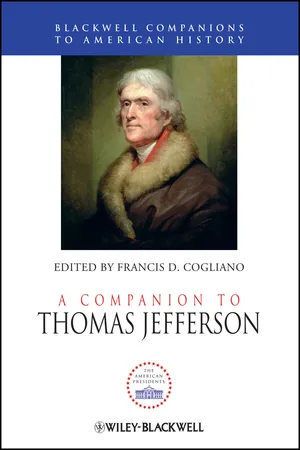
A Companion to Thomas Jefferson
About this book
A Companion to Thomas Jefferson presents a state-of-the-art assessment and overview of the life and legacy of Thomas Jefferson through a collection of essays grounded in the latest scholarship.
Information
PART I
Jefferson’s Life and Times
CHAPTER ONE
Jefferson and Biography
It was the fate of Thomas Jefferson to be at once more loved and praised by his friends, and more hated and reviled by his adversaries than any of his compatriots. Time has produced less abatement of these feelings towards him than is usual; and, contrary to the maxim which invokes charity for the dead, the maledictions of his enemies have of late years been more frequent and loud than the commendations of his friends.
George Tucker, 1837
The argument never ceases. Just who was Thomas Jefferson and what is he – what should he be – to us? Attempts to answer that question began soon after Jefferson drew his last breath on July 4, 1826. His family made the first move with the publication in 1829 of four volumes’ worth of Jefferson’s writings and correspondence. The biographers soon followed, creating narratives that put their own cast on his legacy, hoping to shape posterity’s opinion on where the Virginian should fit in the American pantheon or, sometimes, whether he should be in it at all. From the 1830s until today, the full-length biographies, single- and multi-volume, have poured forth.
It is safe to say that no president besides Lincoln has been the subject of more intense, and varied, investigation. People who love Jefferson have written about him, as have those who loathed him, along with those who are simply deeply conflicted. Like all biographies and written histories, these works are the products of the times in which they were crafted. Some have been more influential and important than others. Because of their talent, or exquisite timing, the authors of those particular volumes managed to use their cultural moment to create a picture of Jefferson that captured the imagination of contemporary readers and, perhaps more importantly, of the historians and biographers who would follow them. Their work covers the field until another strong effort comes to take its place.
The field of Jefferson studies can usefully be divided into three eras, dominated by biographies that were judged the leading word, the “definitive” treatment of Jefferson for that particular age, with the expectation that the book’s influence would continue far into the future. This is not to say that there were not many fine biographies or books about Jefferson written during these same periods, it is to suggest that the research, insights, and conclusions of the defining books had a greater impact on the field than others. Even though it was not the first biography of Jefferson, the nineteenth century, well into the mid-twentieth century, was the era of Henry S. Randall’s Life of Thomas Jefferson, published in 1858. Randall’s work set the tone for writing about Jefferson for his time and influenced generations of biographers who succeeded him up to the present. After Randall came Dumas Malone, who began his majestic six-volume study, Jefferson and His Time, in the 1940s and ended it in the early 1980s. Though not totally eclipsed, the Malone era has been in decline with the rise of more specialized and focused considerations of aspects of Jefferson’s life. Jefferson biography has splintered into a seemingly endless number of fragments. From the 1960s until today we have lived in the era of “Jefferson and” – Jefferson and slavery, Jefferson and women, Jefferson and the character question. Even as these specialized studies have enriched our understanding of Jefferson, they remind us of the need for a comprehensive treatment that puts the man whole again after all that we have learned from the many sophisticated studies of individuals aspects of his life and attitudes.
What follows is a description and analysis of the progression of Jefferson biography from the earliest time until today, with a particular emphasis on the most influential works. But before Jefferson biographies there was, of course, Jefferson himself. He is at the heart of every attempt to fashion a narrative of his life, not merely because he is the biographical subject at hand, but because he tried to so hard to make historians the object of his influence. Any consideration of the history of Jefferson biographies must begin with him.
The Pitch
It would be hard to imagine any figure in history more self-conscious about his legacy than Thomas Jefferson. From the time he burst onto the scene as a young revolutionary, he had good reason to believe that he would live on in history. He had played an integral role in a movement that had successfully defeated what was at the time the most powerful nation on the earth: Great Britain. As his star in the leadership cadre of the new nation continued to rise, he had even more reason to feel certain that later generations would know his name.
This was not only what Jefferson expected, it was what he very much wanted, and in this he was little different from the other well-known members of his revolutionary cohort. In his influential work, Fame and the Founding Fathers, the historian Douglass Adair cited fame as a key motivator for many members of the founding generation (see Colbourn 1974). It helped shaped their sense of themselves and guided their actions during their lifetimes as they, anachronistically, reached across the centuries and tried to model themselves after the famous men of ancient western civilizations, the Greeks and Romans, and, when the situation warranted, resorted to a mythical Anglo-Saxon past. That made sense, given that they were also scouring history looking for templates for the new republic they wanted to create: one that would stake its own claim on the future. Just as in ancient times, the men who made the American republic would have to have the character to pull it off – or at least be seen as having the character to do so. But it was not celebrity during their lifetimes that mattered; the much longed-for goal was fame in posterity.
Jefferson biographer Fawn Brodie observed that “Jefferson had a superb sense of history and an exact understanding of his own role in it” (Brodie 1974, 22). As one who read history and appreciated its pivotal role in determining what later generations felt about events and people of the past, Jefferson realized that his legacy would ultimately be in the hands of historians. How would they go about making their judgments? What material would they use to assess the meaning of his life’s work and those of the other American Revolutionaries? “Who will write the history of the American Revolution?” John Adams asked Jefferson during one exchange in their famous late-in-life correspondence. “Nobody; except it’s (sic) external facts,” Jefferson responded. Then he explained. The men who made the Revolution – including himself – kept sparse, if any notes, about what was going on. Therefore, their thoughts, feelings, and motivations at the time, which was “the life and soul of history must forever be unknown” (John Adams to TJ and Thomas McKean, July 30, 1815; TJ to John Adams, August 10[11], 1815, in Cappon 1959, 2: 451, 452).
Jefferson’s answer to Adams about the American Revolution presents a telling window into his thoughts on the nature and substance of history overall. As the historian Francis Cogliano has noted, Jefferson believed that in order for history to “retain its power and significance,” it had to be based upon primary sources (Cogliano 2006). Documentary evidence, written by the people who were involved in the events, or were the subjects of historical inquiry, provided the chief, if not only, means for getting at the real truth of what had gone on in the past. This conception of history as necessarily coming from the actual participants describing what actions they took and, perhaps, expressing their thoughts and feelings about events as they were unfolding formed the basis for Jefferson’s understanding of how to present himself to posterity. If historians were to be his judges, he wanted to address them and influence their project as much as possible. With this philosophy in mind, he set out to establish what he wanted to be the historical truth of his life, even as he drew sharp limits around what parts of his life were to be included in the historical record.
Of course, many histories of the Revolution have been written – and good ones too. The documentary record is more extensive than Jefferson knew of or imagined. In addition, the understanding of the kinds of things that could be a part of the record has greatly expanded. Perhaps it is here that models from ancient history most poorly served Jefferson’s understanding of what was likely to happen when future historians wrote about him and his times. The words of non-elite men, women, and slaves have been added to the mixture of the attempt to tell the story of America’s origins. History is no longer simply what great men did, said they did, and their explanation for why they did it. As a result the ground has shifted decisively underneath Jefferson’s historical feet. Even without that shift, Jefferson’s statement about the primacy of documentary records does not get at the true heart of the historical enterprise, or how responsible historians go about shaping the legacies of historical figures.
What historians lack in firsthand experience of their subject matter, they more than make up for with the twenty-twenty vision of hindsight and the capacity to play the omniscient observer – to analyze the Rashomon-like narratives that always exist whenever multiple people are involved in an unfolding story. After considering all viewpoints they are, at least, in the position to come to a reasonable conclusion about the relative reliability of the often competing and contradictory stories. Every individual in Jefferson’s cohort experienced that time in his or her own way and, thus, had his or her own version of the truth. Jefferson well understood that it was the historian’s job to interpret the documentary record, to consider the evidence as presented, and to arrive at reliable conclusions about the past, and he was withering when he came upon historians who failed at the task. There is also little doubt that his tendency to divide the world up into the forces of good (truth) and the forces of evil (falsehood) led Jefferson to believe that with strategic prompting – particularly, his strategic prompting – future historians (who undoubtedly would be living in a more progressive and enlightened time) would recognize the truth as he saw it.
But what form would the prompts take? What could he leave behind to tell the story of himself and his times in the way it needed to be told? He could leave his own words, created in the moment that would give future generations the facts about his era and allow them to see his thoughts and reactions to all the events that mattered. Unlike other prominent men of the time, Jefferson did not, as a general rule, keep a journal, which would seem a logical thing to have done for one so keen on speaking directly to generations in the future. The closest he came to keeping a diary was the Anas, his record of his days as Secretary of State in the Washington administration. Jefferson’s initial reason for keeping the notes of his conversations with other members of the cabinet fit perfectly with his belief in the critical importance of contemporary accounts of historical events. And make no mistake; Jefferson knew that what was going on in the Washington administration would be seen as historic. What Jefferson later did with the Anas – revise it and add to it based on his later recollections – and why he did so, show that by the end of his life he well understood the threat that competing narratives in history could pose for his legacy and for later generations’ understanding of what went on in the early American republic. One description of Jefferson’s writings in the Anas suggests why he did not resort to this form more generally.
In these diary notes – vivid, racy, almost prehensile in the way they reach out for the target – Jefferson emerges as a political rhetorician of no mean power, using a salty vocabulary of epithet. We see him at a level considerably below the lofty plane of disinterested public servant that formed his self image. He seems too familiar with the wiles, cabals, and maneuvers of his enemies to convince the reader that this is alien territory to him.
(Lerner 1996, 138)
To the extent that Jefferson wanted historians to accept his own image of himself, the Jefferson of the Anas was almost certainly not his preferred presentation. The exigencies of the moment – he redid the Anas in response to the completion and publication of John Marshall’s five-volume biography of George Washington, which he considered to be so much Federalist inspired propaganda – were such that he could not restrain himself. He felt that he could not pass up the chance to set the record straight while settling some old scores with his nemesis Alexander Hamilton along the way. One could speculate that Jefferson was not entirely comfortable with the idea of keeping a daily record of his reflections on circumstances outside of his political life. Journal-keeping creates the greater chance for informality, and informality carries the risk of the unintended revelation. A Jefferson diary, the kind of thing any student of Jefferson would love to have in hand, might reveal way more of himself than he cared to share with posterity, even if he were as circumspect as possible.
Jefferson’s most direct attempt to communicate with later generations was his autobiography begun in 1821 at the age of seventy-seven. He claimed that writing the Autobiography was intended for his “own ready reference and for the information of his family” (Ford 1914, 3). But surely such a thing would not have to be published, and Jefferson’s voice throughout the document suggests that he expected the book to be read by others beside his family. It is a fairly perfunctory affair, in terms of the information provided, the length, and the time he spent on it. After only several months, he abandoned the effort. It begins with a maddeningly terse account of his family history and ends in 1790 with his arrival in New York to take up his role as Secretary of State after finishing his time abroad as Minister to France. Jefferson lived another thirty-six years after that, years that he evidently did not care to describe in autobiographical form. His heart was not in it. At one point he says flatly, “I am already tired of talking about myself” (Ford 1914, 78).
If Jefferson did not wish to reveal his life in a series of daily reflections or by simply writing a straightforward narrative, he had another means. Letters were his preferred mode of presentation to the audience of the future. He believed that “the letters of a person, especially of one whose business has been chiefly transacted by letters, form the only full and genuine journal of his life.” This bit of Jeffersonian hyperbole – the only full and genuine journal – fit perfectly with his ideas about the proper way to prepare oneself for history. His letters, written in the daily course of his life would give “real time” information to later generations about the things they needed to know. Written while the issues discussed were fresh in the mind, they would be more accurate than an autobiography written, sometimes, long after the salient events occurred. Jefferson’s explanation for the superiority of letters as the medium for telling a life story neatly circumscribes the boundaries of what would be presented. The words “business” and “transacted” immediately signal that the professional, rather than personal life was to be the primary focus.
Jefferson thought that biographies of great men should be about their public lives, the domestic sphere having no real place in the record except insofar as it intersected with the public life. Marriage was a public event, and therefore, it made sense to mention his wife, Martha, in his Autobiography and refer to her illness as a reason for not initially accepting the new government’s commission to go to France in the early 1780s. In 1817, when a man who was thinking of writing a life of Jefferson wrote to ask for the names of Jefferson’s grandchildren, Jefferson responded that he did not want to bore the public with information that had nothing to do with his life as a public man; the reason he was being written about in the first place (TJ to Joseph Delaplaine, April 12, 1817, TJP).
It is not as though there was no precedent for consideration of, or interest in, the private lives of famous people. The goings on among the royalty of Europe were of great interest to members of the public – marriages, mistresses, and children, l...
Table of contents
- Cover
- Series page
- Title page
- Copyright page
- Dedication
- Figures and Tables
- Notes on Contributors
- Abbreviations
- Introduction
- PART I: Jefferson’s Life and Times
- PART II: Themes
- PART III: Legacy
- Bibliography
- Index
Trusted by 375,005 students
Access to over 1.5 million titles for a fair monthly price.
Study more efficiently using our study tools.
Frequently asked questions
Yes, you can cancel anytime from the Subscription tab in your account settings on the Perlego website. Your subscription will stay active until the end of your current billing period. Learn how to cancel your subscription
No, books cannot be downloaded as external files, such as PDFs, for use outside of Perlego. However, you can download books within the Perlego app for offline reading on mobile or tablet. Learn how to download books offline
Perlego offers two plans: Essential and Complete
- Essential is ideal for learners and professionals who enjoy exploring a wide range of subjects. Access the Essential Library with 800,000+ trusted titles and best-sellers across business, personal growth, and the humanities. Includes unlimited reading time and Standard Read Aloud voice.
- Complete: Perfect for advanced learners and researchers needing full, unrestricted access. Unlock 1.5M+ books across hundreds of subjects, including academic and specialized titles. The Complete Plan also includes advanced features like Premium Read Aloud and Research Assistant.
We are an online textbook subscription service, where you can get access to an entire online library for less than the price of a single book per month. With over 1.5 million books across 990+ topics, we’ve got you covered! Learn about our mission
Look out for the read-aloud symbol on your next book to see if you can listen to it. The read-aloud tool reads text aloud for you, highlighting the text as it is being read. You can pause it, speed it up and slow it down. Learn more about Read Aloud
Yes! You can use the Perlego app on both iOS and Android devices to read anytime, anywhere — even offline. Perfect for commutes or when you’re on the go.
Please note we cannot support devices running on iOS 13 and Android 7 or earlier. Learn more about using the app
Please note we cannot support devices running on iOS 13 and Android 7 or earlier. Learn more about using the app
Yes, you can access A Companion to Thomas Jefferson by Francis D. Cogliano in PDF and/or ePUB format, as well as other popular books in History & Early American History. We have over 1.5 million books available in our catalogue for you to explore.