![]()
Chapter 1
A Short History of YouTube
Founded in February 2005, YouTube is now the world’s most popular online video community, allowing millions of people to discover, watch, and share originally created videos. In this chapter, you will learn why YouTube took off, how it changed the online video landscape, and when it passed some memorable milestones.
Chapter Contents:
- Life Before YouTube
- 2005–2006: Early Days
- 2007–2008: Middle Years
- 2009–2010: Coming of Age
Life before YouTube
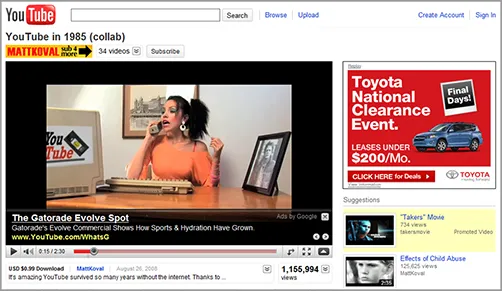
“You know how it is with technology—once something becomes so ubiquitous and so universally used, it is simply impossible to imagine life without it,” observed Chris Tryhorn of guardian.co.uk on August 29, 2008. Embedded in his article “Life before YouTube” is a funny video (www.youtube.com/watch?v=HWDCeEJ9ZfI) by Matt Koval. As Figure 1-1 illustrates, “YouTube in 1985 (collab)” imagines what the personal video sharing service would have looked like a human generation ago.
When Koval calls to submit his latest video, a woman on the YouTube staff asks, “On VHS or Betamax?”
Fast-forward from a mythical time to the real dot-com era and the first-mover advantage in online video actually belonged to Singingfish. Founded in 1999, it was one of the earliest search engines to focus on audio and video content. A public alpha version of Singingfish was unveiled in June 2000, and the company was acquired by Thomson Multimedia in November 2000.
Singingfish employed its own web crawler, Asterias, which was designed to ferret out audio and video links across the Web. It also used a proprietary system to process each of the links it discovered, extracting what little metadata it could find and then enhancing it prior to indexing.
However, Singingfish had the misfortune of going to market just as the dot-com bubble was bursting. So, even as it was being launched, Singingfish was being downsized dramatically.
AOL acquired Singingfish in October 2003 and eventually folded it into AOL Video.
Now, a first mover isn’t always able to capitalize on its advantages. It often faces higher R&D and marketing costs because the first mover is creating products and markets from scratch.
That’s why the title of this book isn’t Singingfish Marketing: An Hour a Day. And it also explains why many companies pursue a fast-follower strategy.
Fast followers try to learn from the first mover what works and what doesn’t. Then they try to use their resources to make superior products or outmarket the first mover. In the words of a civil war general, they try to “git thar fustest with the mostest.”
For example, blinkx launched an audio and video search engine December 2004. Google launched a video search engine in January 2005. And Yahoo! launched a video search engine in May 2005.
But being fast followers didn’t turn out to be a winning strategy for blinkx, Google Video, or Yahoo! Video. If it had worked, then this book would be titled Video Search Engine Optimization: An Hour a Day.
So why did YouTube become the world’s most popular online video community?
That’s the question I’ll answer in this chapter.
2005–2006: Early Days
The YouTube backstory is short. In fact, the Company History page on YouTube is about 400 words long, and “The Making of YouTube” video (www.youtube.com/watch?v=X2N_V2dfS1U) is only 3 minutes and 37 seconds long.
Feb. 2005: YouTube Founded
YouTube was founded in February 2005 by three former PayPal employees: Chad Hurley, Steve Chen, and Jawed Karim. According to Jim Hopkins of USA Today (Oct. 11, 2006), the idea for what became YouTube sprang from two very different events in 2004: Janet Jackson’s “wardrobe malfunction” during the Super Bowl XXXVIII halftime show and the great Sumatra-Andaman earthquake, also known as the Asian Tsunami or Boxing Day Tsunami.
In February 2005, it was difficult to find and share online videos of either event. At a San Francisco dinner party, Karim proposed to Hurley and Chen that they create a video-sharing site. “I thought it was a good idea,” Karim told Hopkins.
Within a few days, the three agreed to develop the idea and then divided work based on their skills: Hurley designed the site’s interface, while Chen and Karim split the technical duties for making the site work. None of the three had strengths or interests in marketing. In May 2005, a public beta test version of YouTube went live.
Note: Later, when the cofounders divided up management responsibilities, Hurley became CEO, Chen became CTO, and Karim assumed an advisory role after leaving YouTube to get a master’s degree in computer science at Stanford.
Apr. 2005: First Video Uploaded
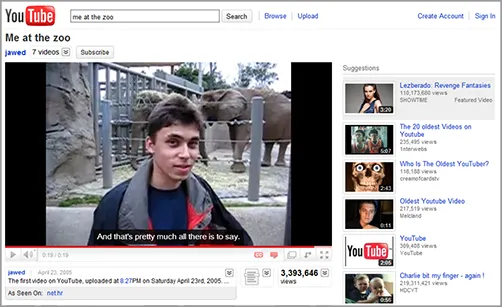
The first video on YouTube was shot by Yakov Lapitsky and features Karim at the San Diego Zoo. As Figure 1-2 illustrates, “Me at the zoo” (www.youtube.com/watch?v=jNQXAC9IVRw) is only 19 seconds long.
That video was uploaded on Saturday, April 23, 2005, at 8:27 p.m. At that time, YouTube’s headquarters was above a pizzeria and Japanese restaurant in San Mateo, California.
In front of the elephants, Karim says, “The cool thing about these guys today is that they have really, really, really long, um, trunks.” An annotation added more than three years later asks, “Can you hear the goat? MEEEEEEEEEEEH!”
As of today, “Me at the zoo” has over 4.8 million views.
Why is this ordinary moment so extraordinary? In spite of what Karim says, it’s not the elephants or their trunks. And despite the annotation, it’s not the goat.
May 2005: YouTube Beta Launched
That’s why the real story is what happened next. And it’s only in hindsight that we can see why YouTube went on to become the world’s most popular online video community.
The beta launch of YouTube took place in May 2005 and YouTube users like Cobaltgruv (www.youtube.com/cobaltgruv) started putting up videos.
On his Channel, Cobalt, 32, says, “Hey... well I’m the crazy guy... who found youtube the second week it was out... became user 42 or something...My first intention with YouTube was to share my channel with family, and friends... then look what happened!!!”
He adds, “I’ll only live once in this life... and now I’m trying to document it, and perhaps entertain your boredom. I love making films and would love to go to school for it one day. I have many other passions but this would have to be my #1 for many years now... Just another way to show who I am, and have fun doing it... even if it is to the whole world... thanks for the views!!!”
Created on May 3, 2005, Cobaltgruv’s channel has over 11,000 subscribers today, and his videos have over 264,000 views.
Aug. 2005: YouTube Embeds Enabled
Although YouTube didn’t spend much time or effort communicating with marketers or advertisers in 2005, the company did a great job of communicating with users. In fact, the YouTube Blog was created in July 2005 “in an effort to communicate improvements and changes.”
The blog said, “We are continuously working towards our goal of making YouTube the digital video repository for the Internet. That said, please let us know if there’s something you’d like us to address—we really, really, really do value any input our users send.”
And in early August, the blog acknowledged that many of the changes being announced “are in direct response to your feedback.”
Later that month, the blog announced, “We have added a ton of new features to our site.” One of these new features enabled users to embed the YouTube video player into their own web page. “That way people can view the video on your website without even coming to YouTube!”
Nov. 2005: YouTube Secures First Round of Funding
In November 2005, YouTube received $3.5 million in funding from Sequoia Capital. In a press release, Hurley said, “Since our public preview, we are already moving 8 terabytes of data per day through the YouTube community—the equivalent of moving one Blockbuster store a day over the Internet.”
Dec. 2005: YouTube Officially Launched and “Lazy Sunday” Goes Viral
YouTube was officially launched one month later. The company said its new service “allows people to easily upload, tag, and share personal video clips through www.YouTube.com and across the Internet on other sites, blogs and through e-mail.”
In other words, YouTube began as a personal video sharing service, not as yet another video search engine. This strategy is called “hit ’em where they ain’t.” It enabled YouTube to emerge from relative obscurity shortly after December 17, 2005, when a video entitled “Lazy Sunday”—which was a copy of the Saturday Night Live skit “The Chronicles of Narnia Rap”—was uploaded to the video sharing site.
On December 27, Dave Itzkoff of the New York Times reported that “Lazy Sunday” had already been viewed more than 1.2 million times.
The next day, LeeAnn Prescott, who was the research director at Hitwise at the time, posted her analysis of the hot video of the past week on her Hitwise Intelligence Analyst Weblog. Visits to YouTube, where people could discover, watch, and share “The Chronicles of Narnia Rap,” shot up...