THE FIRST BOOK OF ITS KIND ON DISTILLATION TECHNOLOGY
The last half-century of research on distillation has tremendously improved our understanding and design of industrial distillation equipment and systems. High-speed computers have taken over the design, control, and operation of towers. Invention and innovation in tower internals have greatly enhanced tower capacity and efficiency. With all these advances, one would expect the failure rate in distillation towers to be on the decline. In fact, the opposite is the case: the tower failure rate is on the rise and accelerating.
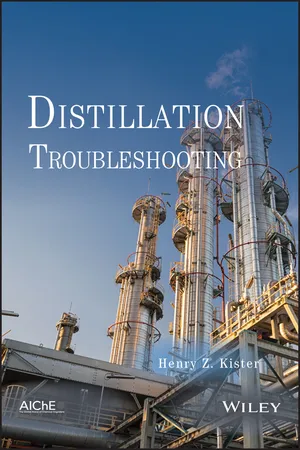
Distillation Troubleshooting collects invaluable hands-on experiences acquired in dealing with distillation and absorption malfunctions, making them readily accessible for those engaged in solving today's problems and avoiding tomorrow's. The first book of its kind on the distillation industry, the practical lessons it offers are a must for those seeking the elusive path to trouble-free distillation.
Distillation Troubleshooting covers over 1,200 case histories of problems, diagnoses, solutions, and key lessons. Coverage includes:
* Successful and unsuccessful struggles with plugging, fouling, and coking
* Histories and prevention of tray, packing, and internals damage
* Lessons taught by incidents and accidents during shutdowns, commissioning, and abnormal operation
* Troubleshooting distillation simulations to match the real world
* Making packing liquid distributors work
* Plant bottlenecks from intermediate draws, chimney trays, and feed points
* Histories of and key lessons from explosions and fires in distillation towers
* Prevention of flaws that impair reboiler and condenser performance
* Destabilization of tower control systems and how to correct it
* Discoveries from shutdown inspections
* Suppression of foam and accumulation incidents
A unique resource for improving the foremost industrial separation process, Distillation Troubleshooting transforms decades of hands-on experiences into a handy reference for professionals and students involved in the operation, design, study, improvement, and management of large-scale distillation.
- English
- ePUB (mobile friendly)
- Available on iOS & Android
eBook - ePub
Distillation Troubleshooting
About this book
Information
Chapter 1
Troubleshooting Distillation Simulations
It may appear inappropriate to start a distillation troubleshooting book with a malfunction that did not even make it to the top 10 distillation malfunctions of the last half century. Simulations were in the 12th spot (255). Countering this argument is that simulation malfunctions were identified as the fastest growing area of distillation malfunctions, with the number reported in the last decade about triple that of the four preceding decades (252). If one compiled a distillation malfunction list over the last decade only, simulation issues would have been in the equal 6th spot. Simulations have been more troublesome in chemical than in refinery towers, probably due to the difficulty in simulating chemical nonidealities. The subject was discussed in detail in another paper (247).
The three major issues that affect simulation validity are using good vapor—liquid equilibrium (VLE) predictions, obtaining a good match between the simulation and plant data, and applying graphical techniques to troubleshoot the simulation (255). Case histories involving these issues account for about two-thirds of the cases reported in the literature. Add to this ensuring correct chemistry and correct tray efficiency, these items account for 85% of the cases reported in the literature.
A review of the VLE case studies (247) revealed major issues with VLE predictions for close-boiling components, either a pair of chemicals [e.g., hydrocarbons (HCs)] of similar vapor pressures or a nonideal pair close to an azeotrope. Correctly estimating nonidealities has been another VLE troublespot. A third troublespot is characterization of heavy components in crude oil distillation, which impacts simulation of refinery vacuum towers. Very few case histories were reported with other systems. VLE prediction for reasonably ideal, relatively high volatility systems (e.g., ethane—propane or methanol—ethanol) is not frequently troublesome.
The major problem in simulation validation appears to be obtaining a reliable, consistent set of plant data. Getting correct numbers out of flowmeters and laboratory analyses appears to be a major headache requiring extensive checks and rechecks. Compiling mass, component, and energy balances is essential for catching a misleading flowmeter or composition. One specific area of frequent mismatches between simulation and. plant data is where there are two liquid phases. Here comparison of measured to simulated temperature profiles is invaluable for finding the second liquid phase. Another specific area of frequent mismatches is refinery vacuum towers. Here the difficult measurement is the liquid entrainment from the flash zone into the wash bed, which is often established by a component balance on metals or asphaltenes.
The key graphical techniques for troubleshooting simulations are the McCabe—Thiele and Hengstebeck diagrams, multicomponent distillation composition profiles, and in azeotropic systems residue curve maps. These techniques permit visualization and insight into what the simulation is doing. These diagrams are not drawn from scratch; they are plots of the composition profiles obtained by the simulation using the format of one of these procedures. The book by Stichlmair and Fair (472) is loaded with excellent examples of graphical techniques shedding light on tower operation.
In chemical towers, reactions such as decomposition, polymerization, and hydrolysis are often unaccounted for by a simulation. Also, the chemistry of a process is not always well understood. One of the best tools for getting a good simulation in these situations is to run the chemicals through a miniplant, as recommended by Ruffert(417).
In established processes, such as separation of benzene from toluene or ethanol from water, estimating efficiency is quite trouble free in conventional trays and packings. Problems are experienced in a first-of-a-kind process or when a new mass transfer device is introduced and is on the steep segment of its learning curve.
Incorrect representation of the feed entry is troublesome if the first product leaves just above or below or if some chemicals react in the vapor and not in the liquid. A typical example is feed to a refinery vacuum tower, where the first major product exits the tower between 0.5 and 2 stages above the feed.
The presentation of liquid and vapor rates in the simulation output is not always user friendly, especially near the entry of subcooled reflux and feeds, often concealing higher vapor and liquid loads. This sometimes precipitates underestimates of the vapor and liquid loads in the tower.
Misleading hydraulic predictions from simulators is a major troublespot. Most troublesome have been hydraulic predictions for packed towers, which tend to be optimistic, using both the simulator methods and many of the vendor methods in the simulator (247, 254). Simulation predictions of both tray and packing efficiencies as well as downcomer capacities have also been troublesome. Further discussion is in Ref. 247.
CASE STUDY 1.1 METHANOL IN C3 SPLITTER OVERHEAD?
Installation Olefins plant C3 splitter, separating propylene overhead from propane at pressures of 220–240 psig, several towers.
Background Methanol is often present in the C3 splitter feed in small concentrations, usually originating from dosing upstream equipment to remove hydrates. Hydrates are loose compounds of water and HCs that behave like ice, and methanol is used like antifreeze. The atmospheric boiling points of propylene, propane, and methanol are -54, -44, and 148°F, respectively. The C3 splitters are large towers, usually containing between 100 and 300 trays and operating at high reflux, so they have lots of separation capability.
Problem Despite the large boiling point difference (about 200°F) and the large tower separation capability, some methanol found its way to the overhead product in all these towers. Very often there was a tight specification on methanol in the tower overhead.
Cause Methanol is a polar component, which is repelled by the nonpolar HCs. This repulsion is characterized by a high activity coefficient. With the small concentration of methanol in the all-HC tray liquid, the repulsion is maximized; that is, the activity coefficient of methanol reaches its maximum (infinite dilution) value. This high activity coefficient highly increases its volatility, to the point that it almost counterbalances the much higher vapor pressure of propylene. The methanol and propylene therefore become very difficult to separate.
Simulation All C3 splitter simulations that the author worked with have used equations of state, and these were unable to correctly predict the high activity coefficient of the methanol. They therefore incorrectly predicted that all the methanol would end up in the bottom and none would reach the tower top product.
Solution In most cases, the methanol was injected upstream for a short period only, and the off-specification propylene product was tolerated, often blended in storage. In one case, the methanol content of the propylene was lowered by allowing some propylene out of the C3 splitter bottom at the expense of lower recovery.
Related Experience A very similar experience occurred in a gas plant depropanizer separating propane from butane and heavier HCs. Here the methanol ended in the propane product.
Other Related Experiences Several refinery debutanizers that separated C3 and C4 [liquefied petroleum gases (LPGs)] from C5 and heavier HCs (naphtha) contained small concentrations of high-boiling sulfur compounds. Despite their high boiling points (well within the naphtha range), these high boilers ended in the overhead LPG product. Sulfur compounds are polar and are therefore repelled by the HC tray liquid. The repulsion (characterized by their infinite dilution activity coefficient) made these compounds volatile enough to go up with the LPG. Again, tower simulations that were based on equations of state incorrectly predicted that these compounds would end up in the naphtha.
In one refinery and one petrochemical debutanizer, mercury compounds with boiling points in the gasoline range were found in the LPG, probably reaching it by a similar mechanism.
CASE STUDY 1.2 WATER IN DEBUTANIZER: QUO VADIS?
Installation A debutanizer separating C4 HCs from HCs in the C5–C8 range. Feed to the tower was partially vaporized in an upstream feed-bottom interchanger. The feed contained a small amount of water. Water has a low solubility in the HCs and distilled up. The reflux drum was equipped with a boot designed to gravity-separate water from the reflux.
Problem When the feed contained a higher concentration of water or the reflux boot was inadvertently overfilled, water was seen in the tower bottoms.
Cause The tower feed often contained caustic. Caustic deposits were found in the tower at shutdown. Sampling the water in the tower bottom showed a high pH. Analysis showed that the water in the bottom was actually concentrated caustic solution.
Prevention Good coalescing of water and closely watching the interface level in the reflux drum boot kept wat...
Table of contents
- Cover
- Half Title page
- Title page
- Disclaimer
- Copyright page
- Dedication
- Preface
- Acknowledgements
- How to Use this Book
- Abbreviations
- Chapter 1: Troubleshooting Distillation Simulations
- Chapter 2: Where Fractionation Goes Wrong
- Chapter 3: Energy Savings and Thermal Effects
- Chapter 4: Tower Sizing and Material Selection Affect Performance
- Chapter 5: Feed Entry Pitfalls in Tray Towers
- Chapter 6: Packed-Tower Liquid Distributors: Number 6 On The Top 10 Malfunctions
- Chapter 7: Vapor Maldistribution in Trays and Packings
- Chapter 8: Tower Base Level and Reboiler Return: Number 2 on the Top 10 Malfunctions
- Chapter 9: Chimney Tray Malfunctions: Part of Number 7 on the Top 10 Malfunctions
- Chapter 10: Draw-Off Malfunctions (Non-Chimney Tray) Part of Number 7 on the Top 10 Malfunctions
- Chapter 11: Tower Assembly Mishaps: Number 5 on the Top 10 Malfunctions
- Chapter 12: Difficulties During Start-Up, Shutdown, Commissioning, and Abnormal Operation: Number 4 on the Top 10 Malfunctions
- Chapter 13: Water-Induced Pressure Surges: Part of Number 3 on the Top 10 Malfunctions
- Chapter 14: Explosions, Fires, and Chemical Releases: Number 10 on the Top 10 Malfunctions
- Chapter 15: Undesired Reactions in Towers
- Chapter 16: Foaming
- Chapter 17: the Tower as A Filter: Part A. Causes of Plugging—Number 1 on the Top 10 Malfunctions
- Chapter 18: the Tower as A Filter: Part B. Location of Plugging—Number 1 on the Top 10 Malfunctions
- Chapter 19: Coking: Number 1 on the Top 10 Malfunctions
- Chapter 20: Leaks
- Chapter 21: Relief and Failure
- Chapter 22: Tray, Packing, and Tower Damage: Part of Number 3 on the Top 10 Malfunctions
- Chapter 23: Reboilers That Did Not Work: Number 9 on the Top 10 Malfunctions
- Chapter 24: Condensers That Did Not Work
- Chapter 25: Misleading Measurements: Number 8 on the Top 10 Malfunctions
- Chapter 26: Control System Assembly Difficulties
- Chapter 27: Where Do Temperature and Composition Controls Go Wrong?
- Chapter 28: Misbehaved Pressure, Condenser, Reboiler, and Preheater Controls
- Chapter 29: Miscellaneous Control Problems
- Distillation Troubleshooting Database of Published Case Histories
- References
- Index
- About the Author
Trusted by 375,005 students
Access to over 1.5 million titles for a fair monthly price.
Study more efficiently using our study tools.
Frequently asked questions
Yes, you can cancel anytime from the Subscription tab in your account settings on the Perlego website. Your subscription will stay active until the end of your current billing period. Learn how to cancel your subscription
No, books cannot be downloaded as external files, such as PDFs, for use outside of Perlego. However, you can download books within the Perlego app for offline reading on mobile or tablet. Learn how to download books offline
Perlego offers two plans: Essential and Complete
- Essential is ideal for learners and professionals who enjoy exploring a wide range of subjects. Access the Essential Library with 800,000+ trusted titles and best-sellers across business, personal growth, and the humanities. Includes unlimited reading time and Standard Read Aloud voice.
- Complete: Perfect for advanced learners and researchers needing full, unrestricted access. Unlock 1.5M+ books across hundreds of subjects, including academic and specialized titles. The Complete Plan also includes advanced features like Premium Read Aloud and Research Assistant.
We are an online textbook subscription service, where you can get access to an entire online library for less than the price of a single book per month. With over 1.5 million books across 990+ topics, we’ve got you covered! Learn about our mission
Look out for the read-aloud symbol on your next book to see if you can listen to it. The read-aloud tool reads text aloud for you, highlighting the text as it is being read. You can pause it, speed it up and slow it down. Learn more about Read Aloud
Yes! You can use the Perlego app on both iOS and Android devices to read anytime, anywhere — even offline. Perfect for commutes or when you’re on the go.
Please note we cannot support devices running on iOS 13 and Android 7 or earlier. Learn more about using the app
Please note we cannot support devices running on iOS 13 and Android 7 or earlier. Learn more about using the app
Yes, you can access Distillation Troubleshooting by Henry Z. Kister in PDF and/or ePUB format, as well as other popular books in Technology & Engineering & Chemical & Biochemical Engineering. We have over 1.5 million books available in our catalogue for you to explore.