![]()
Getting Started with Social Media ROI
![]()
Chapter 1
Getting Started with Social Media ROI
What is social media ROI?
The future of social media and the ability to measure its return on investment (ROI) are being hotly debated. Regardless of which side of the debate you come down on, the need to demonstrate the ROI of a social media investment is becoming more urgent. With the advent of consumers now expecting to participate in a two-way conversation with your brand in a genuine manner, the role of marketers in organizations has changed forever. Marketers must now build their strategies incorporating this two-way dialog and they must measure the impact on their brands in order to make the right strategic and tactical decisions. Marketers can no longer gloss over the importance of measuring the impact of social media without endangering the health of their brands—and their careers.
In the coming chapters, we will introduce the media engagement framework. This concept will finally put in context the key elements of measuring the right things in social media to prove the value of social marketing and to finally compare that value to the value of a similar investment in traditional media. In this way, marketers can make better strategic and tactical decisions about where and how they allocate and invest their precious budget dollars, Chinese yuan, euros and yen.
This book was written to cover the role the marketing function plays in social media as it relates to marketers’ ability to reap positive short- and long-term value for the organization from their social media marketing activities. It will cover all of the popular types of social media from blogging and micro-blogging to social communities. It will cover the popular social marketing sites such as Facebook, Linkedin, Twitter and YouTube, as well as a few from around the world, such as Orkut, Tencent and Cyworld. In order to limit the scope of this book, it will be confined to the ROI generated by marketing (and selling) activities that are driven through social media. Other business functions, such as customer service, operations and product development also generate ROI, but they will only be touched on because they influence the ROI of marketing investments made to support a brand.
Social marketing is measurable: The marketing process model applied to social marketing
In the past, even the recent past, marketing was a process thought to be nearly unmeasurable. Marketing leadership would invest in marketing communications with little to no certainty of the successful outcome of a campaign or branding effort. This has changed significantly over the last decade and, with the advent of social media, marketers can now apply many of the lessons learned from measuring traditional media to measuring social media. John Wanamaker said, “I know half the money I spend on advertising is wasted, but I can never find out which half.”1 Recent surveys (see What Sticks by Briggs and Stuart) now suggest that only 37 percent of the marketing budget isn’t functioning.2 Now marketers need to move to measuring the effectiveness of their social marketing investments.
Just as a website became de rigueur over 10 years ago, so too will social media become a required component of all brands’ marketing activities. As this trend progresses, marketers will need to make the right decisions concerning the key aspects of social media and determine how to measure its effectiveness in the context of all other marketing activities. They will need to make certain that the brand is allocating its marketing investments optimally across all media channels, including social media.
Smart marketers have built and tested many techniques to measure marketing effectiveness for traditional marketing. They invented redemption codes for coupons, built a science around marketing mix modeling using least squared regression analysis and have designed market research methods around choice, brand tracking and many other tools. All this was done to understand how consumers make product choices in order to understand the linkage between those choices and their marketing actions. A clear framework of marketing analytics and data gathering has evolved and been defined for many organizations to support strategic and tactical marketing decisions.
The Media Engagement Framework introduced
This book presents a comprehensive framework to develop metrics and calculate ROI for social marketing activities. It can be applied against all currently known social media channels and we believe it will easily be applicable to other future social media types. It describes how to measure the value of a single social marketing channel, such as Twitter, an integrated social marketing campaign combining, such as Facebook, Twitter and YouTube, and an integrated marketing campaign combining, such as TV advertising, price changes and a branded social media community. In Section 3, the link between incremental value and ROI is then described.
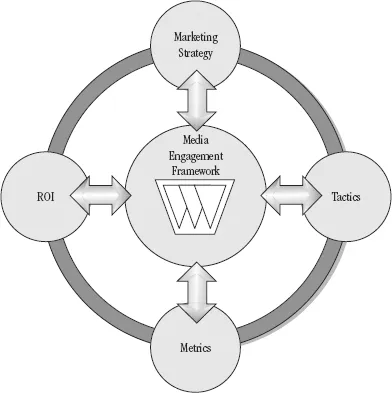
Marketing begins by developing a strategy based on the financial and corporate strategy for the brand, focusing on the customer, competitors, external factors and the resources of the company. Once the marketing strategy has been determined, tactics are defined and specified within a framework, such as the 4Ps: product, price, place and promotion.3 With these tactics now in place, traditional marketers determine how they want to measure the success of these tactics through the definition of appropriate metrics. Some of these are interim metrics such as awareness and purchase intent; others are outcomes metrics such as unit volume and revenue. Once these metrics are in place—depending on the business question—financial values can be determined and a return on investment (ROI) can be calculated. With the ROI known for the various marketing tactics, the marketing strategy can be refined, budget allocations can be adjusted, problems diagnosed and the cycle repeated. This cycle is illustrated in the marketing process diagram in Figure 1.1. It is comprised of the four elements surrounding a central element defined here as the media engagement framework.
The media engagement framework is made up of three distinct personas: the influencer, the individual, and the consumer. For social marketing specifically and traditional media more generally, marketing strategy, tactics, metrics and ROI can be determined by the level of engagement a particular marketing activity has with these three personas in the marketplace. Social marketing strategies are built by first listening and then engaging with influencers, individuals and consumers in order to move consumers down the consumer purchase funnel to stimulate product purchase and later to create loyalty for repeat purchase.
On the other hand, with traditional media, Oprah Winfrey, for example, would be considered an influencer and the marketing team may seek sponsorship to promote their brand to her audience. Television advertising may be targeted to individuals hoping to convert them to consumers. Consumers may receive a Valpak4 coupon to drive them down the consumer purchase funnel to purchase a promoted product. The media engagement framework describes in detail how marketing actions drive engagement with each of these targets and this book will discuss how it applies specifically to social marketing activities.
In order to develop a specific social marketing strategy, it is important to realize that social media makes up only one facet of a marketing strategy. Because no single marketing channel can be considered in isolation, we must make certain that all marketing channels, including each type of social media channel, are considered in the context of all other marketing actions being taken. For example, will a temporary price reduction increase response to a Twitter campaign? Will a new competitive TV advertising campaign affect the fan engagement on Facebook? What are the synergy effects between TV advertising and a YouTube channel? Similar types of questions relating to integrated marketing campaigns were solved for traditional media and they must now also be considered when capturing and calculating the ROI on social media. With the right framework in place, we can not only measure the impact of each of the social media channels but also their combined impact for integrated social marketing campaigns and integrated marketing campaigns in general.
In our model, there is much more to be considered when leveraging social media as a means of presenting a marketing message to drive increased engagement and, finally, increase revenue.
Make better strategic and tactical marketing decisions
As marketing moves to fulfill this trend, new methods will be required to understand the relative impact of each of their brands’ social marketing tactics. They will be required to measure their ability to influence the bottom line—the truest measure of ROI across all media channels. This book was written to help marketers in two ways:
- to help marketers make better strategic and tactical social marketing decisions to drive increased revenue, profit, brand and share for the short and long term
- to help social marketers communicate their results to the rest of the organization in a language they understand: ROI.
With their ability to make better decisions, marketers will be able to improve the bottom line driving valuable corporate profit for both the short and long term. With their ability to communicate their results back to the rest of the organization, they will be able to build, defend and grow their budgets.
To that end, we put forth a series of concepts, methods and techniques that will help the marketer make significantly better strategic and tactical decisions. Marketers need to make better allocation decisions between investments in traditional media (defined here, and throughout the book, as all other non-social media channels) and in social media. They need to make certain that they invest in the right social media tactics, others are improved and the wrong ones are discontinued or reduced. This book will look at each of these dimensions of decision making:
- diagnosing unsuccessful tactics to determine whether their execution can be improved
- reducing or discontinuing those tactics that aren’t delivering value for the brand
- allocations between traditional media and social media—investing more in the best tactics
- choosing successful tactics to drive social media effectiveness and making them even better
- understanding how social media tactics deliver synergies for traditional media and vice versa
- understanding how social media tactics build on each other to deliver overall success.
Generally, we see that executives want to use social media to promote the brand, but they do so in a mindset that has social media as just another channel to put the same message “out there.” They see it as relatively inexpensive compared with traditional media. They see social media as a much higher risk platform. Nevertheless, social media is a much richer method than other traditional media to deliver a message to the marketplace. For that reason, it requires a higher level of finesse in order to make it work properly. It requires a clear understanding of consumer behavior and response in order to determine whether the marketer’s actions are working, compared with other potential marketing investments.
We acknowledge that some social media purists have come out in opposition to measuring ROI in social media, because it dilutes the purported “transparency” of social media. In some cases, we’ve seen the bending of the definition of ROI to mean “return-on-influence” and there have been put forth many other reasons to avoid measuring the ROI of social media in financial terms. (See box: False measures of ROI.)
With this book, we will give marketers a pathway to start to develop data, statistics and analytics to clearly identify the incremental impact on revenue, profit, brand and share that social marketing investments can deliver. In so doing, they will also be better able to develop social marketing strategies and tactics that can deliver significantly better results for their brands. Our encouragement to the reader is to not be sidetracked by non-financial ROI arguments; social media can be, and should be, put in a similar framework as traditional media and the ROI can, and should, be assessed.
Value for social media infrastructure providers
As s...