The Primes
eBook - ePub

The Primes

How Any Group Can Solve Any Problem

  1. English
  2. ePUB (mobile friendly)
  3. Available on iOS & Android
eBook - ePub

The Primes

How Any Group Can Solve Any Problem

About this book

Discover fundamental principles of high-stakes change and organizational transformation

The "primes" are universal and unavoidable patterns of group behavior that emerge whenever people attempt to transform systems or collaborate to solve complex problems. Every change agent has felt their effect, but few can recognize, anticipate, and manage them. Unacknowledged, the primes can put any leadership agenda at risk. Once mastered, the primes become a force that drives intended outcomes. The Primes is a field manual for anyone ready to step up to serious challenges, predict and manage inevitable problems, create a brighter future, and produce extraordinary results.

An essential guide for 21st century problem solvers and change agents, The Primes unveils 46 universal secrets of how to:

  • Tackle complex problems successfully and deliver extraordinary results on time
  • Forge lasting consensus among competing interests and keep teams focused and productive
  • Recognize and eliminate the most destructive forces in an organization
  • Establish cultures of integrity

The Primes gives leaders the edge they need to succeed. Once the primes are revealed, you'll see them everywhere!

Frequently asked questions

Yes, you can cancel anytime from the Subscription tab in your account settings on the Perlego website. Your subscription will stay active until the end of your current billing period. Learn how to cancel your subscription.
No, books cannot be downloaded as external files, such as PDFs, for use outside of Perlego. However, you can download books within the Perlego app for offline reading on mobile or tablet. Learn more here.
Perlego offers two plans: Essential and Complete
  • Essential is ideal for learners and professionals who enjoy exploring a wide range of subjects. Access the Essential Library with 800,000+ trusted titles and best-sellers across business, personal growth, and the humanities. Includes unlimited reading time and Standard Read Aloud voice.
  • Complete: Perfect for advanced learners and researchers needing full, unrestricted access. Unlock 1.4M+ books across hundreds of subjects, including academic and specialized titles. The Complete Plan also includes advanced features like Premium Read Aloud and Research Assistant.
Both plans are available with monthly, semester, or annual billing cycles.
We are an online textbook subscription service, where you can get access to an entire online library for less than the price of a single book per month. With over 1 million books across 1000+ topics, we’ve got you covered! Learn more here.
Look out for the read-aloud symbol on your next book to see if you can listen to it. The read-aloud tool reads text aloud for you, highlighting the text as it is being read. You can pause it, speed it up and slow it down. Learn more here.
Yes! You can use the Perlego app on both iOS or Android devices to read anytime, anywhere — even offline. Perfect for commutes or when you’re on the go.
Please note we cannot support devices running on iOS 13 and Android 7 or earlier. Learn more about using the app.
Yes, you can access The Primes by Chris McGoff in PDF and/or ePUB format, as well as other popular books in Business & Human Resource Management. We have over one million books available in our catalogue for you to explore.

Information

Publisher
Wiley
Year
2012
Print ISBN
9781118173275
eBook ISBN
9781118240045

Part 1
Universal Patterns of Leading in Uncertain Times

How do some people, organizations, and coalitions thrive in uncertain times? What enables them to appear so certain and take decisive action amid ambiguity about the future?
Yogi Berra was right when he said, “The future ain't what it used to be.” Not much else is certain these days. Steady state now is changing at the speed of the environment. This frightens, overwhelms, and immobilizes some people. For others, this global reset is a thrill ride and they want a front seat. If this sounds like you, the PRIMES in Part 1 will get you outfitted to “make your dent in the universe.”
Here's the deal. Almost all the tame problems have been solved. We get to solve the wicked problems. Wicked problems affect a lot of people and it takes a lot of people, all with their own agendas, to collaborate and solve them. In this context, “a lot” means more than seven. When fewer than seven people can solve a problem, even if it is technically complex, they can self-organize and get the job done. Once the group size exceeds seven, the social dynamic switches from small group behavior to large group behavior. Large groups quickly become dysfunctional, are unsustainable, and do not produce meaningful, lasting outcomes unless led. Sorry to break this news to all you “new agers,” but I have tried almost every trendy idea about emergent and self-organizing systems over the last three decades, and have concluded that groups with more than seven members need to be led.
The people who, amid uncertainty, successfully lead large problem-solving groups share three characteristics. First, they are clear about what they are up to and how they spend their precious time. Second, they are intentional and willing to go first. Finally, they have mastered the art of enrolling others to join them. The nine PRIMES revealed in the three chapters of Part 1 will outfit you with these capabilities.
Your own mind is a sacred enclosure into which nothing harmful can enter except by your promotion.
Ralph Waldo Emerson1

Chapter 1
Being Clear on What's Really Important

How did you decide how you spent your time yesterday? What criteria are you using to allocate your time tomorrow?
What do you stand for? What are you leading toward? How do you decide the best way to spend your time? What would your life be like if your answers to these questions were perfectly clear? The PRIMES called “LEADING,” “IN–ON,” and “CHANGE VERSUS TRANSFORMATION” will give you clarity about these fundamental questions. After you are outfitted with these three PRIMES, your calendar will never look the same. You will be selective about which meeting requests you choose to accept or decline. You will have a crystal clear rationale for why you are doing what you are doing and not doing what you are not doing. From this place of clarity, you will access ways to make more significant and meaningful contributions to groups and organizations of which you are a part and communities that you serve, using less effort.
The best is he who calls men to the best. And those who heed the call are also blessed. But worthless who call not, heed not, but rest.
Hesiod1 eighth century BCE Greek poet
UnFigure

LEADING

Does being called a “leader” mean you are “leading”? What does “leading” mean?
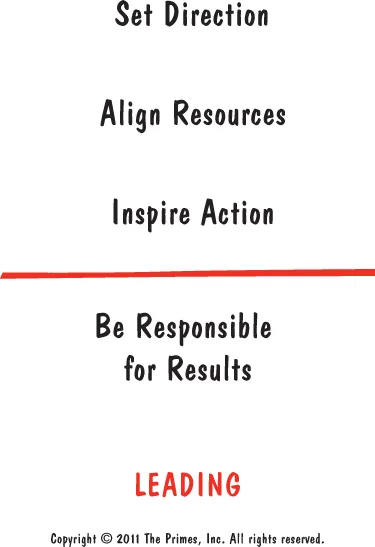
Amazon.com currently sells 13,391 books on leadership. So why are people not leading effectively? Do we make it too complex? The LEADING PRIME defines the act of leading as setting direction, allocating resources, and inspiring action. Any time you are not doing these three things, you are not leading. Now let's put this distinction into context by looking at six words: three nouns and three verbs. First, the nouns:
  1. Leader: A title
  2. Manager: A title
  3. Operator: A title
These three words convey what people are. They do not dictate or even indicate what a person of any given title actually does.
Now let's look at three verbs:
  1. Leading: Setting direction, allocating resources, inspiring action, and being accountable for results
  2. Managing: Balancing capacity with demand and ensuring predictable value is created using an efficient system
  3. Operating: Using the system as designed to produce value
These words convey what people do. They specifically indicate an action. Acting in any of these three ways is not determined by what you are called. Many of us who are called leaders spend most of our time managing and operating. I also see, at times, people who are called managers and operators leading.
Take a moment to highlight the times over the last five days when you were setting direction, aligning resources, and inspiring action. Do the same for your boss (if you have one). Here are some tips to help you do an honest assessment. If you own a law firm, when you were practicing law, you were operating your business. If you are cutting hair in the salon you own, you are operating your business. If you own a consulting firm and you are consulting, you are operating your business. When you spend your time doing what the business does, you are not leading. Even when you spend your time making your business more efficient, you are managing, not leading, your business.
So, if you are like most of us, you will notice, looking back over the last week or so, that the attraction to manage and operate is very strong. This type of work is more certain and less risky. Leading is ambiguous and offers terrific opportunity to look bad in front of others.
I am not suggesting that there is a right answer to your allocation of time across these three activities. I am saying that unless the organization you are part of is perfectly suited for its future, people have to spend time leading. The question is, “Are the right people (including you) spending the right amount of time leading versus managing and operating?”
Discipline is remembering what you want.
David Campbell2
Previous | Next | Index of PRIMES
UnFigure

IN–ON

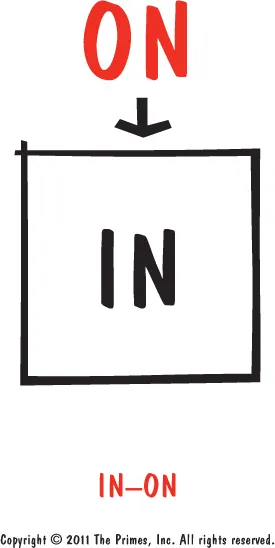
Are you seduced by working “in” the business at the expense of “on” it?
The IN–ON PRIME enables people to distinguish between working IN the business from working ON the business. Most people, especially leaders and managers, spend too much time in...

Table of contents

  1. Cover
  2. Table of Contents
  3. Series
  4. Title
  5. Copyright
  6. Dedication
  7. Acknowledgments
  8. A Note To the Reader
  9. Introduction
  10. Part 1: Universal Patterns of Leading in Uncertain Times
  11. Part 2: Universal Patterns of Powerful Alliances
  12. Part 3: Universal Patterns of Outstanding Group Performance
  13. Part 4: Universal Patterns of Group Failure
  14. Part 5: Universal Patterns of Thriving in Ambiguity
  15. Conclusion
  16. Notes
  17. Index of the Primes (alphabetical)
  18. About the Author
  19. End User License Agreement