A unique introduction for general readers to the underlying concepts of nanotechnology, covering a wide spectrum ranging from biology to quantum computing.
The material is presented in the simplest possible way, including a few mathematical equations, but not mathematical derivations. It also outlines as simply as possible the major contributions to modern technology of physics-based nanophysical devices, such as the atomic clock, global positioning systems, and magnetic resonance imaging. As a result, readers are able to establish a connection between nanotechnology and day-to-day applications, as well as with advances in information technology based on fast computers, the internet, dense data storage, Google searches, and new concepts for renewable energy harvesting.
Also of interest to professionals working in law, finance, or teaching who wish to understand nanotechnology in a broad context, and as general reading for electrical, chemical and computer engineers, materials scientists, applied physicists and mathematicians, as well as for students of these disciplines.
- English
- ePUB (mobile friendly)
- Available on iOS & Android
eBook - ePub
Understanding the Nanotechnology Revolution
About this book
Information
1
Discovery, Invention, and Science in Human Progress
Nanotechnology is a recent addition to the long history of human efforts to survive and make life better. Nanotechnology is based on the understanding of and tools to deal with very tiny objects, down to the size of atoms [1]. To begin, it is worth reviewing some of the broader history, to put nanotechnology in perspective, so that we can better understand how it can serve as a bridge to the future.
Technology has evolved over tens of thousands of years and more by the activities of humans and their predecessors: the history of technology is almost the history of humanity.
1.1 Origins of Technology, the Need for Human Survival
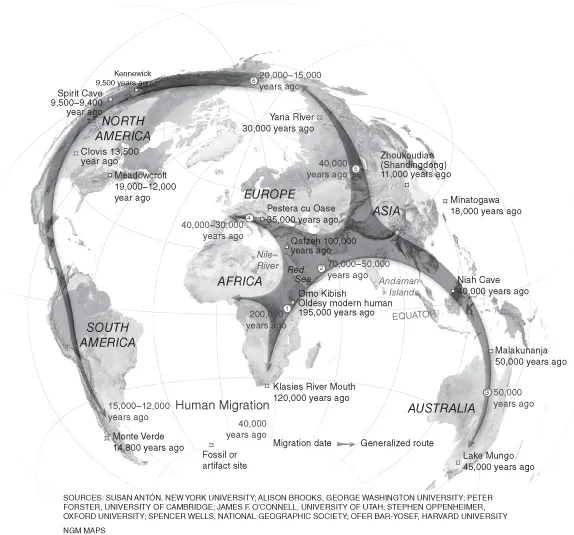
Struggling for survival and ascendency for over 50 000 years (a conventional time frame for the migration of “homo sapiens” out of Africa [2], (see Figure 1.1), humans invented new and useful ways of doing things.1 Technology has advanced ever since, in an accelerating fashion, and we hope to provide an understanding of a current forefront of technological advance called nanotechnology, which specifically deals with small objects and the laws of nature that describe these small objects [1].
Figure 1.1 A speculative but data-based map of human migrations, from genomic technology. Homo sapiens migrations, with approximate dates in thousands of years, are tracked by changes in human DNA. We discuss this in Chapter 4.
(NG Maps/National Geographic Stock).
Technology, often based on discovery, is knowledge on how to get things done, and the tools to make use of that knowledge. This is a practical matter, often a matter of life and death. Stone age tools have been found dating to about 2.4 million years ago. Then came the Bronze age and the Iron age. In 1200 BC, the Hittites were the first to use iron in weapons. We can say that advanced metal technology started long ago [3–7].2 To understand nanotechnology it is useful to review some of the previous technological advances in the 50 000-year history.
1.2 The Industrial Revolution: Watt’s Steam Engine, Thermodynamics, Energy Sources
The development of the wheel, advanced control of fire, and the development of copper, bronze and iron technologies, set the stage for the more recent industrial revolution. The industrial revolution, based on the invention of the steam engine by James Watt in 1776, led quickly to the steam locomotive in 1804. This required a synthesis of the technologies for making fire and elaboration of wheels and axles to include gears and pistons, requiring knowledge of metals to make strong components. The steam engine also brought to the fore knowledge of thermodynamics, a science that could improve the efficiency of engines based upon steam. The concept and measurement of temperature, an aspect of modern science, was part of that advance.
The advance of civilization can be measured by the technology in use and also by the sources of energy that were available at a given time.
A primary source of energy in the mercantile sailing era was wind. Wind has been used since ancient times, to make sailing boats and to power wind-mills to pump water or grind grain. It is reported that in fourth century BC the Greek wind- and human-powered merchant fleet went all the way from Spain to the Black Sea, and of course Julius Caesar invaded Egypt by sea. A three-masted merchant ship is reported in China in 400 AD. The compass, based on magnetite, an iron oxide, was invented in 200 BC in China, and was widely used by the Chinese shipping fleet in 1100 AD. Sailing long distances stimulated the development of better clocks, needed for navigation, and of course, clocks are important in today’s information technology.
The technology of sailing ships and worldwide navigation flourished starting from the time of Columbus, who sailed in 1492 to America from Spain. In 1503 Vasco Da Gama of Portugal took 20 ships from Lisbon, around the bottom of Africa and to India, initiating more wide-ranging open-sea commerce, which had earlier been limited, such as to the Mediterranean Sea. Sailing ships remained important until well after 1860, when steam-powered ships were first constructed.
The Dutch were well known for pumping water with windmills, the predecessors of modern wind turbines. Present-day technologies building on the sailing era technology include airfoils on airliners and the space shuttle, helicopters, and wind turbines of 1 MW (megawatt) generating capacity, that cost about $1 M apiece.
With James Watt’s invention of the steam engine in 1776, to begin the industrial era of engines, the source of energy shifted, from wind to fuels to be burned to generate steam and run the engine. Over time, the fuel of choice has changed from wood, to peat and coal, and then to oil and gas. A recent addition is nuclear power, used by nuclear reactors in submarines, aircraft carriers, and electric power plants. This might be looked at as passing industrial leadership from Holland (wind technology) to England (wood and coal steam engines) and then to America (the era of oil and gas, Henry Ford, and the internal combustion engine). Nuclear energy, since about 1945, with the first nuclear reactor in Chicago developed by Enrico Fermi, has been an international effort.
Although oil was well known in the Middle East since very early times, the modern large-scale extraction of oil as a fuel dates to 1859, in Titusville, Pennsylvania and 1901, in Spindletop, Texas. US oil production peaked in about 1971, and, with depletion, has fallen ever since. The era of availability of oil may be about 200 years, starting in 1859, because the amount of available oil is definitely limited.
1.3 A Short History of Time: Navigation, Longitudes, Clocks
A short history of time involves the technology of devices to measure intervals of time. The earliest clocks were water clocks that date back to the sixteenth century BC in Babylonia and Egypt. These simple useful devices are similar in principle to the sand hourglass, depending upon a steady flow rate of a given mass of water or sand. Accuracy and resolution in clocks was stimulated by the need to know the longitude when crossing an open sea, far from sight of land. The distance in going from one time zone to the next is 15 degrees longitude, which is 645 miles at the Latitude of London, England. This information could be used by the sea captain. Suppose, at the wharf in London, as he sets sail, the captain’s ship clock reads noon when the sun is directly overhead.
After a day of sailing to the west, noon the next day, the sun might be directly overhead at 12:30 on his ship clock (which was set in London). If so, the captain would know, assuming constant latitude, that he had traveled half a time zone, about 322 miles.
For lack of good clocks, this option was not available to sea captains until after 1760, with the invention of an accurate portable clock, the “marine chronometer,” by John Harrison. For centuries before this, sea captains, in practice, had relied on dead reckoning.3 The ship’s compass indicated the direction of travel, and the distance per day was estimated from the speed multiplied by the time elapsed. This was a laborious and honest, but inaccurate process. Ships went astray and lives and fortunes were lost. The failings in navigation became such a problem that the British government established a Board of Longitude, to fund the development of an accurate clock.
A great advance came in 1759 with the invention of the accurate marine chronometer. This clock, based on a spring oscillator, was invented in stages by John Harrison [8], who won a prize from the British government. Somewhat earlier, in 1656, the pendulum clock was invented by Huygens. The idea of a pendulum as establishing a timescale was known earlier, even to Galileo in the early 1600s. A clock based on a pendulum was not built, however, until 1656. Although it predated the John Harrison chronometer, the pendulum clock is not useful except in fixed locations. It requires a stable footing not available on a ship.
A major advance in modern timekeeping was made with the miniaturized quartz oscillator in the Bulova watch (see Chapter 3). Here quartz is shaped to form a cantilever or spring, whose resonant frequency, f, near 33 kHz, is governed by a formula f = (1/2π) (K/m)1/2, where the spring constant K has units Newtons/meter and m is the moving mass. (Here, the Newton is about 0.225 pound force, and m is measured in kilograms. The frequency is in hertz, oscillations per second.) The quartz oscillator has been further miniaturized and still forms the clock in the personal computer (PC), working up to 3 GHz, as we will discuss in Chapter 3.
The atomic clock, based Cs (cesium) atoms, is now used as the worldwide standard of timekeeping, accurate on a scale of nanoseconds, billionths of a second.
Our book is about nanotechnology, the useful (and profitable) application of small-scale working elements and devices [1].
Present major technologies that benefit most from nanotechnology are the silicon computer technology, and information technology. Information technology (IT), couples silicon technology with optical fiber transmission of signals, and with advances in data-storage technology, such as the computer disk drive.
Medical technologies including diagnostics such as X-rays, which are also the basis for unraveling the structure of double-helix DNA (the information aspect of biology), drug design and genomic technology; and magnetic resonance imaging (MRI) also benefit from the emerging area of nanotechnology.
High-energy synchrotron light sources, adapted from high-energy physics, giving huge intensities of X-rays, have allowed rapid determinations of molecular structures. This has enabled modern pharmaceutical advances, which also benefit from computer modeling. While polymers (think polyethylene and polystyrene) are definitely chemistry, one can argue that designing drugs for a specific purpose is an exercise in nanotechnology.
1.4 The Information Revolution: Abacus to Computer Chips and Fiber Optics
The advance of technology is itself accelerating [9]. To illustrate this, we will consider the timing of advances related to information technology! The first record of bones carved with notches dates to 20 000 BC, and bones carved with prime numbers were found as early as 8500 BC. (Prime numbers cannot be expressed as a product c = ab of two other numbers. This is a subtle matter, but evidently understood by smart people nearly 10 centuries ago.) The abacus comes from China and Babylonia, around 1000 BC, and has several forms.
But it was not until 1500 AD that Leonardo da Vinci described a mechanical calculator. Logarithms and the slide rule were invented about 1600 AD. The predecessor of the IBM tabulating machine was invented by Hollerith in 1890 for the US census. (If time starts 50 000 years ago, then the 411-year interval (2011 AD–1600 AD) is 0.8% of the life of Homo sapiens. If time starts 4.54 billion years ago, with the formation of the earth, this is in the last 0.09 millionth of time on Earth.
Time intervals between inventions in this set have reduced from thousands of years to hundreds of years.
But since 1945 or so, a period of 65 years, we have had many, many inventions related to information technology! The transistor was invented in 1947, the Univac programmable computer in 1951, the atomic clock in 1955, the integrated circuit in 1958, the Xerox machine in 1959, the laser in 1964, the magnetic floppy disk in 1971, the Ethernet in 1973, the personal computer in 1973–1976, the optical fiber in 1970–1975, the injection laser in 1978, the Internet global computer network in 1990 and the Pentium chip in 1993, global positioning system (GPS) in 1993, the Internet search engines in 1993–1998, the Blue Gene chess-playing computer in 1997, the magnetic tunnel junction hard disk reader in 2004, and Watson computer winning the Jeopardy TV competition in 2011.
While earlier inventions were spaced by hundreds or even thousands of years, the inventions listed here since 1945 are spaced by about 4 years, a much shorter interval! It is widely agreed that technology is accelerating [9]. Moore’s law, which has predicted the doubling of the number of transistors per chip each 1.5 years, is an example of “exponential growth,” an accelerating increase. A striking, but hypothetical scenario on growth of computing capacity is “the Singularity,” when computer intelligence may exceed human intelligence. It is suggested, in the work of Ray Kurzweil [9], but hotly debated that computers will become completely equal to humans in all thinking activities in 2045. “Singula...
Table of contents
- Cover
- Related Titles
- Title page
- Copyright page
- Preface
- 1 Discovery, Invention, and Science in Human Progress
- 2 Smaller Is More, Usually Better, and Sometimes Entirely New!
- 3 Systematics of Scaling Things Down: L = 1 m → 1 nm
- 4 Biology as Successful Nanotechnology
- 5 The End of Scaling: The Lumpiness of All Matter in the Universe
- 6 Quantum Consequences for the Macroworld
- 7 Some Natural and Industrial Self-Assembled Nanostructures
- 8 Injection Lasers and Billion-Transistor Chips
- 9 The Scanning Tunneling Microscope and Scanning Tunneling Microscope Revolution
- 10 Magnetic Resonance Imaging (MRI): Nanophysics of Spin ½
- 11 Nanophysics and Nanotechnology of High-Density Data Storage
- 12 Single-Electron Transistors and Molecular Electronics
- 13 Quantum Computers and Superconducting Computers
- 14 Looking into the Future
- Index
Trusted by 375,005 students
Access to over 1.5 million titles for a fair monthly price.
Study more efficiently using our study tools.
Frequently asked questions
Yes, you can cancel anytime from the Subscription tab in your account settings on the Perlego website. Your subscription will stay active until the end of your current billing period. Learn how to cancel your subscription
No, books cannot be downloaded as external files, such as PDFs, for use outside of Perlego. However, you can download books within the Perlego app for offline reading on mobile or tablet. Learn how to download books offline
Perlego offers two plans: Essential and Complete
- Essential is ideal for learners and professionals who enjoy exploring a wide range of subjects. Access the Essential Library with 800,000+ trusted titles and best-sellers across business, personal growth, and the humanities. Includes unlimited reading time and Standard Read Aloud voice.
- Complete: Perfect for advanced learners and researchers needing full, unrestricted access. Unlock 1.5M+ books across hundreds of subjects, including academic and specialized titles. The Complete Plan also includes advanced features like Premium Read Aloud and Research Assistant.
We are an online textbook subscription service, where you can get access to an entire online library for less than the price of a single book per month. With over 1.5 million books across 990+ topics, we’ve got you covered! Learn about our mission
Look out for the read-aloud symbol on your next book to see if you can listen to it. The read-aloud tool reads text aloud for you, highlighting the text as it is being read. You can pause it, speed it up and slow it down. Learn more about Read Aloud
Yes! You can use the Perlego app on both iOS and Android devices to read anytime, anywhere — even offline. Perfect for commutes or when you’re on the go.
Please note we cannot support devices running on iOS 13 and Android 7 or earlier. Learn more about using the app
Please note we cannot support devices running on iOS 13 and Android 7 or earlier. Learn more about using the app
Yes, you can access Understanding the Nanotechnology Revolution by Edward L. Wolf,Manasa Medikonda in PDF and/or ePUB format, as well as other popular books in Technology & Engineering & Nanotechnology & MEMS. We have over 1.5 million books available in our catalogue for you to explore.