- English
- ePUB (mobile friendly)
- Available on iOS & Android
eBook - ePub
Mobile Video with Mobile IPv6
About this book
Increased reliance on mobile devices and streaming of video content are two of the most recent changes that have led those in the video distribution industry to be concerned about the shifting or erosion of traditional advertising revenues. Infrastructure providers also need to position themselves to take advantage of these trends. Mobile Video with Mobile IPv6 provides an overview of the current mobile landscape, then delves specifically into the capabilities and operational details of IPv6. The book also addresses 3G and 4G services, the application of Mobile IPv6 to streaming and other mobile video outputs, and closes with a chapter on future directions.
Information
CHAPTER 1
THE MOBILE USER ENVIRONMENT: SMART PHONES, PORTABLE MEDIA PLAYERS (PMPs), AND TABLETS
1.1 INTRODUCTION
Mobile connectivity is becoming ubiquitous for voice, video, and data. A significant percentage of people now carry powerful smartphones and/or tablets that enable them to be productive, connected, entertained, and instrumented while on the move, away from their offices or homes. Clearly, there has been an evolution over time for people on the move, from being able to get “nothing” (up to mid-1980s), to being able to get voice (since the mid-1980s), to getting data (such as e-mails) (mostly from the mid-1990s), to accessing applications (data and location-based applications) (mostly since the early 2000s), and now also to get real-time and/or streaming and/or on-demand video. According to recent Nielsen data, over 28 million people in the U.S. watched video content on their mobile phones in 2011, with a large (>40 percent) increase from 2010; monthly usage of video exceeds 4 hours, as documented in Appendix 1.1A.
The network fabric has transitioned from analog, to digital (time-division multiplexing), to packet technology, especially using voice over IP (VoIP) for voice and using IP version 4 (IPv4) for applications. However, in recent years, there has been a steady depletion of the pool of available IPv4 address blocks; a point of exhaustion was reached in 2011, when only 1 percent of the address space remained available. Service providers are now, of necessity, planning to give serious consideration to the imminent rollout of IP version 6 (IPv6) infrastructures, to parallel the existing IPv4 infrastructure, in order to maintain growth and provide customers with new enhanced services. Mobile IPv6 (MIPv6) is a version of IPv6 that intrinsically supports active, real-time device movement across a wide geography (it supports a concept similar to mobile IP in the version 4 world, but with added capabilities). MIPv6 allows mobile nodes (MNs) to maintain persistent IP connectivity while the MN moves around in an IPv6 network. It has been adopted in 3G code division multiple access (CDMA) networks for handling host-based mobility management, specifically as a way to maintain connectivity when the MN moves between access routers (ARs). In addition to the basic set of initial MIPv6 protocols, several enhancements have been added in the past few years.
At the same time there has been increased interest in new forms of IP-based video distribution, both in terms of the underlying streaming or IP television (IPTV) and/or content distribution networks (CDNs) technology, as well as in terms of the content providers and content creation itself. User-generated video (UGV), “for Web publishing” of original content, video on demand (VoD), and time-shifted video, are seeing steady market penetration. Consumers expect to be able to get access to such content not only on their standard or smart (connected) TV, but also on their smartphones, portable media players (PMPs), and tablets. MIPv6 offers an ideal opportunity to support the evolving consumer paradigm of mobility, productivity, connectivity, entertainment, and instrumentation. It follows that there is interest on the part of service providers to explore the technology, protocols, deployment strategies, and approaches to IPv6-based mobility in general, and IPv6 mobile video in particular. MIPv6 allows session (e.g., Transmission Control Protocol (TCP) session) continuity—while some video applications utilize User Datagram Protocol (UDP), other video applications do use TCP.
The types of content that people typically get with a mobile video device include entertainment (nonlinear video such as music videos, short clips from YouTube/Web TV, and so on) and real-time information (linear video such as breaking news, emergency reports, weather, local/regional news, live events as they happen, and traffic) [1]. One should keep in mind that there are no substitutes for entertainment1 (one needs a video stream), but there are substitutes for news/weather/traffic information: one might simply look at the home page of CNN, FNC, TWC, and so on, to get that type of information via traditional Web browsing—video may or may not actually be required in all these instances.
Besides MIPv6, there are a number of ways to deliver video to a mobile device including but not limited to—European Telecommunications Standards Institute (ETSI) Digital Video Broadcast Handheld (DVB-H), International Telecommunication Union—Telecommunications (ITU-T) IPTV, Internet Engineering Task Force (IETF) IPv4, IETF Mobile IPv4 (MIP), IETF IPv6, Open Mobile Video Coalition (OMVC) mobile digital TV, and vendor-proprietary methods. Each of these methods has advantages and disadvantages. This investigation focuses mostly on MIPv6; we believe to be the first textbook on this topic. An overview of the approach and capabilities afforded by MIPv6 is provided in this introductory chapter. The chapters that follow expand in greater details the concepts introduced herewith.
1.2 BASIC MIPV6 OPERATION
For video distribution, as well as for other applications to smartphones and similar devices, there is a desire to support direct communication between MNs (also known as mobile hosts) and far-end destinations, whether such far ends are themselves a stationary node or another MN. Such far end destination could be, for example, a video streaming service provider. In order to efficiently maintain reachability, thus supporting flexible mobility, the goal is to retain the same explicit IP address regardless of the real-time location or specific network elements and/or networks used to support connectivity. This is not easily achievable with IPv4 for a number of reasons; however, MIPv6 described in Request for Comments (RFC) 3775, “Mobility Support in IPv6” (June 2004), among others2, facilitates this task. RFC 3775 is known as the “MIPv6 base specification.” RFCs are specifications and related materials published by the IETF. IPv6 mobility, specifically MIPv6, relies on IPv6 capabilities.
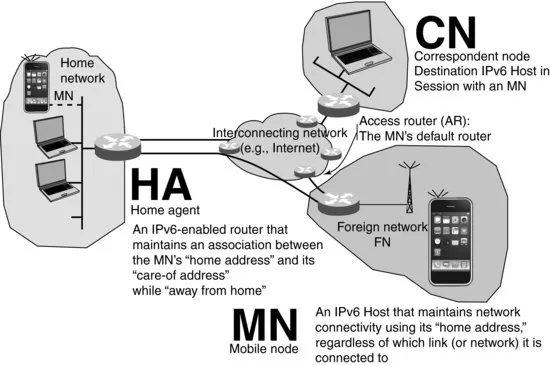
RFC 3775 notes that without specific support for mobility in IPv6, packets destined to an MN would not be able to reach it while the MN is away from its home network. In order to continue communication in spite of its movement, an MN could change its IP address each time it moves to a new link, but the MN would then not be able to maintain transport and higher-layer connections when it changes location. Mobility support in IPv6 is particularly important, as mobile users are likely to account for a majority, or at least a substantial fraction, of the population of the Internet during the lifetime of IPv6. MIPv6 allows nodes to remain reachable while moving around in the IPv6 Internet: it enables a device to change its attachment point to the Internet without losing higher-layer functionality through the use of tunneling between it and a designated home agent (HA). Stated another way, MIPv6 enables an MN to maintain its connectivity to the Internet when moving from one AR to another, a process referred to as handover. Figure 1.1 depicts some of the elements involved in IPv6 mobility and their basic functionality.
Figure 1.1 Basic MIPv6 Environment
IPv6 was originally defined in RFC 1883 but was then obsolete by RFC 2460, “Internet Protocol, Version 6 (IPv6) Specification,” authored by S. Deering and R. Hinden (December 1998). A large body of additional RFCs has emerged in recent years to add capabilities and refine the IPv6 concept. IPv6 embodies IPv4 best practices but removes unused or obsolete IPv4 characteristics; this results in a better-optimized Internet protocol. Some of the advantages of IPv6 include the following:
- Scalability and expanded addressing capabilities: IPv6 has 128-bit addresses versus 32-bit IPv4 addresses. With IPv4, the theoretical number of available IP addresses is 232 ∼ 1010. IPv6 offers a much larger 2128 space. Hence, the number of available unique node addressees is 2128 ∼ 1039. IPv6 has more than 340 undecillion (340,282,366,920,938,463,463,374,607,431,768,211,456) addresses, grouped into blocks of 18 quintillion addresses.
- “Plug-and-play”: IPv6 includes a “plug-and-play” mechanism that facilitates the connection...
Table of contents
- Cover
- Title Page
- Copyright
- Dedication
- Preface
- About the Author
- Chapter 1: The Mobile User Environment: Smart Phones, Portable Media Players (PMPs), and Tablets
- Chapter 2: IPv6 Basics
- Chapter 3: MOBILE IPv6 MECHANISMS
- Chapter 4: Advanced Features And Functions of MIPv6-Related Protocols—Part 1
- Chapter 5: Advanced Features and Functions of MIPv6-Related Protocols—Part 2
- Chapter 6: Proxy Mobile IPv6
- Chapter 7: Security Considerations For MIPv6
- Chapter 8: Mobile Video and Video Streaming Services
- Glossary
- Index
Trusted by 375,005 students
Access to over 1.5 million titles for a fair monthly price.
Study more efficiently using our study tools.
Frequently asked questions
Yes, you can cancel anytime from the Subscription tab in your account settings on the Perlego website. Your subscription will stay active until the end of your current billing period. Learn how to cancel your subscription
No, books cannot be downloaded as external files, such as PDFs, for use outside of Perlego. However, you can download books within the Perlego app for offline reading on mobile or tablet. Learn how to download books offline
Perlego offers two plans: Essential and Complete
- Essential is ideal for learners and professionals who enjoy exploring a wide range of subjects. Access the Essential Library with 800,000+ trusted titles and best-sellers across business, personal growth, and the humanities. Includes unlimited reading time and Standard Read Aloud voice.
- Complete: Perfect for advanced learners and researchers needing full, unrestricted access. Unlock 1.5M+ books across hundreds of subjects, including academic and specialized titles. The Complete Plan also includes advanced features like Premium Read Aloud and Research Assistant.
We are an online textbook subscription service, where you can get access to an entire online library for less than the price of a single book per month. With over 1.5 million books across 990+ topics, we’ve got you covered! Learn about our mission
Look out for the read-aloud symbol on your next book to see if you can listen to it. The read-aloud tool reads text aloud for you, highlighting the text as it is being read. You can pause it, speed it up and slow it down. Learn more about Read Aloud
Yes! You can use the Perlego app on both iOS and Android devices to read anytime, anywhere — even offline. Perfect for commutes or when you’re on the go.
Please note we cannot support devices running on iOS 13 and Android 7 or earlier. Learn more about using the app
Please note we cannot support devices running on iOS 13 and Android 7 or earlier. Learn more about using the app
Yes, you can access Mobile Video with Mobile IPv6 by Daniel Minoli in PDF and/or ePUB format, as well as other popular books in Technology & Engineering & Signals & Signal Processing. We have over 1.5 million books available in our catalogue for you to explore.