![]()
1
Structure and classification of bacteria
Bacterial classification is important, revealing the identity of an organism so that its behaviour and likely response to treatment can be predicted.
Bacterial Structural Components
Bacterial cell walls are rigid and protect the organism from differences in osmotic tension between the cell and the environment. Gram-positive cell walls have a thick peptidoglycan layer and a cell membrane, whereas Gram-negative cell walls have three layers: inner and outer membranes, and a thinner peptidoglycan layer. The mycobacterial cell wall has a high proportion of lipid, including immunoreactive antigens. Bacterial cell shape can also be used in classification. The following cell components are important for classification, pathogenicity and therapy.
- Capsule: a polysaccharide layer that protects the cell from phagocytosis and desiccation.
- Lipopolysaccharide: surface antigens that strongly stimulate inflammation and protect Gram-negative bacteria from complement-mediated lysis.
- Fimbriae or pili: specialized thin projections that aid adhesion to host cells. Escherichia coli that cause urinary tract infections bind to mannose receptors on ureteric epithelial cells by their P fimbriae. Fimbrial antigens are often immunogenic but vary between strains so that repeated infections may occur (e.g. Neisseria gonorrhoeae).
- Flagella: these allow organisms to find sources of nutrition and penetrate host mucus. The number and position of flagella may help identification.
- Slime: a polysaccharide material secreted by some bacteria that protects the organism against immune attack and eradication by antibiotics when it is growing in a biofilm in a patient with bronchiectasis or on an inserted medical device.
- Spores: metabolically inert bacterial forms adapted for long-term survival in the environment, which are able to regrow under suitable conditions.
Bacteria have a single chromosome and lack a nucleus (prokaryotes). The DNA is coiled and supercoiled by the DNA gyrase enzyme system (see Chapter 6). Bacterial ribosomes differ from eukaryotic ones, making them a target for antibacterial therapy (see Chapter 5). Bacteria also contain accessory DNA in the form of plasmids, integrons, transponsons and bacteriophages. These may transmit antimicrobial resistance (see Chapter 7) and may also code for pathogenicity factors.
Classification of Bacteria
We identify microorganisms to predict their pathogenicity: a Staphylococcus aureus isolated from blood is more likely to be causing disease than Staphylococcus epidermidis. It is important to identify organisms that spread widely in the community and cause serious disease, such as Neisseria meningitidis, so that preventative measures can be taken (see Chapter 21). Bacteria are identified using phenotypic, immunological or molecular characteristics.
- Gram reaction: Gram-positive and Gram-negative bacteria respond to different antibiotics. Other bacteria (e.g. mycobacteria) may require special staining techniques.
- Cell shape: Bacteria may be shaped as cocci, bacilli or spirals.
- Endospore: The presence, shape and position of the endospore within the bacterial cell are noted.
- Fastidiousness: Certain bacteria have specific O2/CO2 requirements, need special media or grow only intracellularly.
- Key enzymes: Some bacteria lack certain enzymes, for example, lack of lactose fermentation helps distinguish salmonellae from E. coli.
- Serological reactions: Interaction of antibodies with surface structures may for example help to distinguish subtypes of salmonellae, Haemophilus and meningococcus.
- DNA sequences: DNA sequencing of key genes (e.g. 16S ribosomal RNA or DNA gyrase) can identify the organism precisely.
The classification systems are helpful, but strains differ in pathogenicity and virulence within a species and there are similarities across species. For example, some strains of E. coli may cause similar diseases to Shigella sonnei.
Medically Important Groups of Bacteria
Gram-Positive Cocci
are divided into two main groups: the staphylococci (catalase-positive), the major pathogen being S. aureus; and the streptococci (catalase-negative), the major pathogens being Streptococcus pyogenes, which causes sore throat and rheumatic fever, and S. agalactiae, which causes neonatal meningitis and pneumonia (see Chapters 14 and 15).
Gram-Negative Cocci
include the pathogenic N. meningitidis, an important cause of meningitis and septicaemia, and N. gonorrhoeae, the agent of urethritis (gonorrhoea).
Gram-Negative Coccobacilli
include the respiratory pathogens Haemophilus and Bordetella (see Chapters 17 and 22) and zoonotic agents, such as Brucella and Pasteurella (see Chapter 22).
Gram-Positive Bacilli
are divided into sporing and non-sporing. The sporing types are subdivided into those that are aerobic (Bacillus; see Chapter 16) and those that are anaerobic (Clostridium; see Chapter 19). Pathogens include Bacillus anthracis, which causes anthrax, and clostridia, which cause pseudomembranous colitis, tetanus and, more rarely, gas gangrene and botulism. The non-sporing pathogens include Listeria and corynebacteria (see Chapter 16).
Gram-Negative Bacilli
(including the family Enterobacteriaceae) form part of the normal flora of humans and animals, and can be found in the environment. They include many pathogenic genera: Salmonella, Shigella, Escherichia, Proteus and Yersinia (see Chapter 24). Pseudomonas and Burkholderia are environmental saprophytes that are naturally resistant to antibiotics and are important hospital pathogens (see Chapter 26). Legionella lives in the environment in water but can cause human infection if conditions in the built environment allow it to gain a foothold (see Chapter 26).
Spiral Bacteria
include the small gastrointestinal pathogen Helicobacter that colonizes the stomach, leading to gastric and duodenal ulcers and gastric cancer, and Campylobacter spp. that cause acute diarrhoea (see Chapter 25). The Borrelia may cause a chronic disease of the skin joints and central nervous system, Lyme disease (Borrelia burgdorferi), or rarely relapsing fever (Borrelia duttoni and Borrelia recurrentis). The Leptospira are zoonotic agents that cause an acute meningitis syndrome that may be accompanied by renal failure and hepatitis. The Treponema include the causative agent of syphilis (Treponema pallidum).
Mycoplasma and Chlamydia
are responsible for common respiratory and sexually transmitted infections.
Rickettsia
are the agents of typhus and rarer severe infections (see Chapter 27).
![]()
2
Innate immunity and normal flora
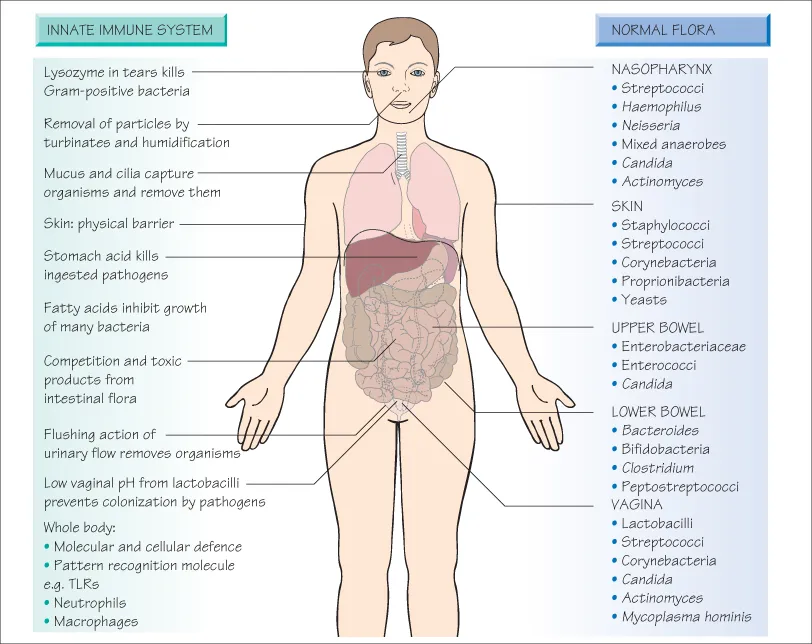
The innate immune system, which consists of the normal flora, physical barriers such as the skin, antibacterial proteins and phagocytic cells, is an important defence mechanism against infection. Many responses to ‘harm’ are detected by pattern recognition molecules such as the Toll-like receptors (TLRs), which trigger cascades that activate phagocytes and the immune response. For example, TLR-4 recognizes lipopolysaccharide and TLR-9 recognizes unmethylated CpG dinucleotides. The main components of the system are listed in the Table. Variation in the expression/composition of each component affects an individual’s resistance to infection.
Normal Flora
Bacterial cells forming part of the normal flora outnumber human cells in the body. The normal flora provides protection by competing with pathogens for colonization sites and producing antibiotic substances (bacteriocins) that suppress other bacteria. Anaerobic bacteria produce toxic metabolic products and free fatty acids that inhibit other organisms. In the female genital tract lactobacilli produce lactic acid that lowers the pH, so preventing colonization by pathogens.
Antibiotics ...